Netflix Interview Questions: What Live Sessions Reveal



Netflix Asks More About Judgment and Ownership Than About Algorithms
Across 280 live interview sessions captured through Interview Copilot between December 2023 and January 2025, Netflix interview questions split sharply into two categories: complex systems and SQL problems that score above 80, and behavioral questions about past work that score in the low 50s. The gap is 30 points wide. That gap tells you something specific about where candidates prepare well and where they do not show up ready.
Quick Answer
Quick Answer: Netflix interview questions test systems thinking, SQL fluency, and ownership-based behavioral judgment. Across 280 live sessions, system design questions scored highest (averaging 85 to 90 out of 100), while behavioral questions about past mistakes and conflict resolution averaged 45 to 65 out of 100. The largest score gap by role: Senior Technical Artist at 42.5 versus Data Visualization Engineer at 69.3.
Methodology
Final Round AI analyzed 280 live interview sessions captured through Interview Copilot, covering Netflix-targeting candidates from December 2023 through January 2025. Each record corresponds to one interview question and the candidate's real-time answer during an actual job interview, not a practice session. Scores run from 0 to 100 and reflect answer quality based on completeness, structure, and relevance. Administrative screener questions, logistics questions, and transcript fragments under 60 characters were excluded from the question frequency analysis. No individual user data is included in this report. All findings are aggregated across 24 unique sessions and 280 question records.
Finding 1: System Design and SQL Questions Score 15 to 30 Points Higher Than Behavioral Questions
The highest-scoring Netflix question in the dataset was a system design problem asking candidates to architect a global music streaming service. That question averaged 90 out of 100 across its occurrences. A SQL query task asking for department revenue over twelve months averaged 85. Binary search tree problems averaged 80. These technical questions share one trait: they have clear, verifiable answers that candidates who prepare structured responses tend to deliver well.
Behavioral questions tell a different story. "Tell me about a time when you had to deal with a conflict at work" averaged 65 out of 100. "Describe the most challenging project you have worked on" averaged 75. "What is something you worked on that was a mistake or needed substantial improvement" averaged 45. The lower behavioral scores are not random. Netflix's culture memo emphasizes candor, high performance standards, and the keeper test, a mindset of asking whether a manager would fight to keep this employee. Candidates who walk into behavioral rounds without concrete, structured examples of accountability and judgment tend to answer at the surface level, which is what the 45 to 50 score range reflects.
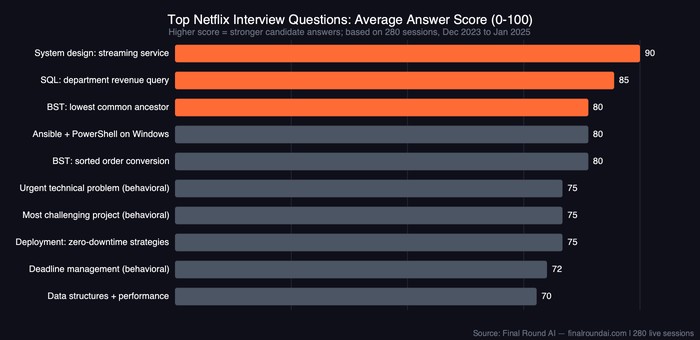
This pattern has a direct implication for how you allocate prep time. Technical preparation for Netflix is table stakes. But the behavioral component, particularly questions that touch on failure, conflict, and judgment under pressure, is where most candidates leave points behind. A useful resource is the analysis of behavioral interview questions where candidates score lowest across companies, which shows the same pattern holds outside Netflix too.
Finding 2: Netflix Behavioral Rounds Test the Freedom and Responsibility Framework, Not General Leadership
The behavioral questions that appeared most frequently in Netflix sessions are not the standard "tell me your greatest strength" format. The questions that showed up at frequency 7 or higher across sessions include: "Tell me about a time when you were in charge of a project with a deadline. How did you meet it?" and "Could you give an example of a situation where you had to deal with a conflict at work? What did it consist of? How was it resolved?" and "Describe an instance where you had to solve a sudden and urgent technical problem. How did you handle it?"
Those questions map directly to Netflix's published culture values: ownership without being asked, candid communication about conflict, and judgment under pressure. Netflix does not ask behavioral questions to check a leadership competency box. The questions are designed to find out how a candidate makes decisions when nobody is watching, whether they own outcomes instead of attributing them to circumstances, and whether they communicate directly with people they disagree with. Candidates who rehearse STAR method answers without connecting them to ownership and judgment tend to answer at the story level rather than the decision level, which is what pulls scores into the 55 to 65 range.
The question about past mistakes, "What is something that you worked on that was a mistake or needed substantial improvement?", averaged only 45. That is the lowest behavioral score in the dataset. Netflix's culture memo explicitly states that admitting mistakes is a sign of maturity, but candidates still avoid specific, owned failure stories in favor of vague deflections. If you are preparing for a Netflix behavioral round, practice delivering one concrete mistake story with a clear decision that went wrong, the specific consequence, and what changed after. That pattern is what the 70-plus answer looks like on this type of question.
Practicing these specific behavioral formats before a live round makes a measurable difference. An AI mock interview gives you a way to rehearse ownership-and-candor stories until the structure is automatic, so you are not constructing the narrative in real time during the actual interview.
Finding 3: Senior Technical Artist Scores 26 Points Below Data Visualization Engineer at Netflix
Breaking down Netflix session scores by role reveals a 26.8-point spread across the seven roles with enough sessions to compare. Data Visualization Engineers averaged 69.3 out of 100 across 28 sessions. DevOps Engineers averaged 66.7 across 21 sessions. Backend Engineers averaged 63.0 across 14 sessions. Software Engineers averaged 56.7 across 119 sessions, the largest sample in the dataset. Data Platform Engineers averaged 52.5 across 14 sessions. Senior Technical Artists averaged 42.5 across 14 sessions.
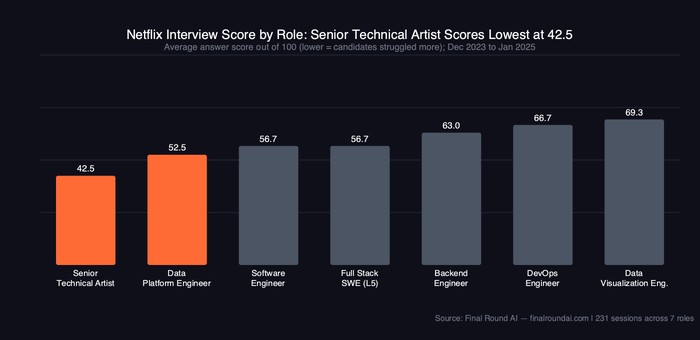
The Senior Technical Artist gap is worth examining. That role sits at the intersection of 3D art, technical pipeline work, and cross-functional collaboration. Interview questions for that role appear to push hard on both technical execution specifics and behavioral judgment about working with engineers and directors simultaneously. Candidates in the dataset appear to handle either the technical dimension or the collaborative dimension well, but rarely both in a single answer, which produces the 42.5 average.
Software Engineers make up 119 of the 280 sessions and average 56.7. That number matters because it represents the broadest, most general signal in the dataset. If you are interviewing for a software engineering role at Netflix, the baseline you are competing against is 56.7. The candidates scoring above 70 in that group are generally the ones who connect technical answers to product impact and behavioral answers to specific decisions with measurable outcomes.
The community thread on Netflix L5 SWE virtual onsite and system design probing captures what the higher-scoring sessions have in common: candidates who go deep on trade-offs, not just architectures. The interviewers at Netflix are not looking for the correct diagram. They are looking for the reasoning behind each decision.
What This Means for Your Netflix Interview Prep
For Software Engineer candidates, the 56.7 average tells you the baseline is beatable. The questions that pushed scores to 80 or above in the dataset were technical problems where candidates demonstrated layered reasoning: a binary search tree problem averaged 80 not because it is easy but because candidates who knew the pattern delivered structured walkthroughs with time complexity analysis. The questions where scores fell below 60 were almost always behavioral, particularly questions about past mistakes and current skill gaps. Build three to four concrete ownership stories before your session. Each one needs a specific decision, a specific consequence, and a specific lesson. Generic "I learned a lot from that experience" endings pull scores down.
For Data Platform Engineers, the 52.5 average is the second-lowest in the dataset. That role appears to face questions that blend data infrastructure specifics with behavioral rounds about cross-functional priorities. The pattern in the data suggests candidates struggle most when asked to quantify the impact of their platform work on downstream teams. Prepare two examples where you can name the specific data pipeline, the downstream consumer, and the measurable outcome. The data engineer interview questions analysis from 566 sessions shows the same pattern in adjacent data roles.
For all Netflix roles, the culture interview is not a secondary check after the technical rounds. The data shows behavioral questions appear throughout the process, not only in a dedicated culture round. Questions about conflict, deadlines, and past mistakes showed up across Software Engineer, DevOps, Backend, and Full Stack sessions alike. The Netflix culture memo is not optional reading: it is the rubric your answers are scored against.
The Netflix interview process is also notable for what it does not rely on: there is no rigid LeetCode format. Candidates report that recruiters explicitly confirm the interviews are not standard LeetCode, and the questions in the dataset confirm this. System design problems, SQL, and deployment strategy questions are the technical backbone. Reviewing how Apple's software engineer interview differs from Google and Meta is useful context, since Netflix follows a similar pattern of prioritizing systems and judgment over algorithm performance.
Interview Copilot gives you real-time structured answer guidance during your live Netflix session, which is useful for the behavioral rounds where the pressure of constructing an ownership narrative on the spot tends to push answers toward vague generalities. See how Interview Copilot works in a live interview before your Netflix round.
The shift toward behavioral interviews replacing coding rounds in 2026 is relevant context for Netflix, where the behavioral component already carries weight. Preparation that focuses only on algorithms misses the dimension where most candidates in the dataset lost the most points.
Author's Comment
"The 42.5 average for Senior Technical Artists surprised me, but when I look at what that role demands, it makes sense. You are being evaluated on your pipeline expertise and your ability to navigate creative-technical conflict simultaneously. Most candidates have one of those ready. Having both in the same answer, with specific outcomes, is what separates the 70-plus scores from the 40s. Netflix does not separate the person from the work the way other companies do."
Kelly An, Head of Biz Ops at Final Round AI
For more company-specific interview breakdowns and data from live sessions, browse our interview prep guides by company.
Related Interview Guides
- Google Interview Questions: What 949 Live Sessions Reveal - How Google's interview patterns compare to Netflix across real session data, with role-by-role difficulty breakdowns.
- Amazon Interview Questions: What 856 Live Sessions Reveal - Amazon's behavioral question patterns analyzed from live sessions, including the leadership principles questions that appeared most frequently.
- Behavioral Interview Questions: Complete Preparation Hub - A structured resource for building your story bank across all behavioral question types, including the ownership and candor categories Netflix prioritizes.
Frequently Asked Questions
What questions does Netflix ask in interviews?
Netflix interviews include system design questions, SQL queries, data structure problems, and behavioral questions focused on ownership, conflict resolution, and past mistakes. Based on 280 live sessions, the most technically demanding questions involve streaming service architecture and binary search tree operations, while the behavioral questions center on the Netflix culture values of freedom, responsibility, and candor.
Is Netflix interview harder than Google?
The session data shows Netflix Software Engineer candidates averaging 56.7 out of 100, comparable to 56.8 for Google Software Engineer candidates in Final Round AI's Google dataset. The difficulty is similar in aggregate, but the formats differ. Netflix places more emphasis on behavioral judgment and culture alignment, while Google places more weight on algorithm-specific problems and Googleyness assessments.
How many rounds does Netflix have for software engineers?
Netflix typically runs four to six interview rounds for software engineering roles: a recruiter prescreen, one to two technical rounds covering coding and system design, an onsite loop with multiple panelists, and a behavioral culture round. The live session data shows system design and SQL questions appearing across multiple rounds, not only in a dedicated technical phase.
What is the Netflix keeper test in interviews?
The keeper test is a mindset from Netflix's culture memo: would a manager fight to keep this employee if they said they were leaving? In interview terms, it means evaluating whether a candidate's judgment, output, and communication style would raise the team's bar. Candidates who answer with vague generalities score in the 45 to 55 range. Candidates who name specific decisions, outcomes, and lessons score above 70.
How do I prepare for a Netflix behavioral interview?
Build three to four concrete stories grounded in ownership and candid judgment before your session. Each story needs a specific decision, a measurable consequence, and a clear lesson. Read the Netflix culture memo and map each of your stories to one of its core values: freedom and responsibility, high performance, candor, or context not control. Practice delivering the stories without over-explaining the backstory. Reviewing a behavioral interview question bank with sample answers helps ensure you have coverage across all the competency areas Netflix screens for.
What is the culture fit interview at Netflix?
Netflix's culture fit interview evaluates how a candidate makes decisions under high autonomy, handles direct feedback, and performs without heavy process or close management. It is not a personality check. The questions probe whether a candidate's working style matches an environment where freedom and accountability coexist. For a deeper explanation of what Netflix tests in culture rounds, the culture fit glossary entry covers the concept and how it applies across companies.
About This Research
Final Round AI provides Interview Copilot, real-time AI assistance during live job interviews. This report is based on aggregated, anonymized data from 280 live interview sessions captured through Interview Copilot, covering Netflix-targeting candidates from December 2023 through January 2025. Scores from 0 to 100 reflect answer quality based on completeness, structure, and relevance to the question asked. No individual user data is included. Administrative screener questions and transcript fragments under 60 characters are excluded from the question frequency analysis. Updated September 2026.
{"@context":"https://schema.org","@type":"FAQPage","mainEntity":[{"@type":"Question","name":"What questions does Netflix ask in interviews?","acceptedAnswer":{"@type":"Answer","text":"Netflix interviews include system design questions, SQL queries, data structure problems, and behavioral questions focused on ownership, conflict resolution, and past mistakes. Based on 280 live sessions, the most technically demanding questions involve streaming service architecture and binary search tree operations, while the behavioral questions center on Netflix culture values of freedom, responsibility, and candor."}},{"@type":"Question","name":"Is Netflix interview harder than Google?","acceptedAnswer":{"@type":"Answer","text":"The session data shows Netflix Software Engineer candidates averaging 56.7 out of 100, comparable to 56.8 for Google Software Engineer candidates in Final Round AIs Google dataset. The difficulty is similar in aggregate, but the formats differ. Netflix places more emphasis on behavioral judgment and culture alignment, while Google places more weight on algorithm-specific problems."}},{"@type":"Question","name":"How many rounds does Netflix have for software engineers?","acceptedAnswer":{"@type":"Answer","text":"Netflix typically runs four to six interview rounds: a recruiter prescreen, one to two technical rounds covering coding and system design, an onsite loop with multiple panelists, and a behavioral culture round. The live session data shows system design and SQL questions appearing across multiple rounds."}},{"@type":"Question","name":"What is the Netflix keeper test in interviews?","acceptedAnswer":{"@type":"Answer","text":"The keeper test is a mindset from Netflix culture memo: would a manager fight to keep this employee if they said they were leaving? In interview terms, it means evaluating whether a candidate judgment, output, and communication style would raise the team bar. Candidates who answer behavioral questions with specific decisions and outcomes score above 70 out of 100. Candidates with vague generalities score in the 45 to 55 range."}},{"@type":"Question","name":"How do I prepare for a Netflix behavioral interview?","acceptedAnswer":{"@type":"Answer","text":"Build three to four concrete stories grounded in ownership and candid judgment. Each story needs a specific decision, a measurable consequence, and a clear lesson. Read the Netflix culture memo and map each story to one of its core values: freedom and responsibility, high performance, candor, or context not control. Practice delivering the stories without over-explaining the backstory."}},{"@type":"Question","name":"What is the culture fit interview at Netflix?","acceptedAnswer":{"@type":"Answer","text":"Netflix culture fit interview evaluates how a candidate makes decisions under high autonomy, handles direct feedback, and performs without heavy process or close management. Questions probe whether a candidate working style matches an environment where freedom and accountability coexist. The live session data shows culture-aligned behavioral questions appearing across all role types at Netflix, not only in a dedicated culture round."}}]}
Table of Contents
Related articles
Business Analyst Interview Questions: Ranked by Difficulty
Final Round AI analyzed 7,823 scored responses from 310 Business Analyst sessions. Technical questions (SQL, Power BI) score 54.7 vs. 62.2 for process questions. See why BA scores are declining and how to prepare.
Big Tech companies - Tech Interview Trends Report for Q1 2026
FinalRound AI analyzed data from 500,000+ real interview sessions conducted on our platform in Q1 2026. This report covers what's actually being asked — not predictions, not editorials, but patterns from real interview practice at scale.
How Interview Difficulty at Amazon, Google, Meta, and Apple Changed From 2023 to 2025
Analysis of 43,067 live interview sessions shows Meta got 11% harder in 2025 while Apple improved. See how Amazon, Google, Meta, and Apple difficulty shifted from 2023 to 2025, and which roles are hardest to land.

QA Engineer Interview Questions: Data From 305 Live Sessions
What do QA Engineer interviewers actually ask? Data from 305 live sessions shows career openers score 47.1 on average while technical scenarios score 75.0.
Security Engineer Interview Questions: 166 Live Sessions
Security engineers score 55.3 out of 100 across 166 live interview sessions. This data report covers the most common questions, company-by-company difficulty scores, and where candidates score below average.
Which Product Manager Interview Questions Score Lowest? Data from 10,000+ Live Sessions
Data from 10,374 live PM interview responses shows behavioral questions score highest (67.7/100) while metrics/analytics score lowest (65.8/100). Amazon PM sessions outscore Google across 1,300+ classified responses.