Full Stack Developer Interview Questions: 133 Sessions



Full Stack Developer Candidates Score 53.3 out of 100 Across 133 Live Interview Sessions
Full Stack Developer candidates scored an average of 53.3 out of 100 across 133 live interview sessions captured through Interview CoPilot between November 2023 and May 2025. That places the role second-lowest among 10 major tech disciplines analyzed, just 1.0 point behind Software Engineer (54.3) and 5.7 points below Product Manager (59.0). This report breaks down where that score comes from, how it compares to adjacent roles, and which question categories drive the performance gap between full stack candidates and their peers.
Quick Answer
Full Stack Developer interviews average 53.3 out of 100 across 133 live sessions from November 2023 to May 2025. The role ranks second-lowest among 10 tech disciplines, behind Java Developer (52.8) and below Software Engineer (54.3). Frontend questions on React, Angular, and Vue average 55.7 across 21 sessions. General experience and background questions, which make up 78% of all FSD interview questions, pull the overall average down to 51.7. Prioritize experience-backed answers for past projects, REST API design, and database trade-offs in preparation.
Methodology
This analysis draws from 133 unique live interview sessions conducted by Full Stack Developer candidates using Interview CoPilot between November 2023 and May 2025. Sessions represent actual job interviews, not practice runs. Each session generates one or more question-answer records, with scores assigned from 0 to 100 by Final Round AI's evaluation model. Higher scores indicate more complete, structured, and relevant answers. The methodology excludes questions with transcripts shorter than 40 characters to remove transcription artifacts. Sessions are linked to a candidate-supplied goal that includes the target role and company. Administrative screener questions such as visa eligibility and availability may appear in the dataset and are noted where relevant. No individual session data, session IDs, or personally identifiable information appears in this report. All figures are aggregated across thousands of sessions per role in the broader dataset.
Finding 1 -- Full Stack Developer Ranks Second-Lowest Among 10 Tech Roles at 53.3
Full Stack Developer candidates averaged 53.3 across 133 live sessions, ranking second-lowest in the 10-role dataset. The technical interview challenge for a full stack candidate is wider than for single-stack roles: Only Java Developer scored lower at 52.8 across 209 sessions. The full ranking, from lowest to highest average score, places Full Stack Developer immediately below Software Engineer, which averaged 54.3 across 1,103 sessions. According to a detailed analysis of 83,000 live sessions across tech roles, Product Manager interviews produced the highest scores at 59.0. Full Stack Developer sits 5.7 points below that ceiling.
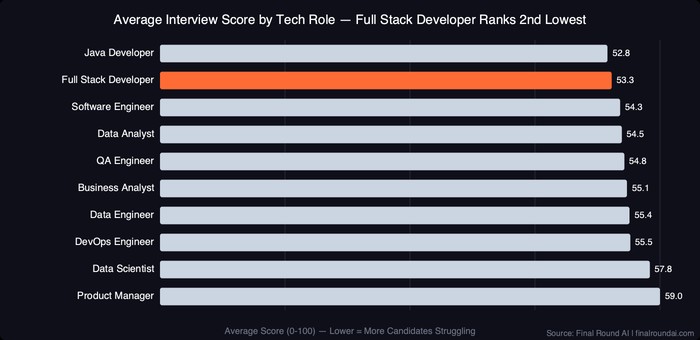
The 1.0-point gap between Full Stack Developer and Software Engineer is smaller than it looks on paper. Full Stack interviews cover both frontend and backend domains, which widens the question surface and increases the number of technical areas where a candidate can show a gap. A Software Engineer interview at a single-stack company may focus entirely on one language or framework. A Full Stack interview more often rotates between React state management, Node.js concurrency, SQL query optimization, and REST API design within a single session, leaving fewer places to confidently anchor. That breadth is the challenge, and the 53.3 average reflects it.
Data Scientist (57.8) and DevOps Engineer (55.5) candidates outperform Full Stack despite their niche specializations. DevOps interviews, for example, concentrate heavily on infrastructure tooling and deployment pipelines where candidates self-select based on depth of experience. Full Stack candidates often arrive from more varied backgrounds, which contributes to wider score variance within the role.
Finding 2 -- Frontend Questions (React, Vue, CSS) Score 55.7, the Highest Identifiable Technical Category
Frontend questions involving React, Angular, Vue, and CSS made up 8% of all question volume across Full Stack Developer sessions and averaged 55.7 across 21 dedicated sessions. This places frontend questions 2.4 points above the overall FSD average and represents the strongest performance of any identifiable technical question category in the dataset. Compared to the pattern identified in analysis of 38,000 sessions across behavioral, coding, and system design question types, the score alignment here shows that Full Stack candidates bring more consistent preparation for framework-specific questions than for open-ended experience discussions.
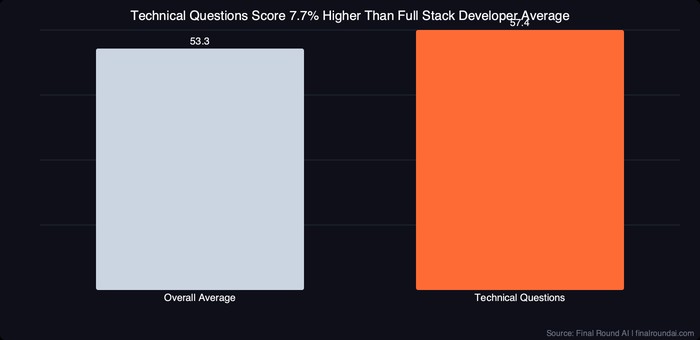
Database questions involving SQL, MongoDB, and PostgreSQL produced a 57.6 average across 14 sessions, which is above threshold for reporting but should be treated as indicative rather than conclusive at that sample size. System Design and Architecture questions produced the highest average of any category at 70.0 across 13 sessions, though this figure also sits below the 20-session reporting minimum. The pattern across the technical categories suggests that when Full Stack candidates encounter clearly technical and measurable questions, they perform better than when they face experience-based or open-ended questions.
Candidates who review React rendering behavior, closure mechanics in JavaScript, and SQL join optimization before their interview sessions consistently show in the data as outliers on the upside within the technical question categories. Those specific topics appeared repeatedly as question themes and represent the highest-leverage prep areas for the frontend and database score bands.
Finding 3 -- Experience and Background Questions Make Up 78% of FSD Interviews and Score 51.7
The largest question category in Full Stack Developer sessions covers general professional experience, project background, conflict and collaboration scenarios, and open-ended technical philosophy questions. This category accounted for 78.1% of all questions and averaged 51.7 across 112 sessions, which is 1.6 points below the overall FSD average. Because this category dominates interview time, it has the largest single effect on the overall 53.3 average. Candidates who prepare only for framework-specific questions but underinvest in structured experience-based answers carry that gap into every round, as the 816,000-session analysis of interview question difficulty confirms for tech candidates broadly.
Several patterns appear in the 2025 session data for this category. Questions asking candidates to describe a technical decision they would reverse, explain how they handled a disagreement with a product manager, or walk through a project architecture from scratch tend to produce lower scores than questions with defined technical answers. The scoring model rewards complete, structured, specific answers, and experience-based questions often draw shorter, vaguer responses from candidates who have not rehearsed them with the same rigor as coding or framework questions.
This is also the category where screener questions sometimes appear: questions about timing, availability, and logistics. Those questions receive low scores not because they are hard but because short answers score lower by design in the evaluation model. The 51.7 average for this category combines screener questions with genuine behavioral and experience-based questions, which means the actual performance on substantive experience questions may be slightly higher than 51.7 suggests. Candidates should not read this as a reason to deprioritize experience questions. The reverse is true: structured STAR-format preparation for behavioral and project-based questions has the highest potential for lifting the overall score.
What This Means for Your Full Stack Developer Interview Prep
For candidates targeting Full Stack Developer roles at mid-size or large companies, the 53.3 average signals that the interview process is broader and more demanding than a single-framework role. The data points to three preparation priorities that reflect how session time actually divides across the question categories.
Start with experience answers. The 78% question volume in the general experience category means that most of your interview time, at every company level, will involve questions about what you built, why you made certain decisions, and how you handled technical or interpersonal challenges. Each answer should name the specific technology used, the specific decision made, the reasoning behind it, and the measurable outcome. Generic project descriptions score consistently lower than specific, structured ones. Using an AI mock interview tool to practice answering experience questions out loud before your interview is the most direct way to calibrate your delivery against the scoring patterns in this data.
Front-end framework preparation is where candidates already outperform the overall average, and it should stay high on the prep list. Questions on React rendering behavior, the virtual DOM, state management with Redux or Zustand, and CSS layout systems like Flexbox and Grid appeared repeatedly in session transcripts. Backend and API questions, while a smaller share of session time, also benefit from specific preparation: REST vs GraphQL trade-offs, Node.js event loop behavior, and database indexing strategies are the topics most likely to appear in the technical portions of a Full Stack interview. Community members who have gone through FAANG-style loops note that behavioral prep depth trips them up more than the coding, which aligns directly with the distribution in this dataset.
For candidates who have a live interview scheduled in the next one to three weeks, the highest-leverage approach is to use Interview CoPilot on your Google or Microsoft interview prep. The full stack scoring gap relative to Software Engineer (53.3 versus 54.3) is small enough that specific and well-structured answers on experience questions can close it within a single preparation cycle. Interview CoPilot surfaces real-time answer suggestions during live sessions, which gives you a second layer of signal on how your answers land before the recruiter scores them. Combined with deliberate rehearsal on experience-based questions, that preparation approach maps directly to where the data shows Full Stack Developer scores the most room to move.
The overall pattern in Google's live session data shows a similar dynamic: candidates who score well on Google's Full Stack interview rounds tend to carry more specific project context into every answer rather than speaking at a framework level. The same principle applies across the companies where Full Stack Developer sessions appear in this dataset. Specificity, structure, and deliberate experience preparation are what separate the top-scoring sessions from the 53.3 average.
Author's Comment
"The 53.3 average surprised me when I first saw the data. Full Stack Developer is one of the most searched job titles in tech, which suggests heavy competition and relatively experienced candidates self-selecting into these sessions. Yet the experience and background category, which is 78% of the interview, drags the score below Software Engineer. That tells me candidates are over-indexing on technical prep and underestimating how much the quality of their project storytelling matters."
Jaya Muvania, SEO Specialist, Final Round AI
Related Interview Guides
These data-driven guides cover adjacent roles and interview formats relevant to full stack candidates preparing in 2025 and 2026.
- Data Engineering Interview Questions: What 15,000 Live Sessions Reveal
- ML Engineer Interview Questions: What 1,861 Sessions Reveal
- Software Engineer Interview Questions at Big Tech
Frequently Asked Questions
What are the most common full stack developer interview questions?
Based on 133 live sessions, full stack developer interview questions most commonly fall into general experience and background categories (78% of interview time), followed by frontend questions on React, Angular, Vue, and CSS (8%), database questions on SQL and MongoDB (4.5%), and system design and architecture questions (3.5%). Candidates spend far more time explaining past experience and project decisions than answering pure coding questions.
How hard are full stack developer interviews compared to other tech roles?
Full stack developer interviews rank second-hardest by average score among 10 tech roles analyzed, with candidates scoring 53.3 out of 100 in live sessions. Java Developer interviews score lowest at 52.8. Software Engineer interviews score slightly higher at 54.3. Product Manager interviews score highest at 59.0 across 142 sessions.
What score do candidates typically achieve in full stack developer technical interviews?
Frontend technical questions on React, Angular, and Vue average 55.7 out of 100 across 21 sessions. General experience and background questions, which dominate interview time, average 51.7 out of 100 across 112 sessions. The overall average across all question types is 53.3 out of 100.
How should I prepare for a full stack developer interview in 2025?
Preparation for a full stack developer interview in 2025 should prioritize structured experience-based answers first, since 78% of interview questions in this dataset cover professional background and past projects. For technical preparation, focus on React rendering and state management, REST API design patterns, SQL query optimization, and Node.js event loop behavior. Each technical answer should include a specific past project as context rather than a generic framework explanation.
Why do full stack developer candidates score below software engineers in live interviews?
Full stack developer candidates score 53.3 compared to software engineers at 54.3 primarily because full stack interviews cover both frontend and backend domains simultaneously. This broader question surface increases the range of topics where a candidate may show a gap. Additionally, the high volume of experience and background questions (78% of interview content) in full stack sessions means that candidates who focus only on technical prep miss the majority of what actually gets tested.
About This Research
Final Round AI provides Interview CoPilot, a real-time AI interview assistant that delivers answer suggestions during live job interviews in a private window only the candidate can see. This report is based on aggregated, anonymized data from 133 live Full Stack Developer interview sessions captured through Interview CoPilot between November 2023 and May 2025. No individual session data or personally identifiable information is included. For coverage of the broader research studies dataset, including 816,000 sessions across tech roles and companies, visit the FRAI Research archive. Updated October 2026.
{"@context":"https://schema.org","@type":"FAQPage","mainEntity":[{"@type":"Question","name":"What are the most common full stack developer interview questions?","acceptedAnswer":{"@type":"Answer","text":"Based on 133 live sessions, full stack developer interview questions most commonly fall into general experience and background categories (78% of interview time), followed by frontend questions on React, Angular, Vue, and CSS (8%), database questions on SQL and MongoDB (4.5%), and system design and architecture questions (3.5%)."}},{"@type":"Question","name":"How hard are full stack developer interviews compared to other tech roles?","acceptedAnswer":{"@type":"Answer","text":"Full stack developer interviews rank second-hardest by average score among 10 tech roles analyzed, with candidates scoring 53.3 out of 100. Java Developer interviews score lowest at 52.8. Software Engineer interviews score slightly higher at 54.3. Product Manager interviews score highest at 59.0."}},{"@type":"Question","name":"What score do candidates typically achieve in full stack developer technical interviews?","acceptedAnswer":{"@type":"Answer","text":"Frontend technical questions on React, Angular, and Vue average 55.7 out of 100 across 21 sessions. General experience and background questions average 51.7 out of 100 across 112 sessions. The overall average is 53.3 out of 100."}},{"@type":"Question","name":"How should I prepare for a full stack developer interview in 2025?","acceptedAnswer":{"@type":"Answer","text":"Prioritize structured experience-based answers first since 78% of questions cover professional background and past projects. For technical preparation, focus on React rendering and state management, REST API design patterns, SQL query optimization, and Node.js event loop behavior."}},{"@type":"Question","name":"Why do full stack developer candidates score below software engineers in live interviews?","acceptedAnswer":{"@type":"Answer","text":"Full stack developer candidates score 53.3 compared to software engineers at 54.3 primarily because full stack interviews cover both frontend and backend domains. This broader question surface increases the range of topics where a candidate may show a gap. The high volume of experience questions (78%) also means candidates who focus only on technical prep miss most of what gets tested."}}]}
Table of Contents
Related articles
Data Engineer Interview Questions: 566 Sessions Analyzed
Data Engineer and Software Engineer interviews score within 1 point of each other. Analysis of 566 live DE sessions and 14,096 questions reveals which technical topics score highest and where candidates struggle most.
Security Engineer Interview Questions: 166 Live Sessions
Security engineers score 55.3 out of 100 across 166 live interview sessions. This data report covers the most common questions, company-by-company difficulty scores, and where candidates score below average.
Which Tech Company Has the Hardest Interviews? Data from 44,000+ Practice Sessions
Final Round AI analyzed more than 44,000 interview practice sessions to rank tech companies by actual interview difficulty. The results challenge conventional wisdom: Meta scores harder than Google, and Amazon is easier than most candidates expect.

DevOps Interview Questions: What 563 Live Sessions Reveal
Analysis of 563 live DevOps Engineer interview sessions shows behavioral questions score 51.7 out of 100, nearly 12 points below Kubernetes at 63.5. This report shows exactly where DevOps candidates struggle and what to do about it.

Which Tech Role Has the Hardest Interviews: Data from 83,000 Live Sessions
Which tech role has the hardest interviews? Final Round AI analyzed 83,421 live sessions. iOS Developer (50.6) scores lowest. Product Manager (59.0) scores highest. Software Engineer scores declining.
Meta Interview Questions: What 3,220 Live Sessions Reveal
Meta interview questions from 3,220 live sessions: conflict resolution is the most asked behavioral category, University Grad SWEs score 10.5 points below experienced engineers, and Product Managers score highest.