Which Tech Roles Face System Design Interviews Most Often



Quick Answer
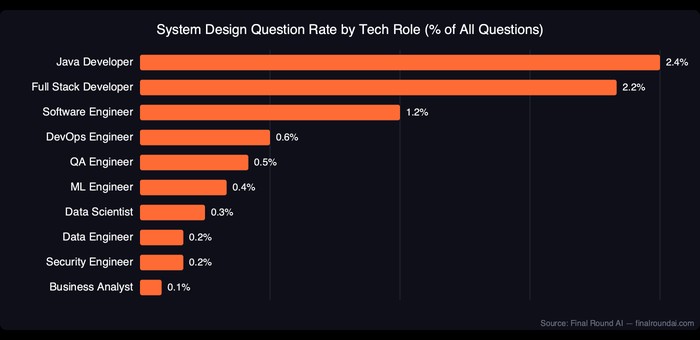
Java Developer is the tech role most likely to face system design questions, with 2.4% of all live interview questions matching system design patterns across 209 sessions. It is also the only role where system design questions outnumber behavioral ones. Software Engineers have seen their system design rate nearly double from 1.0% in 2024 to 2.1% in 2025. Business Analysts, Data Analysts, and Product Managers face almost none.
Java Developer Leads All Roles in System Design Question Rate
Across 4,008 live interview sessions and 816,927 question records captured through Interview Copilot between October 2022 and September 2025, Java Developer tops every other tech role for system design question frequency at 2.4% of all questions asked. Full Stack Developer comes in second at 2.2%, and Software Engineer at 1.2%. Every other role falls below 1%.
The gap between Java Developer and Software Engineer is smaller than most candidates assume. Java Developer sessions included 126 system design questions out of 5,248 total, while Software Engineer sessions included 245 out of 20,955. The SWE volume is far higher, but the rate per question is lower. For every 100 questions a Java Developer faces in a live interview, approximately 2 to 3 involve microservices architecture, distributed systems, or API design. For a Software Engineer, that figure is closer to 1 per 100.
The practical implication for Java Developer candidates is direct: system design is not an optional topic. The data from actual Java Developer live sessions shows questions on microservices integration with Spring Boot, Kafka integration across service boundaries, synchronous vs asynchronous communication patterns, and converting monolithic codebases into service architectures. These are not whiteboard exercises. They arise from the actual technical context of the roles being hired for. The Interview Trends Report category on this site covers additional breakdowns of how question types vary across tech roles.
Java Developer Is the Only Role Where System Design Outpaces Behavioral
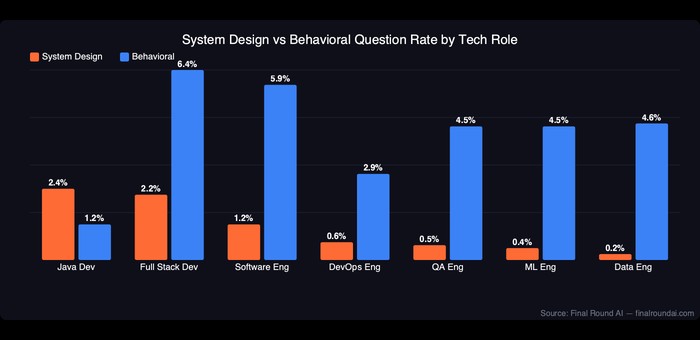
The most counterintuitive finding in this dataset: Java Developer is the only tech role where system design questions appear more frequently than behavioral ones. Java Developer behavioral questions account for 1.2% of all questions in those sessions, compared to 2.4% for system design. Every other role in this analysis shows the reverse pattern, with behavioral questions appearing at two to seven times the rate of system design questions.
Product Manager interviews, for instance, are 8.7% behavioral and 0.0% system design across 2,814 questions from 142 live sessions. Data Engineer interviews are 4.6% behavioral but only 0.2% system design. Even Software Engineer, which candidates routinely prepare for with system design drills, is 5.9% behavioral versus 1.2% system design. The behavioral vs technical question split across interview types is one of the most misunderstood dynamics in interview prep, and the Java Developer data makes that gap concrete.
Why does Java Developer diverge from every other role? The answer is in what Java Developer interviews actually test. The questions captured from live sessions are not generic architecture prompts. They are role-specific: candidates discuss Spring Boot microservices patterns, Netflix OSS tooling like Eureka and Ribbon, Kafka integration across bounded service contexts, and trade-offs between monolithic and service-oriented designs. These questions arise naturally because the job itself involves distributed Java systems. The role content generates the question content. The deeper breakdown in Java Developer interview questions ranked by difficulty confirms this pattern: the hardest questions are architecture and design problems, not language syntax.
Candidates preparing for Java Developer roles who spend the majority of their time on behavioral question banks are misallocating their prep time. The live session data shows that the ratio should be closer to even, and that microservices architecture fluency is not a bonus topic but a core expectation.
Software Engineer System Design Rate Has Nearly Doubled Since 2024
Among roles with multi-year data, Software Engineer shows the sharpest upward trend in system design question frequency. In 2023, Software Engineer sessions showed 0.0% system design questions across 784 records. In 2024, the rate reached 1.0% across 15,757 records. In 2025, it reached 2.1% across 4,414 records through September.
Full Stack Developer held relatively steady: 2.3% in 2023, 1.8% in 2024, and 2.7% in 2025. Java Developer moved from 2.2% in 2024 to 2.8% in 2025, though 2023 data is limited. Machine Learning Engineer showed a different trajectory, dropping from 0.5% in 2024 to 0.0% in 2025, likely reflecting a shift in how ML interviews are structured toward more coding-based and domain-specific questions.
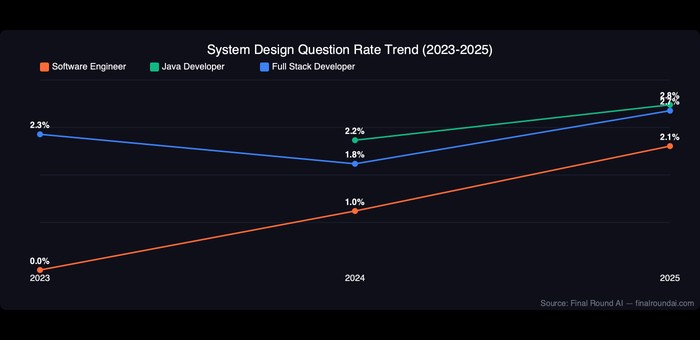
For Software Engineers preparing for 2025 and 2026 interviews, the 2.1% current rate means roughly 1 in 50 questions involves a system design or architecture prompt. In a typical 60-minute interview with 6 to 8 questions, the probability of hitting at least one system design question is now meaningful. The upward trend suggests this rate will continue rising. Candidates who treat system design as a secondary prep topic are working against an emerging interview norm. The system design interview for beginners guide walks through the 8-step framework expected in a standard FAANG-level round.
Roles With Zero System Design Exposure in Live Sessions
Data Analyst, Product Manager, and Network Engineer recorded 0.0% system design questions across hundreds of live sessions each. Product Manager sessions covered 2,814 questions from 142 unique sessions with zero matches to system design patterns. Data Analyst covered 4,466 questions from 196 sessions with the same result.
These roles are not interviewing on architecture. Their interviews are heavily behavioral (Product Manager at 8.7%, Data Analyst at 7.7%) or domain-specific (SQL queries, metric definitions, stakeholder communication). Candidates for these roles who are spending time on system design prep are almost certainly misallocating. The Product Manager interview questions analysis from 10,000-plus live sessions shows the actual distribution is behavioral, analytical, and case-based, with no architecture component.
Security Engineer is a partial exception. At 0.2% system design (7 questions from 4,255 total across 166 sessions), Security Engineer has minimal system design exposure, but the existing questions are substantive: questions about designing secure authentication flows and reviewing distributed system attack surfaces. The rate is too low to make system design a prep priority, but candidates at senior Security Engineer levels may encounter architecture review questions in later-stage rounds.
Candidates searching for a coding interview preparation path often find advice that treats all tech roles as having similar interview formats. The live session data contradicts that. Role selection should directly inform what to prioritize in prep, and system design prep should be concentrated in Java Developer, Full Stack Developer, and Software Engineer rounds, with lighter coverage for DevOps and QA.
What This Means for Your Interview Prep
For Java Developer candidates, the data is unambiguous: system design preparation should sit alongside or slightly ahead of behavioral prep in terms of time allocation. The specific topics that appear in live Java Developer sessions are microservices architecture (Spring Boot, Netflix OSS, Kafka integration), monolith-to-microservices conversion trade-offs, synchronous vs asynchronous communication patterns, and database schema choices for distributed data. Generic LeetCode preparation does not cover these areas.
For Software Engineers targeting senior or staff-level roles, the upward trend from 1.0% to 2.1% between 2024 and 2025 is a signal to increase system design coverage in prep. The community discussion at system design interview tips for new grads captures the real challenges candidates face when encountering their first architecture round, which is often more open-ended than they expect. Specifically: practice explaining trade-offs out loud. The live session data shows system design questions in Software Engineer rounds involving ride-time estimation systems, real-time data processing, and key-value store design. These require a structured approach, not just pattern memorization.
For Full Stack Developer candidates, the 2.7% rate in 2025 means system design questions appear in roughly 1 in every 37 questions asked in live sessions. The appropriate prep level is meaningful but not dominant. The best use of time is understanding API design principles, how to structure backend-to-frontend data contracts, and basic database design for relational vs document stores. Practicing with an AI mock interview that covers architecture scenarios can help build fluency with these prompts before the actual round.
For DevOps Engineer candidates, the 0.6% system design rate is low enough that heavy system design prep is not justified. The behavioral rate (2.9%) is higher, and DevOps interviews focus more on process, tooling choices, incident response, and automation patterns. The exceptions are senior-level and infrastructure architect roles, which may include architecture review components not captured in this dataset.
Across all roles, the core recommendation from this data is to match your preparation mix to the actual question distribution for your specific target role. If you are interviewing for a Java Developer position, system design preparation is not optional prep. If you are interviewing for a Product Manager role, a behavioral question bank and case framework will cover the vast majority of live interview content. Interview Copilot provides real-time assistance during live interviews, including for system design prompts, so candidates can get in-the-moment support regardless of which question type appears.
Author's Comment
"The Java Developer finding genuinely surprised me. Most prep resources treat system design as a software engineering topic, but the live session data shows Java Developer candidates face it more often, and behavioral prep is actually lower priority for that role than the conventional wisdom suggests. The 2025 SWE trend is the other signal worth paying attention to: the gap between Java Developer and Software Engineer is closing fast."
Kelly An, Head of Business Operations at Final Round AI
Related Interview Guides
- Which Tech Role Has the Hardest Interviews: Data from 83,000 Live Sessions - scores by role across 14 tech positions, including which roles produce the lowest average answer quality.
- Data Engineering Interview Questions: What 15,000 Live Sessions Reveal - the actual question distribution for Data Engineer interviews, including behavioral vs technical breakdown.
- ML Engineer Interview Questions: What 1,861 Sessions Reveal - system design question frequency and content for ML Engineer candidates, based on live session data.
Frequently Asked Questions
Which tech role gets the most system design questions?
Java Developer faces system design questions most often, at 2.4% of all live interview questions across 209 sessions captured through Interview Copilot. Full Stack Developer is second at 2.2%, and Software Engineer is third at 1.2%. Every other tech role in this dataset falls below 1%.
Do product managers face system design questions in interviews?
Product Manager interviews show 0.0% system design questions across 2,814 questions from 142 live sessions in this dataset. Product Manager interviews are predominantly behavioral at 8.7%, with analytical and case components making up the remainder. System design preparation is not an effective use of time for candidates targeting PM roles.
How often do software engineers face system design questions?
Software Engineer interviews showed a 2.1% system design question rate in 2025, up from 1.0% in 2024 and effectively 0% in 2023. This means roughly 1 in every 47 questions in a live Software Engineer session involves a system design or architecture prompt. The upward trend from 2024 to 2025 suggests this rate is increasing.
Is system design important for data engineer interviews?
Data Engineer interviews show only 0.2% system design question frequency across 14,201 questions from 569 sessions. The behavioral rate for Data Engineer is 4.6%. System design is a low-priority prep topic for Data Engineer candidates, though senior data engineering roles may include data pipeline architecture questions not captured in this dataset's keywords.
Why do Java Developer interviews have more system design than software engineer interviews?
The Java Developer role itself involves working with distributed Java systems, Spring Boot microservices, Kafka integrations, and service-oriented architectures. Interviewers naturally test the technical context of the job. In the live session data, Java Developer system design questions focus on microservices patterns, service communication trade-offs, and architecture decisions specific to Java ecosystems, rather than generic architecture prompts.
About This Research
Final Round AI develops Interview Copilot, a desktop application providing real-time AI assistance during live job interviews. This report draws on 816,927 interview question records from 4,008 unique sessions across 12 tech roles, captured through Interview Copilot between October 2022 and September 2025. System design classification uses keyword matching on question transcripts covering terms including system design, design a system, API design, database design, distributed system, microservices, scale to, and design the architecture. Cloud DevOps Engineer was excluded from the final ranking due to low session volume (33 unique sessions) despite high record count, which indicated a data duplication issue. All data is aggregated and anonymized. No individual user data is included.
Table of Contents
Related articles

QA Engineer Interview Questions: Data From 305 Live Sessions
What do QA Engineer interviewers actually ask? Data from 305 live sessions shows career openers score 47.1 on average while technical scenarios score 75.0.
Microsoft Interview Questions: 4,921 Live Sessions Reveal
Microsoft interviews average 57.8 out of 100 across 4,921 live sessions. The Growth Mindset question is the most-asked specific question and averages 51.7, making it the highest-frequency underperformer in the dataset.
The Interview Questions Tech Candidates Score Lowest On: Data from 816,000 Live Sessions
Final Round AI analyzed 816,000 live interview sessions and found behavioral screening questions average 44 out of 100, lower than technical questions. See the full breakdown by question type and job role.
Which Tech Company Has the Hardest Interviews? Data from 44,000+ Practice Sessions
Final Round AI analyzed more than 44,000 interview practice sessions to rank tech companies by actual interview difficulty. The results challenge conventional wisdom: Meta scores harder than Google, and Amazon is easier than most candidates expect.

The Interview Questions Candidates Score Worst On: Live Data
Which interview questions do candidates score worst on? Based on 25,753 live sessions: motivational questions like 'Why did you choose that major?' (38.5/100) and 'Why do you want this job?' (43.9/100) score far below the 53.8 dataset average.