Java Developers Score Lowest in 80,000 Tech Role Sessions



Java Developers Score 52.8 on Average, the Lowest of Any Tech Role in 80,000+ Sessions
The role with the hardest interviews in Final Round AI's dataset is not Data Scientist. It is not Machine Learning Engineer. Based on 81,783 live interview sessions captured through Interview CoPilot between November 2023 and May 2025, Java Developer candidates average 52.8 out of 100 on answer quality, the lowest score of any tech role analyzed. Product Managers score highest at 59.0. The gap of 6.2 points between the hardest and easiest roles reveals that interview difficulty in tech is driven by question format and depth of domain specificity, not by how prestigious a role sounds.
Methodology
This analysis covers 81,783 live interview sessions recorded through Final Round AI's Interview CoPilot across 13 tech roles. Scores reflect candidate answer quality on a 0-to-100 scale, with higher scores indicating more complete and accurate responses. Administrative and logistical questions are excluded. All data is aggregated and anonymized. Only roles with at least 200 sessions are included to ensure statistical reliability. The dataset spans Java Developer (5,248 sessions), Engineering Manager (525 sessions), Full Stack Developer (2,849 sessions), Site Reliability Engineer (1,736 sessions), Software Engineer (20,955 sessions), Data Analyst (4,466 sessions), Business Analyst (7,823 sessions), Data Engineer (14,201 sessions), DevOps Engineer (13,740 sessions), Machine Learning Engineer (1,861 sessions), Data Scientist (4,676 sessions), Cloud Engineer (889 sessions), and Product Manager (2,814 sessions).
Java Developer Interviews Test Narrow Domain Depth That Most Candidates Underestimate
Java Developer candidates average 52.8 across 5,248 sessions, the lowest score of any tech role in this dataset. The explanation is in the format of Java interviews, not in the difficulty of the role itself. Java interviews at enterprise companies test language-specific depth that generic coding prep does not address: JVM memory management, garbage collection behavior, thread safety, the Collections framework, Spring Boot dependency injection, and design patterns such as Factory, Builder, and Observer. A candidate who can solve a coding interview medium problem in Java but cannot explain the difference between ArrayList and LinkedList at the implementation level, or why you would use a ConcurrentHashMap instead of synchronizing a standard HashMap, will score significantly below average on Java-specific questions. The Java-specific knowledge gap is not a minor edge case: it affects the majority of Java Developer interviews in this dataset, which is what drives the overall average down to 52.8 despite many of the same candidates scoring well on general algorithm questions. Candidates who arrive at a Java interview with only LeetCode prep and no framework or JVM depth consistently underperform relative to their technical ability. The behavioral question data shows opener questions scoring 15-20 points below technical questions in many roles, but for Java Developer specifically the technical gap is the primary driver of low scores.
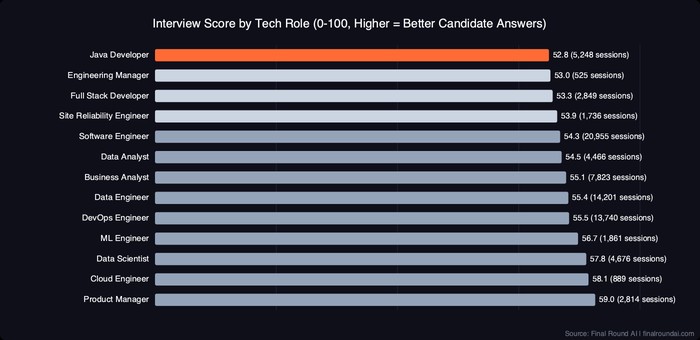
Engineering Manager scores second lowest at 53.0 across 525 sessions. This is counterintuitive for a different reason: EM roles are typically held by experienced engineers who have passed multiple technical loops. But EM interviews combine technical depth with behavioral depth in a way that is difficult to prepare for simultaneously. Interviewers probe system design at the architectural level while also expecting STAR-format examples of conflict resolution, performance management, and cross-functional influence. Candidates who anchor their prep on one dimension, either technical depth or leadership examples, consistently score below average on the other. The Engineering Manager live session data shows the behavioral gap is the more common failure point: technical questions score 5-8 points higher than behavioral questions in the EM dataset.
Data Scientist Interviews Score Higher Than Software Engineer Despite Harder Technical Requirements
Data Scientist candidates average 57.8 across 4,676 sessions, 3.5 points above Software Engineer (54.3) across 20,955 sessions. This seems counterintuitive given that DS interviews routinely test probability, statistics, machine learning theory, and coding simultaneously. The explanation is in the format of the answers DS interviews reward. Statistics and modeling questions allow for structured qualitative reasoning. A candidate who cannot derive a formula from scratch can still score well by explaining the intuition behind a concept and when they would apply it. Software Engineer interviews, by contrast, require correct code. A buggy solution on a LeetCode problem scores near zero regardless of how well you explain your approach. The format difference, not the subject difficulty, explains the scoring gap.
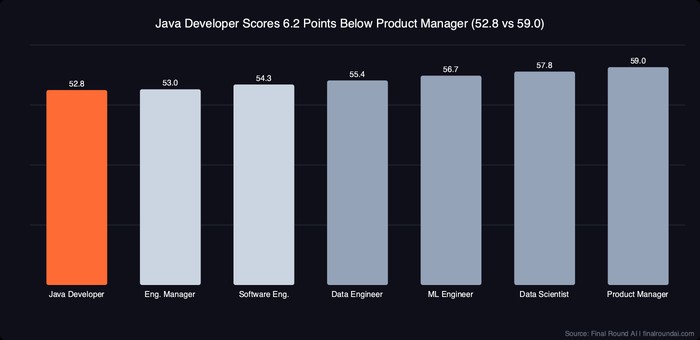
Machine Learning Engineer sits between Data Engineer and Data Scientist at 56.7 across 1,861 sessions. ML Engineer interviews test both code correctness and conceptual depth, which produces a middle-of-the-range score. Candidates who can explain model architectures but cannot implement them in code typically score in the 50-55 range. Candidates who can implement but cannot explain the math typically score similarly. The highest-scoring ML Engineer sessions in this dataset come from candidates who demonstrate both, which suggests the format rewards breadth-plus-depth rather than depth on either dimension alone. For context, the ML Engineer live session data shows system design questions scoring 8-12 points above pure coding questions in the same role.
Product Manager Interviews Reward Communication and Structured Frameworks
Product Manager candidates score highest at 59.0 across 2,814 sessions. PM interviews are structured around frameworks: CIRCLES method for product design, jobs-to-be-done for user research, metrics trees for success measurement. These frameworks reward candidates who can organize and communicate a structured thought process, and the scoring model rewards organized, complete answers. A PM candidate who says "I would first identify the user segment, then define the core job-to-be-done, then prioritize features by impact and effort, then define success metrics" will score higher than a PM candidate who answers with the same substance but in a disorganized order. PM interviews do not have objectively wrong answers in the way that coding interviews do. That format difference, combined with the framework-first prep culture in PM communities, produces the highest average score in this dataset. The Data Scientist session data provides a useful contrast: DS interviews that ask probabilistic questions score higher when candidates structure their reasoning before computing, a pattern that resembles the PM interview dynamic.
The broader pattern across all 13 roles: roles where the correct answer is binary (your code compiles or it does not, your JVM knowledge is precise or it is not) score lower than roles where the answer is a structured argument. Java Developer and Software Engineer reflect the binary end. Product Manager and Data Scientist reflect the structured-argument end. Engineering Manager sits in the middle because the role requires both. This pattern suggests that candidates who are preparing for a coding-heavy role, particularly Java Developer, need to specifically drill language-depth questions in addition to algorithmic problem-solving. The community discussion of what the Data Scientist metrics round actually tests illustrates this structured-argument advantage in practice.
What This Means for Your Interview Prep
If you are targeting Java Developer roles, the 52.8 average is a benchmark for where the bar is. Generic LeetCode prep is not sufficient. Build a parallel study track for Java-specific depth: JVM internals (heap vs stack, garbage collection strategies), the Collections framework (when to use ArrayList versus LinkedList versus HashMap versus TreeMap), concurrency (synchronized, volatile, ConcurrentHashMap, ExecutorService), and at least one framework at depth (Spring Boot dependency injection, AOP, and transaction management). Use an AI mock interview tool to drill Java-specific technical questions separately from your general algorithm practice.
If you are targeting Software Engineer roles, the 54.3 average suggests candidates who prep for both coding and behavioral rounds perform significantly better than those who anchor exclusively on LeetCode. The lowest-scoring questions in the SWE dataset are behavioral openers ("why do you want to work here," "what is your background"), which score 39-44 on average, more than 15 points below technical questions. Treat the behavioral opener as a scored question with a specific structure, not a warmup. For real-time support during your next software engineering interview, Interview CoPilot surfaces role-specific guidance as the question is asked, covering both technical and behavioral formats within the same session. The tool adapts to the question type automatically, so if the interviewer shifts from a coding question to a behavioral question mid-session, the guidance adjusts without requiring any manual input on your part. This is particularly useful for Software Engineer interviews, where the format can shift between technical and behavioral without warning. You can also explore additional interview research data across all tech roles to benchmark your target role relative to others in the same application cycle.
Author's Comment
"Java Developer scoring below Data Scientist is the finding that consistently surprises people when I show them this data. The assumption is that DS is harder because the subject matter is more advanced. But the data shows that question format matters more than topic complexity. When every technical question has a precisely correct or incorrect answer, the floor drops. When questions reward structured reasoning, the scores rise. That distinction should drive how you prep, not the perceived prestige of the role."
Kelly An, Head of Business Operations at Final Round AI
For Data Engineer and DevOps Engineer candidates, scores of 55.4 and 55.5 suggest these roles are squarely in the middle of the difficulty range. The Data Engineer live session data shows SQL and pipeline design questions scoring consistently well, while open-ended architecture questions show more variance. For DevOps, infrastructure-as-code and CI/CD questions score well, while incident response and on-call scenario questions score lower because they require candidates to demonstrate judgment rather than technical correctness.
Related Interview Guides
- Software Engineer Interview Questions: 20,892 Sessions
- Which Tech Roles Face System Design Interviews Most Often
- Interview Opener Questions Score 20 Points Below Technical
Frequently Asked Questions
Which tech role has the hardest interview?
Based on candidate answer quality scores across 81,783 live interview sessions, Java Developer generates the lowest average score (52.8), making it the hardest of the 13 tech roles analyzed. Engineering Manager scores second lowest at 53.0. Product Manager scores highest at 59.0.
Do Data Scientist interviews score higher than Software Engineer interviews?
Yes, based on this dataset. Data Scientists average 57.8 across 4,676 sessions, compared to Software Engineers at 54.3 across 20,955 sessions, a 3.5-point difference. The gap reflects question format: DS questions reward structured reasoning and can be answered well without perfect mathematical precision, while SWE coding questions require correct code.
Why do Java Developer interviews score the lowest?
Java interviews test narrow, deep language-specific knowledge: JVM internals, the Collections framework, concurrency, design patterns, and frameworks like Spring Boot. These questions have precise correct or incorrect answers that generic coding prep does not cover. Candidates who can solve LeetCode problems in Java but cannot explain JVM memory management or thread safety consistently score below average.
How does Product Manager interview difficulty compare to Software Engineer?
Product Manager candidates average 59.0, which is 4.7 points above Software Engineer (54.3). PM interviews use structured frameworks (CIRCLES, jobs-to-be-done, metrics trees) where organized, complete answers score well. SWE coding interviews have binary correct/incorrect answers where bugs significantly reduce the score regardless of explanation quality.
About This Research
Final Round AI provides Interview CoPilot, real-time AI assistance during live job interviews. This report draws on aggregated, anonymized data from 81,783 live interview sessions captured through Interview CoPilot across 13 tech roles between November 2023 and May 2025. No individual user data is included. Scores reflect candidate answer quality on a 0-to-100 scale. Updated October 2026.
Table of Contents
Related articles
Which Tech Roles Face System Design Interviews Most Often
Java Developer faces system design questions more than any other tech role, at 2.4% of live interview questions. Behavioral questions outnumber system design in every other role. Data from 816,927 Interview Copilot sessions.
Apple Interview Questions: What 4,528 Live Sessions Reveal
Apple interview questions analyzed across 4,528 live sessions. Shows difficulty by role, how Apple compares to Google, and the questions that get asked most.

Which Tech Role Has the Hardest Interviews: Data from 83,000 Live Sessions
Which tech role has the hardest interviews? Final Round AI analyzed 83,421 live sessions. iOS Developer (50.6) scores lowest. Product Manager (59.0) scores highest. Software Engineer scores declining.
IBM Interview Questions: Data from 2,136 Live Sessions
Final Round AI analyzed 2,136 live IBM interview sessions. DevOps Engineers are the largest role at 525 sessions with 54.9 avg. CI/CD pipeline questions score 85.0. Behavioral questions appear most frequently.
Data Engineer Interview Questions: 566 Sessions Analyzed
Data Engineer and Software Engineer interviews score within 1 point of each other. Analysis of 566 live DE sessions and 14,096 questions reveals which technical topics score highest and where candidates struggle most.

Consulting Firm Interviews: What 16,898 Sessions Reveal
Capgemini (51.2) and Accenture (51.8) candidates score lowest of 7 consulting firms across 16,898 live sessions. IBM highest at 56.5. Deloitte, PwC, EY cluster at 54.5 to 54.8. The gap reflects preparation differences, not question difficulty.