Expedia Layoffs: 58 Seattle Jobs Cut, 71% Data and Finance



Expedia Group is cutting 58 jobs at 1111 Expedia Group Way West in Seattle, with separations expected between November 21 and December 1, 2026. The cuts were disclosed in a Worker Adjustment and Retraining Notification letter received by the Washington State Employment Security Department on September 22, 2026, and GeekWire reporter Kurt Schlosser published the filing the same day. This is the second Washington WARN round Expedia Group has filed in 2026, after 162 Seattle roles went in January, and it is a very different cut from that one.
Quick Answer
- Expedia Group is permanently eliminating 58 positions at its Interbay waterfront campus, 1111 Expedia Group Way West, Seattle, WA 98119, with separations scheduled between November 21 and December 1, 2026.
- Roughly 71% of the 58 roles sit in just two functions: 22 in finance, tax and audit, and 19 in data science. The list includes one SVP, two VPs, three directors and a Tax Director, so this is a senior-heavy cut, not a junior trim.
- The WARN filing never mentions artificial intelligence. Expedia Group CEO Ariane Gorin called AI a force multiplier on the August 5, 2026 earnings call, but that statement was about company strategy and is not a stated reason for these 58 cuts.
What Expedia disclosed in the Washington WARN filing
Expedia Group told Washington State that it will permanently eliminate 58 positions at a single Seattle address. The Worker Adjustment and Retraining Notification letter was received by the Washington State Employment Security Department on September 22, 2026, and it names 1111 Expedia Group Way West, Seattle, WA 98119 as the only affected worksite. That is the company's Interbay waterfront campus. The filer entity on the notice is Expedia, Inc., while the letterhead and signature block are Expedia Group.
The letter is signed by Cathy Rankin, Senior Director of Employee Relations at Expedia Group. "I am writing to notify you that Expedia, Inc. plans to conduct layoffs impacting Washington employees, with separations expected to occur between November 21 and December 1, 2026," Rankin wrote. She added that "The layoffs are expected to include 58 employees and be permanent."
Two operational details matter for anyone on that list. Rankin confirmed that "No union represents the affected employees, and no bumping rights exist," which means there is no seniority process to claim someone else's role. The letter also commits the company to "at least 60 days' advance notice."
Run the arithmetic on that promise. September 22 to November 21 is exactly 60 days, and the Washington WARN database lists the layoff start date as 11/21/2026. Expedia Group filed on the earliest date the statute permits for that separation window.
The filing gives no business reason. The only explanation in the document is statutory boilerplate: "Some of the layoffs are the result of, or will result in, the relocation or contracting out of the employer's operations or the employees' positions." There is no paragraph on market conditions, cost targets, or restructuring goals. The letter was copied to Katie B. Wilson, Mayor of the City of Seattle. Employee names and home addresses are redacted by the Employment Security Department under RCW 42.56.230, so the public file carries job titles and counts but no individuals.
GeekWire reporter Kurt Schlosser published the first detailed account on September 22, 2026, and noted that the outlet had asked Expedia Group for the reason behind the cuts and had not heard back. Lynnwood Times covered the filing the same day, and The Business Journals followed on September 23, 2026.
Who was actually cut, and how the role mix shifted
Roughly 71% of the 58 Expedia Group roles in this filing sit in two functions: 22 in finance, tax and audit, and 19 in data science. Engineering accounts for 8. The remaining 9 are program management, sourcing, risk and compliance, business intelligence and operations leadership. No news outlet covering the filing published this breakdown, so here it is in full.
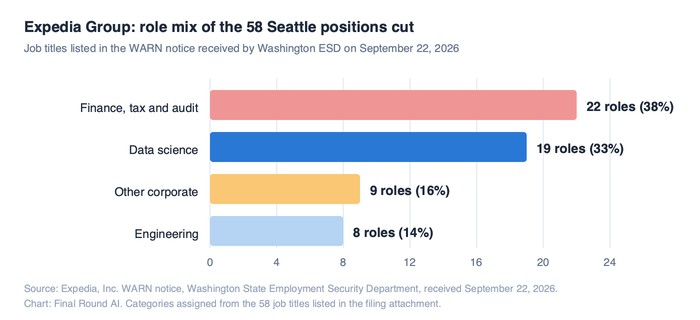
The data science block is unusually specific. It includes Data Scientist II roles in Analytics, Customer Analytics, Lodge Offerings Analytics and Marketing Testing, Data Scientist III in Analytics and in Payments, DS Analytics III in Loyalty Experience and in Ad Sponsored Listings, DS II SPX Analytics, Senior DS Analytics for Booking Experiences and Booking Platform, a Senior Machine Learning Scientist, and two Director-level data science analytics leaders covering Booking Experiences and Membership.
The finance block is larger and reaches higher. It covers four Finance Managers, a Manager of Financial Systems, two Senior Accountants, six Senior Finance Analysts, a Senior Finance Manager, a Senior Audit and Compliance Analyst, a Technical Audit and Compliance Manager, a Senior Tax Analyst, two Tax Directors, a Treasury Manager for Banking Infrastructure, and a Vice President of Finance for P&M.
That seniority profile is the part worth sitting with. One SVP for Book-to-Trip, a VP of Operations and Services, a VP of Finance, a Director of Program Management, two Directors of Data Science Analytics and two Tax Directors are on a 58-person list. Companies trimming cost at the edges do not usually put an SVP and two VPs on the same notice.
Compare that with January. The market for data science roles has been reshaped by exactly this kind of filing, and the shift inside Expedia Group is visible across eight months. The January 28, 2026 WARN listed 162 Seattle roles in engineering, product and design. The September 22 WARN lists 41 of 58 in analytics and finance. In eight months the company moved from cutting the people who build the product to cutting the people who measure and fund it.
One caution on compensation. The WARN PDF contains no salary information at all. Lynnwood Times described the 58 as six-figure jobs, sourcing that to public aggregate compensation data and labelling it a reasonable estimate. Treat it as an estimate, because it is not in the filing.
How this fits the pattern of Expedia layoffs since 2024
This is at least the eighth publicly documented reduction at Expedia Group since February 2024. The rounds have got smaller and more surgical, and they have moved steadily up the org chart.
- February 22, 2024: about 1,500 roles companywide, roughly 8.7% of staff, concentrated in Product and Technology. Disclosed in an SEC 8-K with an $80M to $100M restructuring charge.
- February 27, 2024 WARN: 208 Seattle roles, effective May 1, 2024.
- April 22, 2024 WARN: 2 Seattle roles. May 29, 2024 WARN: 36 Seattle roles, effective August 1, 2024.
- March 2025: a marketing team restructuring.
- April 28, 2025: about 3% of the workforce, roughly 495 people, across product, technology and finance.
- January 28, 2026 WARN: 162 Seattle roles in engineering, product and design, effective April 1 to April 19, 2026.
- Mid-2026: about 400 roles companywide.
- August 2026: eight or more VPs and SVPs departed in a product and technology reorganisation.
- September 22, 2026 WARN: 58 Seattle roles, this round.
Headcount context makes the trend legible. Expedia Group reported about 16,000 employees across nearly 50 countries as of December 31, 2025 in its FY2025 annual report filed on February 13, 2026, and stated that "approximately one half of our people work in technology roles." The company peaked above 25,000 people in 2019. The 2024 round removed 8.7% of staff in a single announcement. The 2026 rounds remove dozens at a time, which never makes national news and lands just as hard on the people named in them.
In practice, the smaller filings are harder to read as a signal than the big one was. A 1,500-person cut tells the market the company is resetting. A 58-person cut with an SVP on it tells you a specific function is being restructured, and it does not tell you which one is next.
Why the Expedia filing never mentions AI
The September 22 WARN filing is completely silent on artificial intelligence. The word does not appear. The only reason given is the relocation and contracting-out boilerplate quoted above, and GeekWire reported that it asked Expedia Group directly for the reason and had not received an answer at publication.
Two AI statements are circulating alongside this story, and both come from separate events. An internal memo tied to the August 2026 VP-level reorganisation said AI has "radically changed what's possible," according to GeekWire. That memo concerned a different reduction, not these 58 roles.
The second is from Ariane Gorin, CEO of Expedia Group, on the Q2 2026 earnings call on August 5, 2026, where she described the company as "leveraging AI as a force multiplier to innovate faster and operate more efficiently." That line appears in the earnings release filed with the SEC as Exhibit 99.1 and it is a statement about company strategy. It is not a stated cause of the September cuts, and no filing connects the two.
So the accurate framing is a juxtaposition, not a causal claim. A company whose chief executive publicly describes AI as a force multiplier filed a notice eliminating 19 data science roles and said nothing about AI in it. Anyone writing that Expedia cut 58 jobs because of AI is inferring, not reporting.
The financial backdrop is the other half of the picture, and it cuts against the usual distress narrative. In the quarter ended June 30, 2026, Expedia Group reported revenue of $4,315M, up 14%, and net income attributable to Expedia Group of $878M, up 166%. Gross bookings reached $33,928M, up 12%, with B2B up 21% and B2C up 8%. Booked room nights hit 111.5M, up 6%. Operating income was $800M, up 65%, adjusted EBITDA was $1,119M, up 23%, and diluted EPS was $7.16, up 188%. The company raised full-year 2026 revenue guidance to a range of $16.05B to $16.22B.
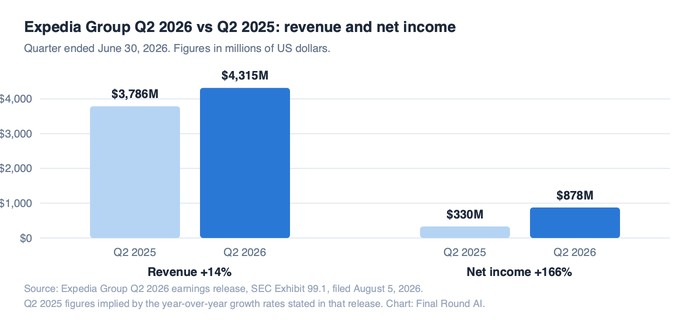
For comparison, full-year 2025 revenue was $14.73B, up 8%, with net income of $1.29B. Profit nearly tripled year over year in Q2, guidance went up, and a WARN notice followed seven weeks later. That sequence is the story, and it does not need an AI headline to be worth reading.
What the 2026 layoff numbers actually show
Profitable companies are running the largest share of 2026 tech layoffs, and Expedia Group is a clean example. The pattern across the year is not distressed firms shrinking to survive. It is firms with rising margins reallocating headcount between functions while total headcount drifts down.
The Seattle area has absorbed this pattern repeatedly. Our running analysis of what the 2025 and 2026 layoff data actually shows about AI and hiring tracks how often the AI explanation is asserted publicly and how rarely it appears in the underlying government filings. Expedia Group is now another entry where the filing and the narrative do not match.
Read the two Expedia Group rounds of 2026 side by side and the reallocation becomes concrete. In January the company removed 162 engineering, product and design roles while telling reporters it was also opening new positions as it assessed the skills it would need. In September it removed 41 analytics and finance roles out of 58, in the same quarter it raised guidance. Neither filing describes a company running out of money. Both describe a company deciding that a function it funded in 2024 is not the function it wants to fund in 2027, and doing that with permanent separations rather than internal transfers.
Scale matters for perspective. Expedia Group is cutting 58 Washington roles here. In the same market, Amazon cut 121 Seattle roles with 43% of them in technology, a different mix from Expedia's analytics and finance concentration. Microsoft, Oracle, T-Mobile, Uber, Google, Starbucks, Qualtrics and Salesforce have all run comparable targeted reductions in Washington rather than single large events, which is why the cumulative Seattle total rarely gets reported as one number even though the people affected all enter the same local hiring pool.
What that means for a candidate is specific. You are not competing against one company's laid-off cohort. You are competing against a rolling supply of senior analytics and finance people released in batches of 50 to 200 across the same metro, several times a year, most of them holding the same certifications and the same three or four employer names on their resumes. That is why the speed of your first two weeks matters more than it used to, and why generic advice about updating your resume misses the actual constraint. The constraint is order of arrival, not polish. For ongoing coverage of filings like this one, our hiring and layoffs news desk tracks each WARN notice as it lands.
What to do if you were affected
You have roughly eight and a half weeks of paid employment left, and that is the single most useful fact in this article. The filing landed September 22 and the earliest separation is November 21, which is 60 days of notice. Treat that as a funded job search, not a waiting period. The difference between a WARN layoff and a same-day termination is almost entirely this window, and most people spend the first two weeks of it waiting for a severance number that will not change anything they do next.
The mistake people make with a 60-day WARN runway is treating week one as recovery time. Week one is the only week you still have system access. A senior finance analyst who exports six quarters of close-cycle metrics before badge-off walks into interviews with numbers; the same person two months later is reconstructing them from memory. Do the extraction first and process the news second. Our guide to landing a tech job after a layoff walks through the full sequence, including how to handle the gap on your resume and how to time applications against the notice period.
Do these five things in the first week, in this order:
- Export every performance review, promotion document and written manager feedback you have. These disappear the moment your access is revoked.
- Save the metrics that prove your work. Dashboard screenshots, model accuracy figures, revenue or cost numbers you influenced, close-cycle timings, audit findings you closed.
- Collect personal contact details for four to six references, including at least one skip-level leader. Company email addresses stop working for them too, given how many managers are on this list.
- Read your severance and benefits paperwork against the November 21 to December 1 window, and confirm in writing which date applies to you. The filing gives a range, not a single date.
- Start applying in week one. Roles posted in October are interviewing in November, which is when your notice period ends.
Then build a short screening script. Most of these processes open with a 20 to 30 minute recruiter initial screening, and it is a filter, not a conversation. You get about 90 seconds to explain why you left Expedia Group. Write that answer, say it out loud ten times, and stop improvising it.
How to explain an Expedia layoff in your next interview
Lead with the scale of the action, not with your performance. The correct opening is one sentence: "My role was eliminated in a 58-person restructuring at Expedia Group's Seattle campus that removed most of the analytics and finance function." That sentence does three things at once. It names a number, it names a function, and it makes clear the decision was structural.
Never volunteer a theory about why you specifically were chosen. Interviewers are not testing whether you have an explanation; they are testing whether you are still carrying the event. A candidate who says "I think my manager wanted to keep the other analyst" has answered a question nobody asked and introduced a doubt that was not there.
Three framings that work for this specific filing:
- The seniority point. The notice included an SVP, two VPs and three directors. If a hiring manager hesitates, that fact resolves the performance question faster than any assurance you can give.
- The function point. Say which function was restructured. "The company cut 19 data science roles across analytics, loyalty and payments" is verifiable and specific.
- The timing point. The company reported record profit in the same quarter. That is not bitterness if you state it flatly; it is evidence the cut was a reallocation decision.
Then move on. The layoff answer should take under 30 seconds, and everything after it should be about the work. Our breakdown of how to explain a layoff without sounding negative has the full wording patterns, including what to do when the interviewer pushes a second time.
Expect the question twice in the same process. The recruiter asks it as a screening filter, and the hiring manager asks it again later to see whether the story holds under a second pass. Those two versions need the same facts and different lengths. The recruiter version is the one-sentence framing above. The hiring manager version can add one line about what you were working on when the notice landed and what state you left it in, because that is the version where handing over a project cleanly reads as a professional signal rather than an excuse. Rehearse both out loud, on separate days, and record yourself once so you can hear whether the tone drifts.
Final Round AI's Interview CoPilot™ is built for that rehearse-and-review half of the problem. The product runs in the Final Round AI desktop app and covers the whole loop: set up a Goal for the exact role and company you are targeting, add the job description and your resume, rehearse with Practice Interview, then read the automatic Debrief and re-drill whatever the debrief flags. If the live round itself is where you tighten up, the live copilot gives you real-time guidance while the interview is happening, with Screen Help for coding and system design questions and Stealth Mode keeping the floating assistant hidden from Zoom, Meet and Teams screen sharing. Preflight checks the goal, materials and audio before you go live, which is worth running once the week before rather than five minutes before a round that matters.
One last thing worth doing this week, and it costs nothing. The phrasing that works for "why did you leave your last job" changes depending on whether the interviewer already knows about your company's layoffs, and people who have just been through it give better guidance on that than any template a career site will hand you. Candidates who were laid off in mid-2026 have been comparing notes on exactly this in the Final Round AI community, including which openers get follow-up questions and which ones close the topic. It is worth reading what phrasing actually works when they ask why you left before you write your own version.
Author's Comment
"Search volume around a layoff peaks within 48 hours and it is almost never people looking for the headcount number. It is people typing the company name plus severance, plus WARN, plus how to explain. The queries that spike hardest are the ones about wording, which tells you the real anxiety is the next interview, not the notice. What is different about this Expedia filing is that so many of the affected people are senior, and senior candidates search differently: they want the specific sentence, not reassurance."
Jaya Muvania, SEO Specialist at Final Round AI
Related Interview Guides
- Data Science Interview Preparation Guide: 19 of the 58 eliminated roles are data science, so this covers the rounds that cohort will face next.
- What to Do When You Get Laid Off: the five immediate actions to take inside the notice period, before access is revoked.
- Post-Layoff Job Search Guide: how to structure applications across an eight-week runway rather than applying at random.
- How Long Does a Job Search Take in the US?: realistic timelines to plan against when your separation date is fixed at November 21.
Prepare for the interviews that follow
A 60-day notice period is enough time to run a real interview process, but only if the preparation starts in week one. Final Round AI covers the full loop in one desktop app: build a Goal for the exact role and company you are targeting, rehearse the layoff question and the role-specific rounds with Practice Interview, then use the automatic Debrief to fix the weak answer before the next conversation. Download App to get started, or See Plans for what each tier includes.
Frequently Asked Questions
How many employees did Expedia lay off in September 2026?
Expedia Group is eliminating 58 Washington state positions. The WARN notice was received by the Washington State Employment Security Department on September 22, 2026, and every affected role is at 1111 Expedia Group Way West in Seattle. Separations are scheduled between November 21 and December 1, 2026, and the filing states the layoffs are permanent.
Why is Expedia laying off employees?
The filing does not say. The only reason the WARN letter gives is statutory language about relocation or contracting out of operations or positions. GeekWire asked Expedia Group for an explanation on September 22 and had not received one at publication, so no verified business rationale for this specific round exists in any public document.
Are the Expedia layoffs because of AI?
There is no evidence for that in the filing, which never mentions AI. CEO Ariane Gorin described AI as a force multiplier on the August 5, 2026 earnings call, and an internal memo tied to a separate August reorganisation said AI had changed what is possible. Neither statement is attached to these 58 cuts.
Which roles did Expedia cut in Seattle?
Finance, tax and audit accounts for 22 of the 58, and data science accounts for 19, so the two functions together are about 71% of the notice. Engineering accounts for 8. The list reaches senior levels and includes an SVP for Book-to-Trip, a VP of Operations and Services, a VP of Finance and two Tax Directors.
Is Expedia still profitable after the layoffs?
Yes, and strongly. For the quarter ended June 30, 2026 the company reported revenue of $4,315M, up 14%, and net income of $878M, up 166% year over year. It also raised full-year 2026 revenue guidance to between $16.05B and $16.22B. The WARN notice was filed seven weeks after those results.
Table of Contents
Related articles

Jobs Lost Globally Since ChatGPT Came in 2022
Since ChatGPT's launch in 2022, AI has eliminated millions of jobs from customer service to coding. The workplace revolution experts predicted for decades happened in just three years.

Andrew Yang warns AI could erase 40 million jobs in a decade
Andrew Yang warns AI could eliminate 30–40 million US jobs in a decade. Based on a CNN interview and real labor data, this post breaks down which jobs are most at risk and what workers can do now.

AWS CEO Says Replacing Junior Developers with AI Is the Dumbest Thing I've Ever Heard
AWS CEO Matt Garman calls replacing junior developers with AI "the dumbest thing" and argues companies should keep hiring junior talent.

Nike Announces 775 Job Cuts at US Distribution Centers
Nike starts 2026 US layoffs at their distribution centers as it boosts automation to streamline operations and cut costs.