55 Dollars an Hour Is How Much a Year? (Before & After Taxes 2026)


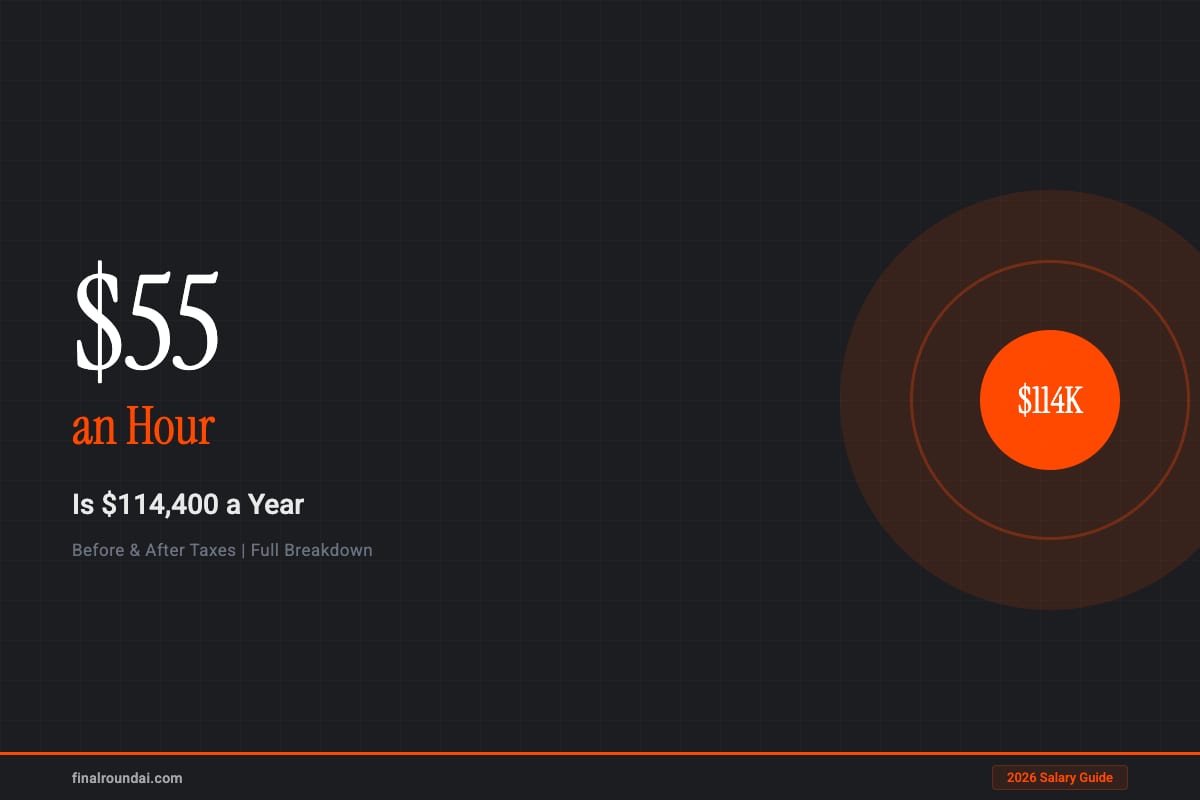
At $55 an hour working full-time, you earn $114,400 per year before taxes. That's 40 hours per week across 52 weeks (2,080 total hours). After federal taxes and FICA, a single filer typically takes home around $88,866 net annually, or about $7,406 per month, well above the U.S. median household income of $78,000.
Quick Answer
- $55/hour = $114,400/year before taxes (40 hrs/week, 52 weeks)
- Single filer take-home: ~$88,866/year (~$7,406/month) after federal taxes and FICA
- Married filing jointly take-home: ~$95,997/year (~$8,000/month) after federal taxes
$55 an Hour Is How Much Per Paycheck (Gross)?
$55 an hour equals $2,200.00 per week, $4,400.00 biweekly, $4,766.67 semi-monthly, or $9,533.33 monthly before taxes. Your actual paycheck will vary based on pre-tax 401(k) contributions, health insurance premiums, and your employer's pay schedule.
Weekly: $55 x 40 hours = $2,200.00
Biweekly: $2,200.00 x 2 = $4,400.00
Semi-monthly: $114,400.00 / 24 = $4,766.67
Monthly: $114,400.00 / 12 = $9,533.33
Biweekly pay comes 26 times per year; semi-monthly comes 24 times. The biweekly schedule means two extra paychecks annually, useful for budgeting large expenses or accelerating debt payoff.
What Is $55 an Hour After Taxes in 2026?
After federal taxes and FICA, $55 an hour leaves a single filer with approximately $88,866 per year, or $95,997 married filing jointly. These figures use 2026 standard deductions ($15,000 single, $30,000 married) and current tax brackets.
Single Filer Federal Tax Breakdown
Gross annual: $114,400.00 | Standard deduction: -$15,000.00 | Taxable income: $99,400.00
10% on the first $11,925.00 = $1,192.50 | 12% on $11,925-$48,475 = $4,386.00 | 22% on $48,475-$99,400 = $11,203.50 | Total federal income tax = $16,782.00
FICA (7.65%): $8,751.60 | Net Annual: $88,866.40 | Net Monthly: $7,405.53
Married Filing Jointly Federal Tax Breakdown
Gross annual: $114,400.00 | Standard deduction: -$30,000.00 | Taxable income: $84,400.00
10% on $23,850 = $2,385.00 | 12% on $23,850-$84,400 = $7,266.00 | Total federal income tax = $9,651.00
FICA (7.65%): $8,751.60 | Net Annual: $95,997.40 | Net Monthly: $7,999.78
Note: Texas, Florida, and Nevada have no state income tax; California can add 9%+ at this income level, reducing take-home further.
How Many Hours Do You Work at $55 an Hour Per Year?
Full-time at $55/hour means 2,080 hours per year (40 hrs/week x 52 weeks), earning $114,400 before taxes. Reducing hours meaningfully cuts income at this rate.
40 hours/week: $2,200.00/week to $114,400.00/year
35 hours/week: $1,925.00/week to $100,100.00/year
30 hours/week: $1,650.00/week to $85,800.00/year
25 hours/week: $1,375.00/week to $71,500.00/year
20 hours/week: $1,100.00/week to $57,200.00/year
Part-time workers at $55/hour earn competitive income but may not qualify for employer benefits that typically require 30+ hours/week.
$55 an Hour Full-Time Annual Income
$55 an hour full time (40 hours/week, 52 weeks) equals $114,400 per year before taxes, $9,533 per month gross. This is the standard calculation based on 2,080 annual hours.
52 weeks (no time off): $114,400.00/year | 50 weeks (2 weeks off): $110,000.00/year | 48 weeks (4 weeks off): $105,600.00/year | 46 weeks (6 weeks off): $101,200.00/year
Each unpaid week costs $2,200. Two weeks off reduces annual income to $110,000. Negotiating paid time off is worth the same as a $2,200 raise per week you would otherwise go unpaid.
$55 an Hour Part-Time Income
At $55/hour part time: $85,800/year at 30 hrs/week, $71,500 at 25 hrs, $57,200 at 20 hrs. Even at 20 hours/week, $57,200 annually exceeds the federal poverty line for most household sizes.
30 hours/week: $1,650.00/week to $7,144.50/month to $85,800.00/year
25 hours/week: $1,375.00/week to $5,953.75/month to $71,500.00/year
20 hours/week: $1,100.00/week to $4,763.00/month to $57,200.00/year
What Are the Most Common Mistakes When Calculating $55 an Hour?
Mistake 1: Ignoring Taxes. Gross $114,400 vs net $88,866 is a $25,534 difference. Always budget from net income. Federal taxes plus FICA consume about 22% of gross at $55/hour.
Mistake 2: Assuming Full-Time Hours Are Guaranteed. Each unpaid week costs $2,200. Two weeks unpaid reduces annual income by $4,400 to $110,000. Contractors and hourly workers should plan for 80-90% utilization, not 100%.
Mistake 3: Confusing W-2 and 1099 Take-Home. Self-employment tax is the additional 7.65% paid by 1099 contractors on top of what W-2 employees pay. At $55/hour, this adds $8,752 annually. Contractors should charge $60-$62/hour to match W-2 net pay.
Mistake 4: Ignoring Geographic Cost-of-Living. $114,400/year is comfortable in most mid-sized cities but tight in San Francisco or NYC. A $55/hour offer in a high-cost city may deliver less purchasing power than $50/hour in a lower-cost market.
Mistake 5: Forgetting Benefits Value. Health insurance, 401(k) match, and PTO can add $10,000-$20,000 in total compensation. Use the AI resume builder to help benchmark your full package when evaluating offers.
How Does $55 an Hour Compare to Other Wages?
$55/hour ($114,400/year) is well above the U.S. median household income of approximately $78,000. According to BLS data, it places earners in the top 25% of U.S. wage earners nationally. Each additional dollar per hour adds $2,080 annually.
$51/hour to $106,080.00/year | $53/hour to $110,240.00/year | $55/hour to $114,400.00/year (you are here) | $57/hour to $118,560.00/year | $59/hour to $122,720.00/year
At the $55/hour level, a $2/hour raise means $4,160 more per year. For context on career trajectories that reach this wage, explore jobs that pay $10 to $100 an hour.
What Jobs Pay $55 an Hour?
According to BLS occupational data, several career categories reliably pay $55/hour for experienced professionals in 2026:
Healthcare and Medical: Registered Nurse (RN), Nurse Practitioner (entry), Dental Hygienist, MRI Technologist, Occupational Therapist
Engineering: Civil Engineer, Electrical Engineer, Systems Engineer, Mechanical Engineer, Environmental Engineer
Finance and Business: Financial Analyst (mid), CPA, Management Consultant, Investment Analyst, Corporate Accountant
Technology and IT: Software Engineer (mid), Data Analyst, Cloud Architect (junior), Cybersecurity Engineer, DevOps Engineer
Skilled Trades: Master Electrician, Elevator Mechanic, Instrumentation Technician, Industrial Maintenance Engineer, Offshore Welder
Legal and Government: Associate Attorney, Government Contract Specialist, Senior Compliance Officer, Policy Analyst, Intelligence Analyst
Use an AI mock interview tool to practice for roles in these salary ranges, technical and healthcare positions where interview performance directly impacts offer levels.
How to Negotiate a $55/Hour Rate (Or Higher)
Most employers have a 5-10% buffer in initial offers at this wage level. Research comparable roles in your area before negotiating. Tech hubs and high-demand specialties often pay $60-$65/hour for the same role.
Negotiate after a job offer but before accepting, that is the optimal window. Asking during initial interviews or months into a role without documented wins reduces leverage significantly.
At $55/hour, a counter of $58-$60/hour is within professional norms. The employer has invested significant time in the hiring process, they won't walk away over a 5-10% counter from a strong candidate. Use Interview Copilot to get real-time coaching during salary negotiation conversations.
Salary negotiation improves with practice. Join the Final Round AI community to connect with others navigating compensation discussions and share negotiation strategies.
Related Salary Guides
- $50 an Hour Is How Much a Year?, The comparison point just below $55/hour, with full 2026 after-tax breakdown.
- $58 an Hour Is How Much a Year?, What the next salary tier looks like, including when the 24% federal bracket kicks in.
- $60k a Year Is How Much an Hour?, Annual-to-hourly conversion for evaluating salaried offers.
- $40 an Hour Is How Much a Year?, Baseline comparison for understanding how far $55/hour takes you above mid-range wages.
Conclusion
Earning $55 per hour puts you at $114,400 per year, well above the U.S. median household income and a wage that enables real financial stability across most of the U.S. Single filers keep $88,866 annually ($7,406/month); married filers keep $95,997 ($8,000/month) after federal taxes. Overtime at $82.50/hour accelerates progress significantly, 5 extra hours/week adds $21,450 annually before taxes.
Browse more salary advice articles to compare wages, understand tax implications, and benchmark compensation across career levels. Or use the AI salary calculator to model your specific situation with state taxes, benefits, and retirement contributions factored in.
Try Final Round AI Free, 100% invisible real-time interview assistance trusted by 10M+ users.
Many candidates use AI for job interviews to prepare for questions exactly like these.
Frequently Asked Questions
How much is $55 an hour annually?
$55 an hour equals $114,400 per year working full-time (40 hours/week, 52 weeks, 2,080 hours total).
What is $55 an hour after taxes?
A single filer earning $55/hour takes home approximately $88,866 per year ($7,406/month) after federal income tax and FICA in 2026. Married filing jointly nets about $95,997/year.
Is $55 an hour a good wage?
$55 an hour equals $114,400 per year, well above the U.S. median household income of $78,000. It places you in the top 25% of wage earners nationally and supports comfortable living in most U.S. cities.
How much is $55 an hour per month?
$55 an hour produces $9,533 gross per month. After federal taxes, a single filer nets approximately $7,406/month.
How much is $55 an hour biweekly?
$55 per hour biweekly (80 hours) equals $4,400.00 gross before taxes.
Can you live comfortably on $55 an hour?
$114,400/year supports comfortable living in most mid-sized U.S. cities. High-cost markets like San Francisco or NYC require tighter budgeting but remain manageable for most households.
What is $55 an hour for part-time work?
At 25 hours/week, $55/hour yields $71,500/year. At 20 hours/week, the annual figure is $57,200.
What jobs pay $55 an hour?
Common roles at $55/hour include registered nurses, software developers, dental hygienists, financial analysts, civil engineers, and master electricians, depending on location and experience level.
Table of Contents
Related articles

Average Salary in Canada: National and Provincial Breakdown
Canada's average hourly wage is C$34.92 (C$72,600/year); the median is C$58,400. See earnings by province, industry, and occupation, plus benchmarks for salary negotiation across Canadian cities.

24 Dollars an Hour is How Much a Year
$24 an hour equals $49,920 per year before taxes. Learn exact breakdowns for full-time, part-time, after-tax pay, and budgeting tips for realistic planning.
48 Dollars an Hour Is How Much a Year? (Before & After Taxes 2026)
$48 an hour is $99,840 a year before taxes. After federal taxes, a single filer takes home $78,623 annually ($6,552/month). See the full 2026 weekly, monthly, biweekly breakdown and jobs that pay $48/hr.
Minimum Wage in London: Statutory and Living Wage
London's statutory minimum wage is £12.71 per hour from 1 April 2026. The voluntary London Living Wage is £14.80/hr from May 2026. Learn the difference, which employers pay it, and how to earn above the minimum in London.

50,000 Dollars a Year Is How Much an Hour
Find how much $50,000 a year is per hour, week, and month. Includes part-time math, unpaid time off scenarios, and after-tax take-home guidance.
44 Dollars an Hour Is How Much a Year? (Before & After Taxes 2026)
$44 an hour is $91,520 a year before taxes. After federal taxes, a single filer takes home $72,770 annually ($6,064/month). See the full 2026 weekly, monthly, biweekly breakdown and jobs at $44/hr.