48 Dollars an Hour Is How Much a Year? (Before & After Taxes 2026)


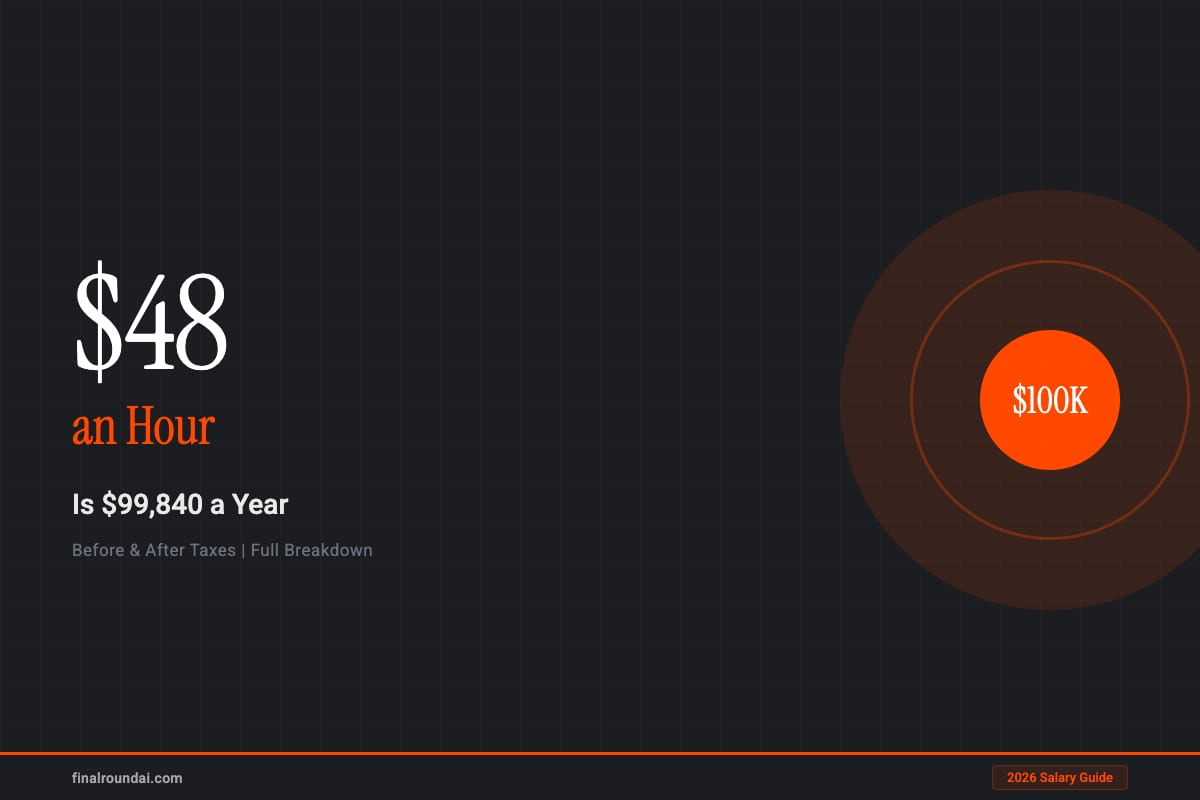
48 Dollars an Hour Is How Much a Year
At $48 an hour working full-time, you earn $99,840 per year before taxes. That's 40 hours per week across 52 weeks (2,080 total hours). After federal taxes and FICA, a single filer typically takes home around $78,623 net annually, or about $6,552 per month. FICA is the Federal Insurance Contributions Act tax (7.65%) that covers Social Security and Medicare, deducted from every paycheck regardless of filing status.
Quick Answer
- $48/hour = $99,840/year before taxes working full-time (40 hrs/week, 52 weeks, 2,080 hours).
- Single filers take home approximately $78,623/year ($6,552/month) after federal income tax and FICA in 2026.
- Common $48/hr roles: Registered Nurse, Software Engineer (mid), Financial Analyst, Civil Engineer.
$48 an Hour Is How Much Per Paycheck (Gross)?
$48 an hour equals $1,920.00 per week, $3,840.00 biweekly, $4,160.00 semi-monthly, or $8,320.00 monthly before taxes.
$48 an Hour Pay Frequency Breakdown
Weekly: $48 × 40 hours = $1,920.00
Biweekly: $1,920.00 × 2 = $3,840.00
Semi-monthly: $99,840.00 ÷ 24 = $4,160.00
Monthly: $99,840.00 ÷ 12 = $8,320.00
Biweekly pay comes 26 times per year; semi-monthly comes 24 times. The biweekly difference means two extra paychecks annually, useful for budgeting large annual expenses.
$48 an Hour After Taxes (Federal-Only Example)
After federal taxes, $48 an hour leaves you with approximately $78,623 per year as a single filer, or $84,298 married filing jointly.
Federal Tax Calculation for $48/Hour, Single Filer
Gross annual: $99,840.00 | Standard deduction: −$15,000.00 | Taxable income: $84,840.00
- 10% on the first $11,925.00 = $1,192.50
- 12% on $11,925.00 to $48,475.00 = $4,386.00
- 22% on $48,475.00 to $84,840.00 = $8,000.30
- Total federal income tax = $13,578.80
FICA (7.65%): $7,637.76
Net Annual: $78,623.44 | Net Monthly: $6,551.95
Federal Tax Calculation for $48/Hour, Married Filing Jointly
Gross annual: $99,840.00 | Standard deduction: −$30,000.00 | Taxable income: $69,840.00
- 10% on the first $23,850.00 = $2,385.00
- 12% on $23,850.00 to $69,840.00 = $5,518.80
- Total federal income tax = $7,903.80
FICA (7.65%): $7,637.76
Net Annual: $84,298.44 | Net Monthly: $7,024.87
Note: These figures exclude state income taxes. Texas, Florida, and Nevada have no state income tax; California can add 9%+ at this income level.
Hours Worked vs Annual Pay at $48/Hour
Your annual income at $48/hour scales directly with weekly hours. Full-time (40 hrs) earns $99,840; each hour reduction costs $2,496/year.
40 hours/week: $1,920.00/week → $99,840.00/year
35 hours/week: $1,680.00/week → $87,360.00/year
30 hours/week: $1,440.00/week → $74,880.00/year
25 hours/week: $1,200.00/week → $62,400.00/year
20 hours/week: $960.00/week → $49,920.00/year
Part-time workers at $48/hour earn competitive income but may not qualify for employer benefits typically requiring 30+ hours/week.
Full-Time Annual Income Adjusted for Unpaid Time Off
Hourly workers lose income during unpaid leave. Each week off at $48/hour costs $1,920 in lost wages.
52 weeks (no time off): $99,840.00/year
50 weeks (2 weeks off): $96,000.00/year
48 weeks (4 weeks off): $92,160.00/year
46 weeks (6 weeks off): $88,320.00/year
Part-Time Income at $48/Hour
At $48/hour part time: $74,880/year at 30 hrs/week, $62,400 at 25 hrs, $49,920 at 20 hrs. Even 20 hours/week exceeds the federal poverty line for most household sizes.
30 hours/week: $1,440.00/week → $6,235.20/month → $74,880.00/year
25 hours/week: $1,200.00/week → $5,196.00/month → $62,400.00/year
20 hours/week: $960.00/week → $4,156.80/month → $49,920.00/year
After-Tax Take-Home: W-2 vs 1099 at $48/Hour
W-2 employees at $48/hour keep roughly 75–82% of gross pay. As a 1099 independent contractor, you pay the full 15.3% self-employment tax (vs 7.65% for W-2), adding $7,638 annually in tax obligation.
Contractors at $48/hour typically need to charge $53–$55/hour to match W-2 net pay after self-employment taxes and the cost of self-funded benefits. Use an AI salary calculator to model contractor vs employee pay scenarios.
Common Mistakes When Calculating $48 an Hour
Mistake 1: Ignoring Taxes
Gross $99,840 vs net $78,623 is a $21,217 difference, 21% of income. Always budget from net, not gross.
Mistake 2: Assuming Full-Time Hours Are Guaranteed
Each unpaid week costs $1,920. Two weeks unpaid reduces annual income by $3,840 to $96,000. Plan for realistic work weeks.
Mistake 3: Confusing W-2 and 1099 Take-Home
1099 contractors pay $7,638 more in FICA annually at $48/hour. Missing quarterly tax payments triggers IRS penalties.
Mistake 4: Ignoring Geographic Cost-of-Living
$99,840/year stretches far in Raleigh or Austin but tight in San Francisco or NYC. A $48/hour offer in a high-cost city may deliver less purchasing power than $43/hour in a lower-cost market.
Mistake 5: Forgetting Benefits Value
Health insurance, 401(k) match, and PTO can add $10,000–$20,000 in total compensation. Calculate full package value, not just the hourly rate.
How $48 an Hour Compares to Other Wages
$48/hour ($99,840/year) is well above the U.S. median household income of approximately $78,000. Each additional $1/hour adds $2,080 annually.
$44/hour → $91,520.00/year
$46/hour → $95,680.00/year
$48/hour → $99,840.00/year ← (you are here)
$50/hour → $104,000.00/year
$52/hour → $108,160.00/year
Careers That Commonly Pay $48 an Hour
Seven career categories where $48/hour is a realistic wage in 2026:
Healthcare & Medical
- Registered Nurse (RN)
- Nurse Practitioner (entry)
- Dental Hygienist
- MRI Technologist
- Occupational Therapist
Engineering
- Civil Engineer
- Electrical Engineer
- Systems Engineer
- Mechanical Engineer
Technology & IT
- Software Engineer (mid-level)
- Data Analyst
- Cloud Architect (junior)
- Cybersecurity Engineer
- DevOps Engineer
Finance & Business
- Financial Analyst (mid)
- CPA
- Management Consultant
- Corporate Accountant
Skilled Trades
- Master Electrician
- Elevator Mechanic
- Instrumentation Technician
- Industrial Maintenance Engineer
How to Negotiate $48 an Hour (and Higher)
Most employers have a 5–10% buffer in initial offers at this pay level. A $3/hour improvement from $48 to $51 adds $6,240 annually, worth a brief conversation.
Mistake 1: Accepting Without Researching Market Rate
Research comparable roles in your area before accepting. Tech hubs and high-demand specialties often pay $53–$58/hour for the same role as lower-cost markets. Data wins negotiations.
Mistake 2: Negotiating at the Wrong Time
Negotiate after a job offer, before acceptance. Asking too early reduces leverage; asking months into a role without documented wins reduces it further.
Mistake 3: Only Negotiating Rate, Not Total Package
Benefits, signing bonuses, remote flexibility, and development budgets all have dollar value. Prepare your compensation conversation with real-time interview coaching from AI interview preparation.
Mistake 4: Not Quantifying Your Impact
Connect your ask to measurable outcomes: "I saved the team $50,000 last quarter" is stronger than "I deserve more." Practice this framing with an AI mock interview before the real discussion.
Mistake 5: Skipping Community Prep
Salary negotiation is a practiced skill. Join the Final Round AI community to connect with professionals who have navigated the same conversations and share real-world negotiation outcomes.
Related Salary Guides
- 50 Dollars an Hour Is How Much a Year?, See how $50/hr annual income, tax burden, and take-home pay compare to $48/hr.
- 40 Dollars an Hour Is How Much a Year?, Full breakdown of $40/hr: weekly, monthly, after federal taxes, and common careers at this rate.
- $60k a Year Is How Much an Hour?, Convert a $60,000 annual salary to its hourly equivalent with a complete 2026 tax breakdown.
- Career Objective Examples for Freshers, Use these resume objective templates when applying for roles at the $48/hour salary tier.
Browse more salary advice guides to compare wages, plan your compensation strategy, and understand your full take-home pay.
Conclusion
Earning $48 per hour puts you at $99,840 per year, well above the U.S. median household income. Single filers keep $78,623 annually ($6,552/month) after federal income tax and FICA; married filers keep $84,298 ($7,025/month). Overtime at $72.00/hour adds $18,720 before taxes for 5 extra hours per week, a meaningful income accelerator.
Try Final Round AI Free, 100% invisible real-time interview assistance trusted by 10M+ users.
Frequently Asked Questions
How much is $48 an hour annually?
$48 an hour equals $99,840 per year working full-time (40 hours/week, 52 weeks, 2,080 hours total).
What is $48 an hour after taxes?
A single filer earning $48/hour takes home approximately $78,623 per year ($6,552/month) after federal income tax and FICA. Married filing jointly nets about $84,298/year.
Is $48 an hour a good wage?
$48 an hour equals $99,840 per year, which is well above the U.S. median household income of approximately $78,000. It supports comfortable living in most U.S. cities.
How much is $48 an hour per month?
$48 an hour produces $8,320 gross per month. After federal taxes, a single filer nets approximately $6,552/month.
How much is $48 an hour biweekly?
$48 per hour biweekly (80 hours) equals $3,840.00 gross before taxes.
How much is $48 an hour weekly?
Working 40 hours at $48/hour produces $1,920.00 per week before taxes.
Can you live comfortably on $48 an hour?
$99,840/year supports comfortable living in most mid-sized U.S. cities. In high-cost markets like San Francisco or NYC, budgeting becomes tighter but remains manageable.
What is $48 an hour for part-time work?
At 25 hours/week, $48/hour yields $62,400/year. At 20 hours/week, the annual figure is $49,920.
How much federal tax do you pay on $48 an hour?
A single filer earning $99,840 pays approximately $13,579 in federal income tax plus $7,638 in FICA, totaling $21,217 in federal obligations.
Is $48 an hour middle class?
$48/hour ($99,840/year) is well above the U.S. median household income, qualifying as middle class or upper-middle class in most U.S. regions.
What jobs pay $48 an hour?
Common roles at $48/hour include registered nurses, software developers, dental hygienists, and financial analysts, depending on location.
What is $48 an hour as a 1099 contractor?
As a 1099 contractor, you pay 15.3% self-employment tax vs 7.65% for W-2 employees. On $99,840 gross, this extra $7,638 in tax means contractors should charge $53–$55/hour to match W-2 net pay.
Table of Contents
Related articles

70,000 Dollars a Year Is How Much an Hour
$70,000 a year is $33.65 an hour before taxes. See the full 2026 breakdown: weekly, monthly, after-tax take-home for single, MFJ, and HOH filers, plus careers and negotiation tips.
Living Wage Canada: Rates by Province and City
Canada living wage varies by province and city. GTA: $27.20/hr. Metro Vancouver: $25.68/hr. Calgary: $22.40/hr. All higher than the federal minimum wage of $18.15/hr.
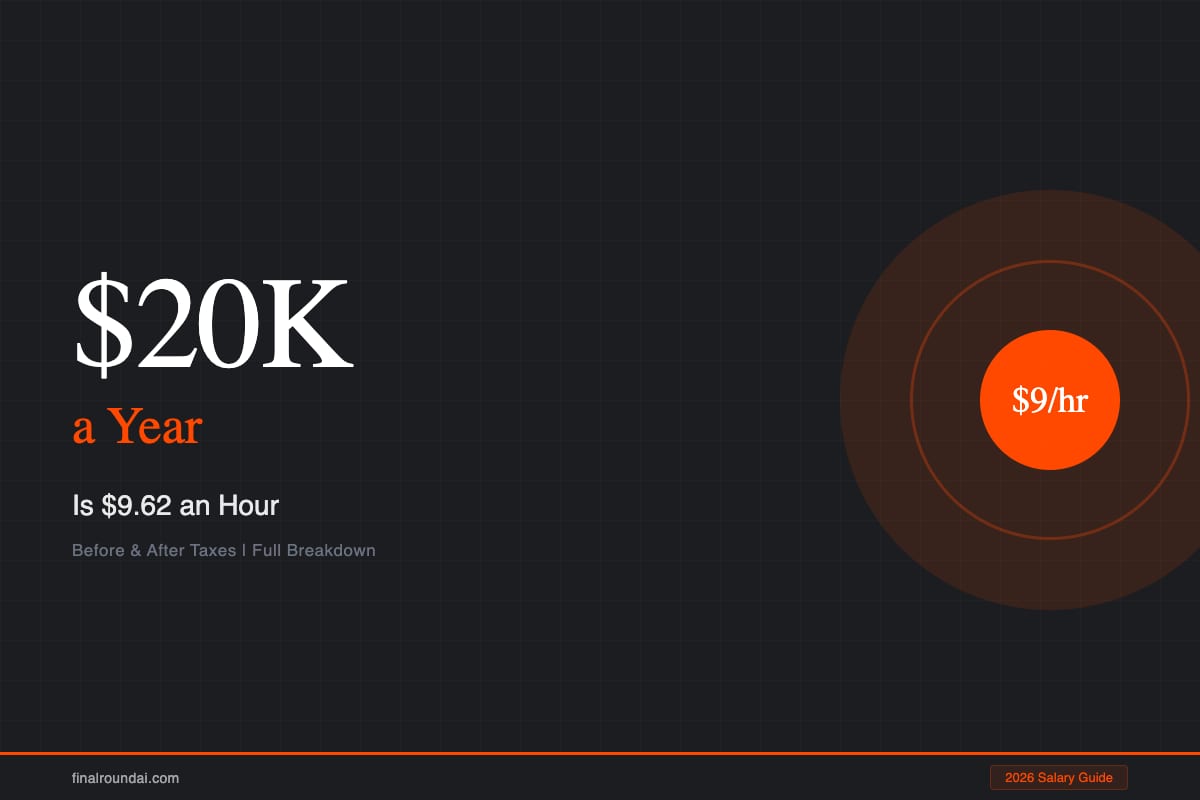
20,000 Dollars a Year Is How Much an Hour
20k a year is $9.62/hour (before taxes). See the full 2026 breakdown: weekly, monthly, after taxes by filing status, and jobs that pay $20k.

45 Dollars an Hour Is How Much a Year
$45 an hour is $93,600 a year before taxes (40 hrs/week, 52 weeks). See the full 2026 breakdown: weekly, monthly, after-tax take-home, and jobs that pay $45/hour.
Minimum Wage in Quebec: Current Rate and Rules
Quebec's minimum wage is $16.60 per hour effective May 1, 2026, set by CNESST. Learn who it covers, annual equivalent, recent history, and how to earn above the floor in Quebec.
London Living Wage: Current Rate and Accreditation
The London Living Wage is GBP14.80/hr, effective 1 May 2026. Learn how it differs from the statutory GBP12.71 National Living Wage, which employers are accredited including KPMG, Barclays, and Google UK.