Tesla Interview Process and Questions: Complete 2026 Guide



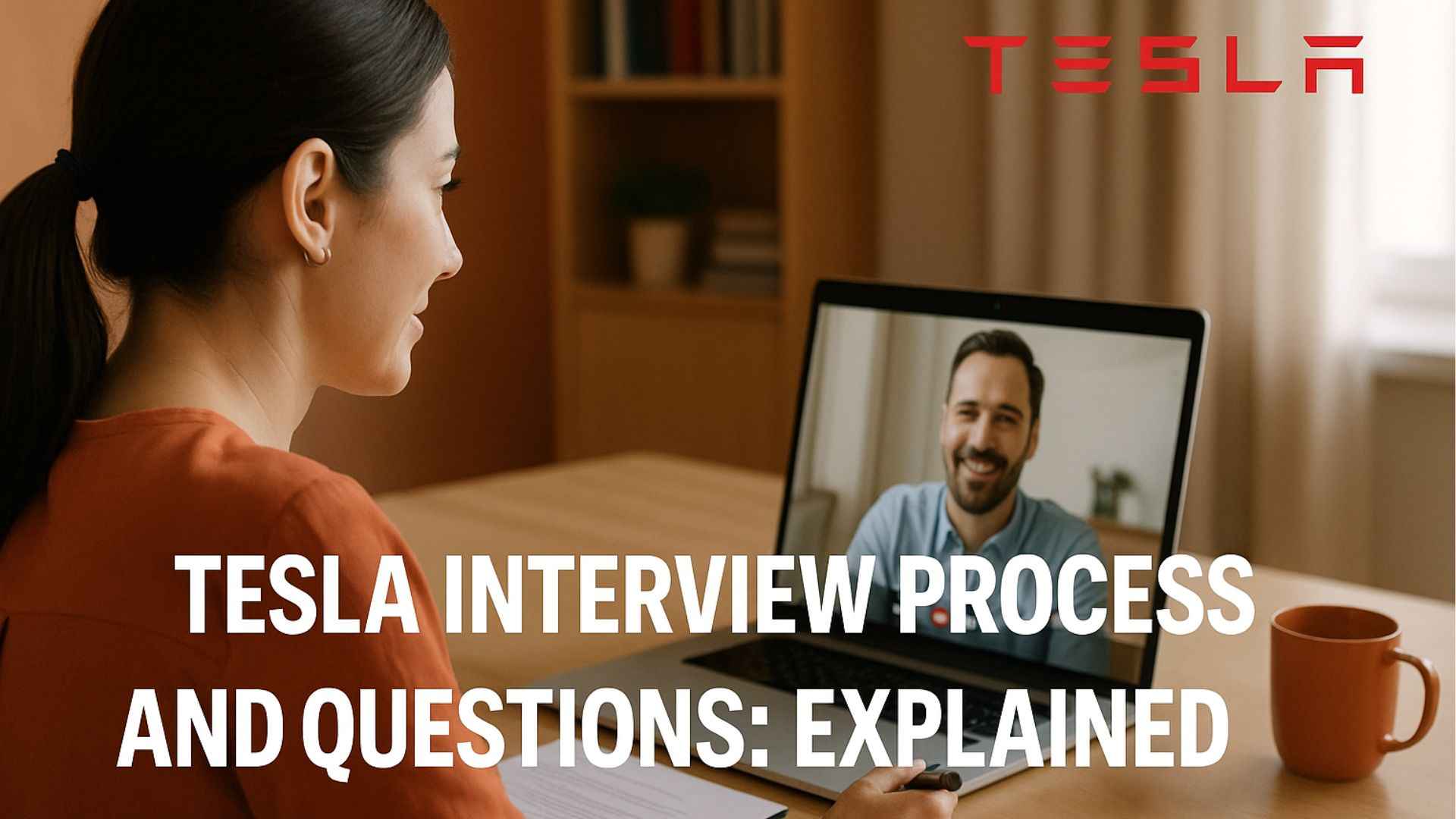
Tesla's interview process consists of 5-6 stages over 4-8 weeks: an AI-assisted or recruiter screen, a technical phone interview, a coding assessment, and 2-3 panel rounds covering system design, coding, and behavioral questions. In 2025, Tesla introduced AI-conducted first-round screens for many roles, the "Tesla AI interview" candidates report is an automated voice or video screening that scores your answers before any human reviews your application. Software engineering candidates typically face 4-5 LeetCode-style problems in technical rounds. Most candidates receive a final decision within two weeks of their last panel.
Quick Answer
- Tesla's process spans 5-6 rounds over 4-8 weeks: AI/recruiter screen, technical phone interview, coding assessment, and 2-3 panel interviews.
- Tesla rates 3.9/5 difficulty on Glassdoor, harder than 90% of tech companies, comparable to Google and Meta.
- The AI-conducted first-round screen evaluates verbal communication and problem decomposition before any human interviewer sees your application.
What Is Tesla's AI Interview and How Does It Work?
Tesla's AI interview is an automated first-round screening tool introduced in 2025 that uses natural language processing to evaluate candidates' spoken responses to structured questions. A Tesla AI voice interview is an asynchronous video or phone-based screening where a machine records and scores your answers based on communication clarity, problem-structure, and content relevance. Candidates for software engineering, operations, and manufacturing roles may encounter this before any human contact.
The AI screen typically asks 3-5 questions: one motivation question ("Why Tesla?"), one behavioral question using the STAR format, and one or two role-specific technical questions. Most candidates complete it in under 20 minutes. The most common failure pattern is giving answers that are too short, the AI scores partially on response completeness, so aim for 90-120 seconds per answer. To prepare, practice your STAR-format answers out loud rather than just reading them. Use Interview Copilot to simulate an AI-scored mock session so you're comfortable with the format before it counts.
The Tesla hiring process runs 5 to 6 stages: recruiter phone screen, technical phone interview, a Codility coding assessment, 3 to 4 onsite interview rounds covering coding and system design, and an offer review. The full process takes 4 to 8 weeks from application to offer.
Tesla Interview Process: All 5-6 Stages Explained
The Tesla interview process runs 5-6 rounds over 4-8 weeks. Each stage has a different elimination rate, knowing which rounds cut the most candidates helps you allocate preparation time correctly. According to Glassdoor data, Tesla interview difficulty is rated 3.9 out of 5, placing it in the top 15% of most difficult tech company interview processes.
Stage 1: AI-Assisted or Recruiter Phone Screen
Depending on your role and application source, your first contact is either an automated AI screen or a 30-minute recruiter call. Recruiter calls assess background, motivation, and compensation expectations. The key question: "Why Tesla specifically?", give a specific answer about their engineering challenges, not generic mission-alignment language. If you received an AI screen link, complete it within 24-48 hours before the link expires.
Stage 2: Technical Phone Interview
A hiring manager or senior engineer conducts a 45-60 minute technical screen. For software roles, expect one or two LeetCode-style coding problems at medium difficulty plus resume project questions. Tesla engineers routinely ask "how would you change the architecture if you had to scale this 100x?" Come ready to walk through your most technically complex project at a component level.
Stage 3: Take-Home or Online Assessment
Many engineering candidates receive a CodeSignal or custom take-home assessment. Software engineering assessments run 60-120 minutes covering data structures, algorithms, and sometimes a system design sketch. Turnaround is typically 3-5 days. Tesla does drop candidates here for incomplete or poorly-explained solutions, treat this as seriously as an onsite.
Stage 4-6: Panel Interviews (Virtual or Onsite)
The final stage involves 2-3 rounds with separate interviewers, each 45-60 minutes. Rounds cover: (1) coding focused on algorithmic problem-solving, (2) system design for mid-senior roles, and (3) behavioral and culture-fit assessment. Tesla received over 3 million applications globally in 2025, so the final panel reflects a highly filtered candidate pool. LinkedIn data shows Tesla postings averaging 400+ applicants per role in 2025-2026.
Tesla Interview Questions: What to Expect by Category
Tesla interview questions fall into four categories: coding problems (Codility assessment + live rounds), system design (hardware-software co-design for production systems), behavioral questions aligned to ownership and speed, and technical domain questions specific to your role (for ML engineers, AI architecture; for hardware, embedded systems).
Tesla interview questions test three dimensions: technical coding ability, system design reasoning, and behavioral alignment with Tesla's mission-driven culture. The most commonly reported question types are medium-to-hard LeetCode problems, system design scenarios involving EV fleet data pipelines, and STAR-format behavioral questions about working under pressure. Practicing out loud using AI mock interview tools is one of the most effective preparation methods for this interview style.
Technical Coding Questions
Expect algorithmic challenges covering: arrays and strings (manipulation, searching, optimization), hash maps and sets (efficient lookup and frequency counting), graphs and trees (traversal, shortest paths, connectivity), and dynamic programming (optimization and recursive problem-solving). Questions are typically medium-to-hard difficulty. You'll need to write clean, efficient code and explain your approach clearly, Tesla interviewers score your communication as much as your solution correctness.
System Design: Sample Question and Approach
For mid-level and senior roles, system design is a major focus. A commonly-reported 2025-2026 Tesla system design prompt: "Design a system to collect and process telemetry data from Tesla's fleet of vehicles in real-time." Start by clarifying requirements: scale (how many vehicles?), data collection frequency, data types, and whether the system optimizes for low latency or high throughput. Then outline your architecture, a distributed message queue like Kafka for incoming data streams, Apache Flink or Spark for real-time analytics, and a storage solution combining a time-series database for recent data with a data warehouse for long-term storage. Discuss failure handling, scaling strategy, and data security. If you want peer feedback on your system design approaches, the Final Round AI community is a place to share your thinking with engineers who've been through similar rounds.
Behavioral Questions: First-Principles Focus
First-principles thinking is reasoning from fundamental truths rather than from analogy or convention. Tesla behavioral rounds specifically test this, interviewers don't want answers about "best practices," they want answers that show how you derived a solution from the actual constraints of a specific problem. Use the STAR method (Situation, Task, Action, Result) to structure all behavioral answers, and quantify results wherever possible.
Common Tesla behavioral questions reported in 2025-2026: "Describe a time you faced a tight deadline and how you handled it." "Tell me about a project where you had to learn a new technology quickly." "How do you organize and sequence tasks in a fast-paced environment?" "Tell me about a decision you made from first principles rather than precedent." Prepare 5-8 real stories that can flex across these prompts.
How to Prepare for Tesla's Interview in 2026
Candidates who pass Tesla's technical rounds consistently report two preparation habits: daily algorithmic practice for at least 8 weeks, and deliberate system design study using distributed systems principles. A realistic preparation timeline: 3-6 months out, practice coding problems daily at medium-to-hard difficulty. 2-3 months out, ramp to 2-3 problems per day and begin system design study. 1 month out, run mock interviews and build STAR stories from your real experience. 1 week out, stop learning new material and reinforce patterns you know. To build a resume that passes Tesla's ATS and gets human attention, Final Round AI's AI Resume Builder helps tailor your experience to Tesla's specific job description language.
Tesla Compensation by Level and Role in 2026
Tesla does not publish formal level bands publicly, but candidate-reported data from 2025 and 2026 shows consistent ranges by level. Entry-level L1 and L2 roles fall in the $150,000 to $240,000 total compensation range. Mid-level L3 and L4 roles land between $240,000 and $390,000. Senior L5 and above roles typically start at $350,000 and reach $610,000 or higher for principal and staff-level positions. These figures include base salary, annual bonus, and equity.
Tesla's technical assessment platform is Codility, not HackerRank or LeetCode OJ directly. The Codility assessment for engineering roles is a timed coding test with 2 to 3 problems at medium to hard difficulty, typically covering algorithms, data structures, and system reasoning. Knowing which platform you will use matters: Codility has a specific IDE and test runner interface that benefits from familiarity before the actual assessment.
Tesla Product Context for 2026 Interviews
Tesla interviewers increasingly tie technical and behavioral questions to current product initiatives. Being fluent in Tesla's active technical directions signals genuine interest and helps you frame system design answers in relevant contexts. Key product areas in 2026 include the Cybertruck production ramp and its structural battery pack engineering challenges, the Optimus humanoid robot program and its real-time control requirements, the 4680 battery cell manufacturing scale-up at Gigafactories, and Vision-only Full Self-Driving where Tesla has removed radar and ultrasonic sensors entirely in favor of camera-based neural network perception. System design candidates who can reference these constraints specifically in design prompts stand out from those giving generic distributed systems answers.
The Evidence of Excellence Submission
For senior engineering and technical leadership roles at Tesla, some candidates are asked to submit a written Evidence of Excellence document before or during the interview process. This is a structured summary of a technical project you are most proud of, covering the problem context, your specific technical contributions, the scale or impact of the outcome, and what you would do differently with hindsight. OphyAI and other competitor guides cover this in depth; FRAI candidates should prepare a concise 1 to 2 page written version before interviews for senior roles. The document is not a formality. Tesla uses it as a substantive evaluation of technical depth and communication clarity.
Frequently Asked Questions About the Tesla Interview Process
How many rounds does the Tesla interview process have?
Tesla's interview process has 5-6 rounds over 4-8 weeks: an AI-assisted or recruiter phone screen, a technical phone interview, a coding or take-home assessment, and 2-3 panel interview rounds covering coding, system design, and behavioral questions.
What is the Tesla AI interview in 2026?
Tesla's AI interview is an automated screening tool introduced in 2025 that records and analyzes candidates' spoken responses. It evaluates communication clarity, answer structure, and content relevance. Candidates who speak in complete, well-organized sentences and give specific examples score higher.
How hard is it to get a job at Tesla in 2026?
Tesla's interview process is rated 3.9/5 difficulty on Glassdoor, placing it in the top 15% most difficult tech interview processes. With 3+ million annual applications globally, the bar is comparable to Google or Meta. Candidates who prepare thoroughly across algorithms, system design, and behavioral questions have the best success rates.
Does Tesla use LeetCode-style questions?
Yes. Tesla's technical coding interviews feature medium-to-hard LeetCode-style algorithmic problems focusing on arrays, strings, graphs, trees, dynamic programming, and hash maps.
What is Tesla interview attire?
Tesla interviews are business casual at most levels. In practice, most candidates wear clean, non-branded casual clothes: jeans and a collared shirt or blouse are standard. Avoid formal business attire as it can read as out of place in Tesla's culture. For virtual interviews, background and lighting matter more than clothing formality.
Does Tesla offer referrals and do they help?
Tesla accepts referrals through its internal employee portal. A referral increases the visibility of your application in initial screening but does not guarantee advancement. All referred candidates still complete every stage of the technical and behavioral process. The quality of your Codility assessment and interview performance is the primary driver of outcomes.
Does Tesla provide visa sponsorship?
Tesla sponsors H-1B visas for eligible engineering roles. H-1B processing and transfer timelines are similar to other large US employers. Some Tesla roles at specific facilities have additional background check or clearance requirements due to government contracts in Starlink adjacent or defense-adjacent programs. Confirm sponsorship eligibility and any clearance requirements with your recruiter early.
How relevant is LeetCode for Tesla interviews?
LeetCode-style algorithm problems are relevant but not the dominant format. Tesla's Codility assessment tests medium to hard algorithmic problems. The technical interview rounds include coding but also system design and deep technical discussions about past projects. Candidates who over-index on competitive programming and underinvest in system design and product context typically struggle in the final rounds.
What does Tesla look for in candidates?
Tesla prioritizes strong technical skills, first-principles thinking, adaptability in fast-paced environments, and genuine passion for sustainable energy innovation. Cultural fit matters as much as technical ability, candidates who thrive in demanding, ambiguous, mission-driven environments consistently stand out.
Candidates who use AI that helps with interviews to practice before the real interview typically feel more prepared and confident going in.
Related Interview Guides
- Nvidia Interview Process, Compare Tesla's process with Nvidia's rigorous hiring approach, both demand deep technical preparation and mission alignment.
- Hardware and Networking Interview Questions, Prepare for Tesla's hardware and IT infrastructure interview rounds with 25 essential Q&As.
- Data Center Technician Interview Questions, Essential prep for candidates targeting Tesla's data infrastructure and energy systems roles.
- Adaptability to Change Interview Questions, Tesla's behavioral rounds heavily test adaptability; these sample answers will sharpen your preparation.
Find more company-specific interview guides in our company interview guides collection.
Table of Contents
Related articles
Best Practices for Virtual Interviews: Make a Great Impression
Ace your virtual interviews with the best practices! Learn expert tips to enhance your presentation and win over potential employers!
Interview Sidekick vs Parakeet AI: 2026 Breakdown
Interview Sidekick vs Parakeet AI: pricing breakdown, detection risks, and which AI interview tool makes sense in 2026 given the 16x price increase that most reviews haven't caught yet.
Preparing for First Job Interviews: Tips for Success
Get ready for your first job interview with practical tips that will boost your confidence and help you shine.
7 Best Parakeet AI Alternatives in 2026 (Ranked)
7 best Parakeet AI alternatives in 2026 ranked for monthly plans, behavioral support, and practice mode. Interview Copilot, LockedIn AI, Verve AI, and more
US Visa Interview Questions and Answers 2026: B1/B2 Complete Guide
Preparing for a US B1 or B2 visa interview? Get 20+ common US visa interview questions with expert answers, dos and don'ts, and AI practice tips for 2026.
Pymetrics Assessment Guide: Goldman Sachs, Accenture and More
Pymetrics assessment guide for Goldman Sachs, JPMorgan, Accenture, and Unilever: 12 games explained, no-score system, 330-day result sharing, and what preparation actually helps.