NatWest Redundancies: Headcount Falls 1,000 as Profit Rises




The NatWest redundancies disclosed this week are a net figure: the group's headcount fell by around 1,000 full-time equivalent (FTE) roles in the three months to 30 September 2026, according to the bank's Q3 2026 Interim Management Statement published on 30 October 2026. The same statement says ongoing transformation has removed a net 1,400 FTE so far this year, a figure hidden inside a headline headcount that is actually up 800 because the Evelyn Partners deal added around 2,200 people. PA Media's Anna Wise reported the cuts the same morning under the headline "NatWest efficiency drive results in job cuts and £420 million of cost savings." They landed eight days after Barclays announced about 5,000 job cuts, with HSBC and ING also signalling reductions alongside their own third-quarter numbers in between.
Quick Answer
- NatWest's headcount fell by around 1,000 FTE in Q3 2026, leaving the group at about 59,500 FTE on 30 September 2026, per its results statement of 30 October 2026.
- Strip out Evelyn Partners and NatWest's own workforce shrank by a net 1,400 FTE in nine months, with about 1,000 of that in Q3 against roughly 400 implied for the whole first half.
- NatWest's statement never uses the word "redundancies" and never links the headcount fall to AI, even though the same document promotes an AI fraud-triage agent that handled 52,000 credit card conversations.
What did NatWest disclose in its Q3 2026 results?
NatWest disclosed a net headcount fall, not a redundancy program. The key sentence sits in the cost section of the NatWest Group Q3 2026 results: "Headcount decreased by around 1,000 full-time equivalent (FTE) in the quarter and increased by around 800 FTE for the year to date, which included around 2,200 FTE related to Evelyn Partners. Ongoing transformation has driven the remaining net reduction of 1,400 FTE."
That's the whole disclosure. There's no list of sites, no job titles and no separation dates.
The segment tables in the same document put group headcount at 59,500 FTE on 30 September 2026, down from 60,500 FTE on 30 June 2026. A year earlier, on 30 September 2025, the figure was 59,100 FTE. So NatWest employs slightly more people than it did twelve months ago, entirely because it bought a wealth manager, while the bank it already owned has been shrinking.

The financial backdrop matters because it changes how you read the cut. Operating profit before tax was £2,225 million in Q3 2026, up 1.9% on £2,183 million in Q3 2025, although it was 2.6% lower than the £2,285 million NatWest made in Q2 2026. For the first nine months of 2026, operating profit before tax reached £6,543 million, 13.4% higher than a year earlier. The cost:income ratio (excluding litigation and conduct) came in at 45.7% for the year to date, 2.1 percentage points lower than last year, which the bank says was "supported by gross cost savings of around £420 million."
NatWest frames all of this as progress "towards becoming a simpler, more agile and technology driven bank." Chief Executive Paul Thwaite's quoted comment in the statement opens with "NatWest Group has delivered another strong performance in the third quarter of 2026" and does not mention staff numbers at all.
Who was actually cut, and where did the headcount fall?
NatWest didn't say which roles went, so the only evidence is the segment headcount table, and it points to the center of the group rather than the customer-facing businesses. Between 30 June and 30 September 2026, Central items & other fell from 31,300 to 29,900 FTE, a drop of 1,400. Commercial & Institutional slipped from 12,700 to 12,400 FTE. Private Banking & Wealth Management held at 4,400 FTE, and Retail Banking rose from 12,100 to 12,800 FTE.
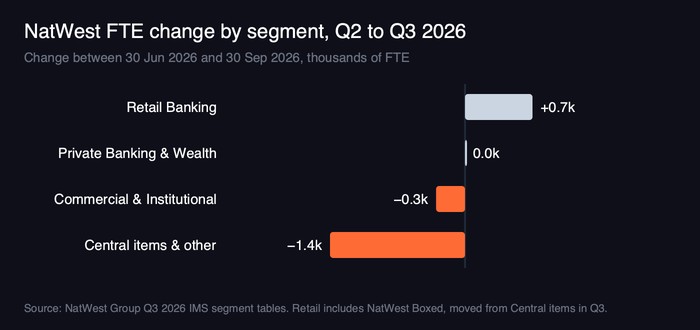
Read that table carefully before drawing conclusions. The Retail Banking increase is partly an internal move, because the statement notes that NatWest Boxed was transferred into Retail from Central items & other. Some of the 1,400 drop in Central items is therefore likely to be people changing segments, not people leaving. What survives the adjustment is the net figure: the group as a whole ended the quarter about 1,000 FTE lighter, and Central items & other still holds roughly half of all NatWest staff, so that's where any large reduction would have to show up.
A net FTE number also hides several different things. It nets departures against new hires, and it counts part-time staff as fractions. It also mixes voluntary exits, unfilled vacancies and compulsory redundancies into one line. NatWest's statement doesn't use the word "redundancies" anywhere, and it doesn't break the 1,000 down by mechanism.
You also won't find a filing that fills the gap. In the US, a cut of this size would usually surface in a state WARN notice listing addresses and job titles. The UK has no public equivalent. Under UK government redundancy consultation rules, an employer proposing 100 or more redundancies must consult for at least 45 days before the first dismissal and notify the Redundancy Payments Service on form HR1, but HR1 notices go to the Redundancy Payments Service rather than to any public database. If NatWest made any individual cuts at that scale, affected staff should have heard about them through consultation long before the 30 October statement.
How does this fit the pattern of NatWest redundancies?
The Q3 drop is the steepest step in a reduction NatWest has been running all year, and the bank told investors in July that it was deliberately moving early. Here's the 2026 sequence, with the earlier round that still dominates search results for "natwest redundancies":
- August 2020: NatWest Group announced 550 job cuts across its branch network, handled through voluntary redundancies, as reported by Scottish Financial News on 13 August 2020. That round still ranks near the top of results for this search six years later.
- First half of 2026: Headcount rose by around 1,800 FTE, of which around 2,200 FTE came from Evelyn Partners, with "the remaining net reduction driven by ongoing transformation activity." The arithmetic implies a net transformation reduction of about 400 FTE in the half.
- 30 June 2026: NatWest completed its acquisition of Evelyn Partners, which is why the headcount line jumped that quarter.
- 14 August 2026: GBC News reported that NatWest International was cutting 32 back-office jobs in Gibraltar, citing Unite the Union. The bank did not confirm a number.
- 20 October 2026: NatWest told staff it would end its "remote-first" working category and require all employees to work from the office two days a week from February 2027, as reported by City AM.
- 30 October 2026: The Q3 statement disclosed a fall of around 1,000 FTE in the quarter and a net transformation reduction of 1,400 FTE for the year to date.
The half-year figures come from NatWest's H1 2026 results published on 31 July 2026, which also explained why costs rose: higher operating expenses reflected "investment in staff and technology and severance spend, as we front load our transformation plans." Severance spend in the first half and a 1,000 FTE fall in the third quarter fit together. The bank paid to restructure early, and the headcount followed.

Picture a NatWest operations analyst who has worked remote-first from Edinburgh since 2021. In one fortnight of October 2026 she learns that she'll need to be in the office twice a week from February, and then reads that 1,000 FTE left the group in the last quarter. Nobody has told her that her role is at risk. But she starts updating her CV that weekend anyway, and she's probably right to.
The office attendance change belongs in the same story even though it isn't a job cut. Unite said the remote-first category covers up to 13,497 employees and that a further 17,272 hybrid workers would also have to come in more often, according to FStech's report of 21 October 2026. Unite General Secretary Sharon Graham called it "yet another kick in the teeth for workers who have suffered years of real-terms pay cuts." Stricter attendance rules tend to push some people to leave on their own, which would show up in future FTE numbers without ever being called a redundancy.
Are the NatWest job cuts because of AI?
NatWest doesn't say so, and the silence is the most interesting part of the statement. The headcount sentence credits "ongoing transformation" and nothing else. Neither "AI" nor "artificial intelligence" appears in the explanation of why staff numbers fell.
AI does appear elsewhere in the same document. NatWest says it launched an AI Spending Insights tool trial during the quarter and that its AI fraud-triage agent in Cora "has supported 52,000 credit card customer conversations, providing faster help and freeing colleagues for more complex needs." In Private Banking & Wealth Management, the bank says "AI use by colleagues rose 66% in the quarter." So the bank is happy to talk about AI as a productivity story while keeping it out of the headcount story.
The PA Media report went further than the bank did. It said investment in technology, including AI tools, has helped reduce costs, and it described the 1,400 figure as jobs lost this year. Both points need care. The £420 million is gross cost savings for the year to date, and NatWest attributes it to "structural simplification and sustained investment in our technology platforms," not to AI specifically. The 1,400 is a net FTE reduction, which is not the same as 1,400 people being made redundant.
Compare that with Barclays, which announced about 5,000 job cuts eight days earlier and put AI directly into its explanation, listing "organisational simplification and technology change efficiency driven by AI" in its results presentation. NatWest chose not to make that link. Some banks name AI because it reassures investors, and others avoid it because it inflames staff and unions. NatWest's Q3 statement is a clean example of the second habit: the AI tools are real, but the bank has not tied them to a single job.
The thing most people miss: a fraud-triage agent that handles 52,000 conversations is doing work that contact-center staff used to do. NatWest describes it as freeing colleagues, not replacing them. Whether those freed-up hours turn into fewer roles is exactly what the next two quarterly statements will show, and the phrase to watch for is any change from "transformation" to something more specific.
What do the 2026 UK bank job cut numbers actually show?
NatWest's cut is mid-sized for a UK bank in late 2026, and it's the least explicit about cause. The week of results produced four separate signals from large European lenders, each measured differently:
- Barclays, 22 October 2026: about 5,000 job cuts, roughly 5% of its workforce, with AI named in the explanation. Barclays said about 60% of the reductions fall in support functions and named developers among the roles affected.
- HSBC, 27 October 2026: HSBC's UK wealth job cuts are in a consultation period, the bank told AFP after a Financial Times report on planned reductions in that business.
- ING, 29 October 2026: 400 jobs worldwide in its corporate banking division, announced alongside its quarterly results, as reported by The Brussels Times.
- NatWest, 30 October 2026: a net fall of around 1,000 FTE in the quarter, with no cause given beyond transformation.
These figures aren't directly comparable. Barclays gave a gross number of planned cuts, ING gave a planned number tied to one division, HSBC confirmed only a consultation, and NatWest reported a net change after the fact. Ranking NatWest layoffs against Barclays by size would mislead you. What they share is timing and logic: each bank was reporting quarterly results, each was trimming costs, and Barclays, HSBC and NatWest all talked about AI somewhere in their results messaging.
If you want the full picture across sectors and not just UK banking, our 2026 tech and AI layoffs tracker logs every major round this year, including which companies gave AI as a reason and which only implied it. If you work in financial services technology, operations or support, these four announcements are one trend rather than four separate stories. It also separates announced cuts from net headcount changes like NatWest's. That distinction matters when you're judging your own risk, because an announced number names a target while a net number only tells you what already happened.
One more data point puts NatWest's number in context. A 1,000 FTE quarterly fall is about 1.7% of a 60,500 FTE workforce. That sounds small. But it comes on top of a first-half reduction and a severance budget the bank chose to front-load. It also lands ten days after an attendance change aimed at more than 30,000 staff. Taken together, those moves describe a bank that is resetting how many people it needs and where they sit. We track rounds like this as they land in our job market and layoff news coverage, so you can see which employers are cutting and which are still adding staff.
What should you do if you were affected by NatWest job cuts?
Start your search now, even if you haven't been told your role is at risk. If you work in a NatWest central function, operations, technology or support role, the numbers say your area is where the bank is shrinking. Waiting for a formal letter only shortens the time you have to search while you're still being paid. A quiet start also means you can be choosy, because nobody is rushing you into the first offer.
If you have received notice, the UK consultation period is your runway. For proposals of 100 or more redundancies, collective consultation runs for at least 45 days, and your contractual notice period comes on top of that. Use that time for interviews, not for waiting. Our guide on how to land a tech job after a layoff covers the first 30 days in order, from updating your CV to restarting your network.
Do these in the first week, before your system access changes:
- Save copies of your performance reviews, objectives and any recognition you received, because those are hard to recover later.
- Write down metrics while they're fresh: transaction volumes, cost savings, project timelines, team sizes and customer outcomes you owned.
- Ask two or three colleagues and one manager whether they'll act as references, and get personal email addresses.
- Check your redundancy pay, notice pay and any voluntary package terms in writing before you sign anything.
- Ask HR whether internal redeployment roles are open, because large banks often fill some of them from people at risk.
- Check what happens to any pension contributions and share plans, such as Sharesave, when you leave, and note any deadlines.
Expect the first conversation with any new employer to be a recruiter call, often booked within days of applying. That call is a screening interview, usually 20 to 30 minutes, and it checks your motivation, availability, salary range and the reason you're leaving. For anyone coming out of NatWest, that last question is the one to rehearse, because it will come up early and often. Treat the screen as a short audition for the rest of the process. Recruiters pass candidates who sound settled, specific and calm, and they quietly drop the ones who sound bitter or vague about why they're moving on.
Practice helps more than people expect here. Saying your exit story out loud a few times shows you how it actually sounds, which is rarely how it sounds in your head. Two or three timed rehearsals are usually enough to cut a rambling two-minute answer down to a confident 40 seconds.
Banks, insurers, building societies and fintechs all hire from the same talent pool, and many of them interview for the same skills: regulation, risk, operations and stakeholder management. Your NatWest experience transfers well. The task is to present it in their language, with numbers, and AI mock interview practice is a quick way to test that before a real recruiter hears it.
How do you explain a NatWest redundancy in your next interview?
Say it in one or two factual sentences and then move on to what you'd do in the new role. A good version is: "NatWest's headcount fell by around 1,000 full-time roles in the third quarter of 2026 as part of a group-wide transformation, and my role was one of them." That framing works because it's true, it's public and it puts the decision at the company level rather than on your performance. Keep the number and the quarter accurate, because interviewers can check both in a few seconds.
In a real interview, the follow-up question matters more than the opening answer. Interviewers rarely care why NatWest cut jobs. What they're actually checking for is whether you sound bitter, whether you're hiding a performance problem, and what you did with the time since. Our guide to explaining a layoff in interviews without sounding negative has word-for-word answers for each of those follow-ups.
Here's what doesn't work, and it's a common mistake. Candidates assume they need to defend the bank or criticize it, so they spend a full minute on strategy, AI and office policy. Don't. The interviewer doesn't need your analysis of NatWest's cost:income ratio. They need to know you're ready to work.
Prepare three short stories before your first interview: one about a problem you solved at NatWest with a number attached, one about working through change, and one about learning something new quickly. Those cover most behavioral questions you'll face, including "Why did you leave?" and "What have you been doing since?" Get each one under 90 seconds and practice until it sounds natural rather than memorized.
People who've been through the same thing say the same. In a thread where members of the Final Round AI community shared the phrasing that worked when interviewers asked why they left, one person who had been through two restructurings said to keep it under 45 seconds, keep it factual and then stop talking. Another pointed out that naming a layoff that was in the news reads as more confident than a vague mention of "business conditions."
The question that catches people out is "What have you been doing since?" If you're still employed during consultation, say so plainly, because interviewing while still in post is a strength. If there's already a gap, name one concrete thing you did with it: a course finished, a contract taken, a project shipped. A gap with a purpose reads as a decision. A gap with nothing in it reads as drift, even when it isn't. Prepare that answer as carefully as the exit story itself.
When the interviews are live, Final Round AI's Interview CoPilot™ gives you real-time answer suggestions during the call, shaped by the role, the job description and your own CV. It runs in the FinalRound desktop app, sits in a private window only you can see, and writes an automatic debrief after each session so the next round starts from what went wrong in the last one.
Author's Comment
"Someone searching 'natwest redundancies' this week is rarely looking for the bank's cost:income ratio. They want to know whether their own team is next, and a net figure like 1,000 FTE can't answer that. It does tell you the direction, though. My advice is to treat the uncertainty as your head start: update the CV, rehearse the exit story and book the first recruiter call while you still have a salary and a badge."
Jaya Muvania, SEO Specialist, Final Round AI
Related Interview Guides
- How to Pass the Barclays Interview Process
- Nationwide Redundancies: 275 Jobs Go After Virgin Money Deal
- 59% of Companies Blame AI for Layoffs and Hiring Freezes
- American Express Layoffs: 3,500 Jobs Cut as Profit Jumps 28%
Prepare for the interview that comes next
A redundancy notice starts a clock, and the interviews that follow decide what happens next. Final Round AI helps you prepare for a specific job with a Goal built around the role and company, practice against an AI interviewer, get live guidance during the real interview, and review an automatic debrief afterwards. Download the app and set up your first Goal before your first recruiter call.
Frequently Asked Questions
How many employees did NatWest lay off in 2026?
NatWest has not published a redundancy count. Its Q3 2026 statement of 30 October 2026 reports a net headcount fall of around 1,000 FTE in the third quarter and a net reduction of 1,400 FTE from ongoing transformation over the first nine months. Total headcount still rose by about 800 FTE because Evelyn Partners added around 2,200.
Why is NatWest cutting jobs?
The bank attributes the reduction to "ongoing transformation" and says it is becoming "a simpler, more agile and technology driven bank." Gross cost savings of around £420 million helped lower its cost:income ratio to 45.7% for 2026 so far, even as operating profit before tax rose 1.9% year on year in Q3 to £2,225 million.
Are the NatWest job cuts because of AI?
NatWest has not said that. Its headcount explanation mentions only transformation. The same results document does describe AI tools, including a fraud-triage agent that supported 52,000 credit card conversations, but it presents them as freeing staff for complex work rather than replacing them. That contrasts with Barclays, which named AI when announcing about 5,000 cuts.
Which NatWest roles were cut?
No role list has been published. Segment data shows the largest Q3 fall in Central items & other, down 1,400 FTE to 29,900, with Commercial & Institutional down 300. Part of that central drop reflects NatWest Boxed moving into Retail Banking, which grew by 700 FTE.
Is NatWest still hiring after the job cuts?
Headcount is still higher than at the start of 2026, but only because of the Evelyn Partners acquisition, completed on 30 June 2026. The Q3 statement gives no hiring figure and doesn't say which teams are recruiting, so NatWest's own careers site is the most reliable guide to open roles right now.
Table of Contents
Related articles

Mercedes Stellenabbau: Abfindungen ab Dezember 2026
Mercedes Stellenabbau: Der Konzern legt das Abfindungsprogramm ab Dezember 2026 neu auf. Wer betroffen ist, welche Rechte gelten und was jetzt zu tun ist.
Sam Altman says World wants 1000x more software, So Programmer Salaries are Skyrocketing
OpenAI CEO Sam Altman tells Federal Reserve conference that programmer salaries are rising as world demands 1000x more software despite AI growth.


Barclays Layoffs: 5,000 Jobs Cut as AI Reshapes the Bank
Barclays layoffs: about 5,000 full-time roles go in 2026, 1,000 already cut. Who is affected, the AI angle, and how to explain it in your next interview.

