59% of Companies Blame AI for Layoffs and Hiring Freezes




Hiring is slowing down, people are getting laid off, and it’s all because of AI. But maybe AI is just a scapegoat.
59% Companies Blame AI because it plays better
Across boardrooms and business press releases in the last couple of years, a familiar explanation has popped up when companies talk about layoffs: AI.
But they use AI as a buzzword because it is the clearest explanation to sell.
In a survey of 1,000 U.S. hiring managers by Resume.org, 59% said they “emphasize” AI when explaining hiring freezes or layoffs because it plays better with stakeholders than admitting financial constraints.
This single statistic should change how we read the next AI-driven restructuring press release.
Companies were asked if the following statement is their layoff explanation: "We emphasize Al's role in reducing hiring or cutting jobs because it is viewed more favorably by stakeholders than saying layoffs or hiring freezes are driven by financial constraints.” or not.
About 17% said that this is their exact approach to put full blame on AI, while 42% said they use this cover-up somewhat.
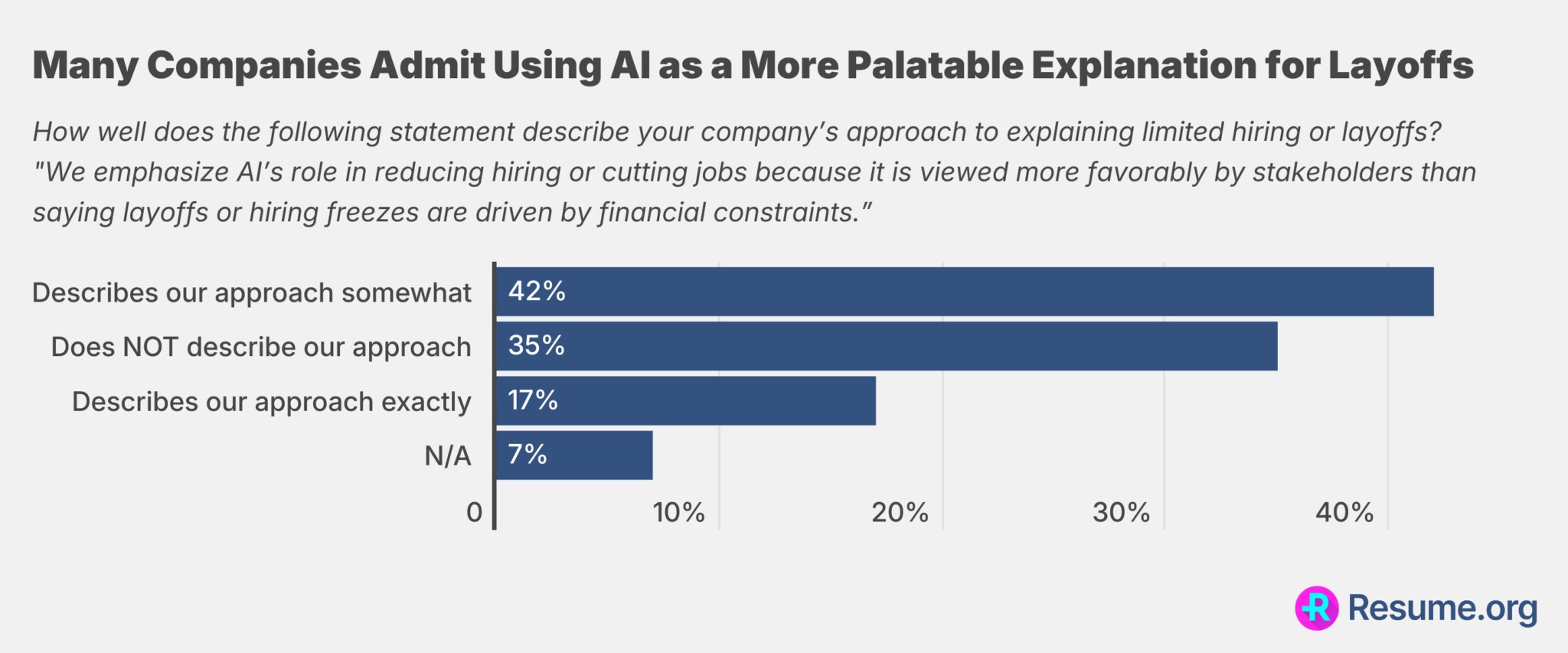
That puts the figure at 59% of companies.
We were thinking it is all because of AI, but that is just one part of the story. AI is mostly used as a convenient cover to justify layoffs.
Resume.org’s data shows AI/automation was cited as a leading driver of layoffs (44%), alongside reorganization/restructuring (42%) and budget constraints (39%).
This suggests many layoffs are not purely “AI replacing humans,” but classic cost-control and corporate reshuffling.
Also, problem-solving is the top skill for getting hired in 2026. With AI handling more routine work, humans are expected to tackle real-world problems that don’t have clear answers. This is a skill that AI can’t replace.
Why AI is the perfect corporate excuse?
Executives face intense pressure from investors and the public to present layoffs in a positive light. So, AI as an explanation offers companies a kind of strategic spin.
If a company says, “We are cutting jobs because demand is weak,” it raises scary questions: Are sales dropping? Is leadership failing? Is the business model broken? No company wants headlines suggesting it’s struggling financially.
If a company says, “We are cutting jobs because AI makes us faster,” it sounds like progress. It sounds forward-looking. It suggests the company is investing in new technology and preparing for the future.
Even if the day-to-day workload for remaining employees doesn’t shrink much, the headline sounds future-focused.
Bottom Line
But the trend is dangerous. When workers hear that AI is the reason for layoffs, and then watch managers refill roles under new titles, or pile the same work onto fewer people, trust collapses.
Managers might think the “AI” explanation will keep the internal morale from going down. Telling employees that jobs are being cut because of budget issues can create uncertainty. Workers may start worrying about delayed salaries or even the company’s survival.
But saying roles are being reduced because of AI makes it sound less personal. However, ultimately, we saw that it led to a situation where people are discussing the Jobpocalypse.
So, we all know that the real drivers for layoffs are more complex. In reality, layoff factors are rooted in economics rather than technology hype. Companies should be more transparent about them.
What This Means for Your Job Search Strategy
Layoffs at companies citing AI are part of a broader pattern of workforce restructuring across industries. If you are currently in a job search or concerned about your own role, this is the time to act rather than wait for more clarity.
Update your resume to lead with measurable impact rather than job duties. Hiring managers reviewing hundreds of applications move past generic descriptions quickly. The candidates who stand out connect their work directly to business outcomes: revenue generated, costs reduced, problems solved.
Identify the 10 companies you most want to work at and research them thoroughly. Targeted, informed outreach almost always outperforms mass applications. Reach out to former colleagues and managers before you need anything from them, since warm connections convert to offers at a much higher rate.
Prepare before interviews begin, not during them. Tools like Interview Copilot give you real-time coaching during actual interviews, and running a practice round with AI mock interview practice helps you sharpen your answers under pressure. In a tight market, preparation is the one variable entirely within your control.
What Affected Employees Should Do Next
If your role was eliminated as part of an AI-driven restructuring, the first priority is documenting your accomplishments before losing access to internal systems. Export performance reviews, project metrics, and any measurable business impact you can attribute to your work. These specifics become the backbone of your resume and interview stories.
Next, reframe your job search around the skills that AI cannot automate: strategic judgment, stakeholder communication, and cross-functional coordination. Roles that survived the Challenger survey's 59% cutback wave share a common trait: they require humans to synthesize ambiguous information and make decisions in contexts where a wrong answer carries real consequences.
Update your resume to lead with impact numbers rather than task lists. Hiring managers scanning dozens of applications stop on specifics like "reduced onboarding time by 30%" far faster than generic descriptions. Then use Interview Copilot to rehearse how you articulate your value in live interview settings. Real-time coaching helps you translate your experience into concise, compelling answers before the pressure of an actual interview removes that margin for error.
Many candidates use AI for interviews to prepare for questions exactly like these.
Frequently Asked Questions
What causes companies to announce mass layoffs?
Companies typically announce mass layoffs when facing revenue shortfalls, rising operating costs, shifts in business strategy, or competitive pressure from automation and AI. Macroeconomic downturns also accelerate these decisions. In most cases, the company is trying to reduce its cost base while reinvesting in higher-growth areas such as technology or new product lines.
What rights do laid-off employees have?
Laid-off employees are generally entitled to severance pay, continuation of health benefits for a set period, and access to unemployment insurance. In the United States, the WARN Act requires employers with 100 or more employees to give 60 days notice before mass layoffs. Always review your employment contract and consult an employment attorney if you have concerns.
How should you update your job search strategy after a layoff?
After a layoff, prioritize updating your resume and LinkedIn profile within the first week. Reach out to former colleagues and managers for references and referrals. Focus on roles that align with your transferable skills and consider upskilling in AI tools relevant to your field. Networking remains the most effective way to land a new role quickly.
How does AI contribute to the rise of layoffs in tech and corporate sectors?
AI is enabling companies to automate tasks that once required large teams, including customer support, data analysis, content creation, and basic software development. As AI tools become more capable, companies reduce headcount in departments where automation delivers equivalent output at lower cost. This trend is accelerating across both tech and non-tech industries.
Table of Contents
Related articles

2026 Data Shows Historic Rise in Jobless College Graduates
Unemployed Americans with 4-year college degrees hit a record share in January as hiring slows in white-collar sectors.

Starbucks Layoffs 2026: 224 Jobs Cut, Every Round So Far
Starbucks is cutting 224 jobs at its Seattle Support Center from October 19, 2026. About 120 declined a Nashville move. Full 2026 timeline and role breakdown.

Cloudflare Cuts 20% of Its Workforce and Blames AI
Cloudflare cut 20% of its workforce while posting record revenue. Find out why the company says AI made these jobs unnecessary.
40 Jobs AI Can't Replace in 2026, According to Microsoft Research
Microsoft's largest real-world study reveals the 40 jobs AI can't replace in 2026. Physical work, human connection, and hands-on skills dominate the safe list.
Google Interview Warmup Shut Down, What To Use Now?
Google Interview Warmup shut down in April 2026. Here are 8 free and paid alternatives tested for behavioral, technical, and live interview support in 2026.
