How to Recover from a Bad Interview?




A bad interview can leave you feeling pretty frustrated.
Maybe you struggled with a few questions, got nervous, or simply felt like you were not at your best. It’s easy to assume you have completely ruined your chances.
But hiring doesn’t depend on one moment.
This guide will tell you exactly what to do in the hours and days after an interview that did not go the way you hoped.
First, Don’t Assume You Failed the Interview
One bad job interview does not automatically mean you lost the opportunity.
An academic study of real job applicants looked at their anxiety levels after interviews. The researchers found little difference in interview anxiety between candidates who were hired and those who weren’t.
In other words, feeling like you messed up an interview doesn’t necessarily mean you actually performed badly.
After an interview, almost every candidates fall into a loop of overthinking. You go over every interview question again and again or focus on the one answer you fumbled.
There is a difference between feeling nervous and actually performing poorly. Feeling nervous is about your internal experience. Performing poorly is about what the interviewer actually observed.
After the interview, don’t panic. Give yourself a short break of at least 1 hour. You can take a walk, grab a coffee, listen to music, exercise, or simply relax for a while. Reacting immediately, while your emotions are still high, almost always leads to a distorted picture.
Now, answer this quick self-assessment to tell the difference between a bad feeling and a bad Interview. Answer these questions with a simple Yes or No:
- Did I fail to answer more than 20% of the interview questions?
- Did I struggle to explain my relevant experience or skills?
- Did I ramble so much that I regularly lost the point?
- Did I have trouble answering questions that were directly related to the job?
- Did I make a serious mistake that I could not recover from?
- Did the interviewer give clear signs that they were concerned about my answers?
Just remember while doing this assessment that a minor mistake like stumbling over your words or forgetting one small detail about a project is not something serious.
Now, if you checked mostly "no," you are probably just experiencing post-interview anxiety, and it's normal. Even interviewers know that there will be minor mistakes. They rarely expect a flawless performance.
But if you find a genuinely damaging mistake, that is something like being unable to answer a core question about the role, that’s where you need to pay more attention.
Second, Identify What Actually Went Wrong
After a couple of hours, review the interview in detail while it is still fresh.
Do this the same day as the interview so you do not spend the evening spiraling into post-interview anxiety instead of taking action.
Start by writing down every question you remember.
Next to each question, evaluate your response to that question by including bullet points of what you said and how well you answered.
Then mark which answers felt strong and which ones felt shaky.
If you used an AI Interview Copilot from Final Round AI during the interview, you can do the process in a few seconds. The tool works in real time and can give you a live transcript, notes, and actionable feedback, so instead of relying purely on memory, you can look back at what was actually said.
Here also, you need to separate fixable mistakes from uncontrollable factors. Uncontrollable factors are things you had no power over, like the interviewer running late and rushing through questions or technical issues on their end.
Third, Decide Whether You Should Follow Up
You should follow up whenever there is something specific to clarify or correct. Do it within 24 hours of the interview if possible. A fast, thoughtful follow-up shows the interviewer that you are self-aware, which can soften the impression left by a rough moment during the conversation.
A follow-up email helps most when you gave an incomplete or inaccurate answer, when you forgot to mention something relevant, or when external circumstances affected your performance.
In these cases, a short, professional note can add context the interviewer did not have.
A follow-up is less necessary if the interview actually went fine and you are only feeling anxious about it. Sending an unnecessary "apology" email can sometimes draw attention to a problem the interviewer never noticed in the first place.
Only send a follow-up when you have something specific and useful to add.
A strong follow-up is short, specific, and forward-looking. Start with a simple thank you for their time. Then get directly to the point you want to address.
For example:
Subject: Thank You, [Job Title] Interview
Hi [Interviewer's Name],
Thank you for taking the time to speak with me today about the [Job Title] position at [Company Name]. I enjoyed learning about [specific topic discussed].
My [relevant skill/experience] is a strong fit for what you described, and I am excited about the opportunity to contribute to your team.
I look forward to hearing about next steps. You can reach me at [email] or [phone].
Best, [Your Name]
Keep the entire email under 100 words. Send this follow-up within 24 hours, while the interview is still fresh in the interviewer's mind, so your clarification actually lands in context.
Fourth, Fix Your Problems
You fix your problems by identifying exactly what went wrong in each area, then building a specific plan to address it.
This should be done ideally the day after the interview when you are mentally fresh again.
Trying to fix everything the same night, right after the emotional intensity of the interview, usually leads to rushed conclusions instead of real solutions.
- If You Couldn’t Answer a Question: Research the correct answer afterward and understand what the interviewer was actually testing. Interviewers often ask questions to test a broader skill, not just factual recall. Prepare a stronger response for any question you struggled with, so the next time it comes up, you already have a clear answer ready.
- If You Rambled or Talked Too Much: The fix is to practice giving concise answers using a clear structure, such as the STAR method for behavioral questions, and to pause briefly before answering instead of speaking the moment the question ends.
- If You Gave the Wrong Answer: First decide whether a correction is actually necessary, since some small factual slips do not affect the overall impression you left. If the mistake was significant, study the concept behind the wrong answer, so you actually understand it the next time a similar question comes up in a different form.
- If You Had a Bad Technical Setup: Document exactly what happened and, if necessary, briefly explain the issue to the interviewer. If the problem affected your ability to answer questions properly, politely clarify what happened and focus on showing that you are still interested in the role.
Fifth, Keep Applying for Other Jobs
You keep your job search moving by continuing to apply and interview for other roles, instead of putting all your emotional energy into one company while you wait for a response.
Staying in motion protects both your hiring timeline and your confidence.
Avoid attaching your entire sense of progress to a single opportunity, no matter how much you liked the role or the team.
A job search is a numbers game in many respects, and continuing to build interview momentum with other companies keeps your skills sharp and your options open.
If you stop applying while waiting to hear back from one company, you risk losing weeks of progress if that opportunity does not work out.
Also, do not withdraw yourself from consideration just because you feel discouraged. Stay professional and let the process play out until you actually receive a decision, whether that decision is a rejection or an offer.
Companies sometimes take longer than expected to respond. In fact, 44% of U.S. hiring managers surveyed in 2026 said their company’s hiring process had become longer.
Overall, you should treat every interview as practice, even the ones that do not lead to an offer. Each conversation sharpens your ability to explain your experience, handle unexpected questions, and manage nerves.
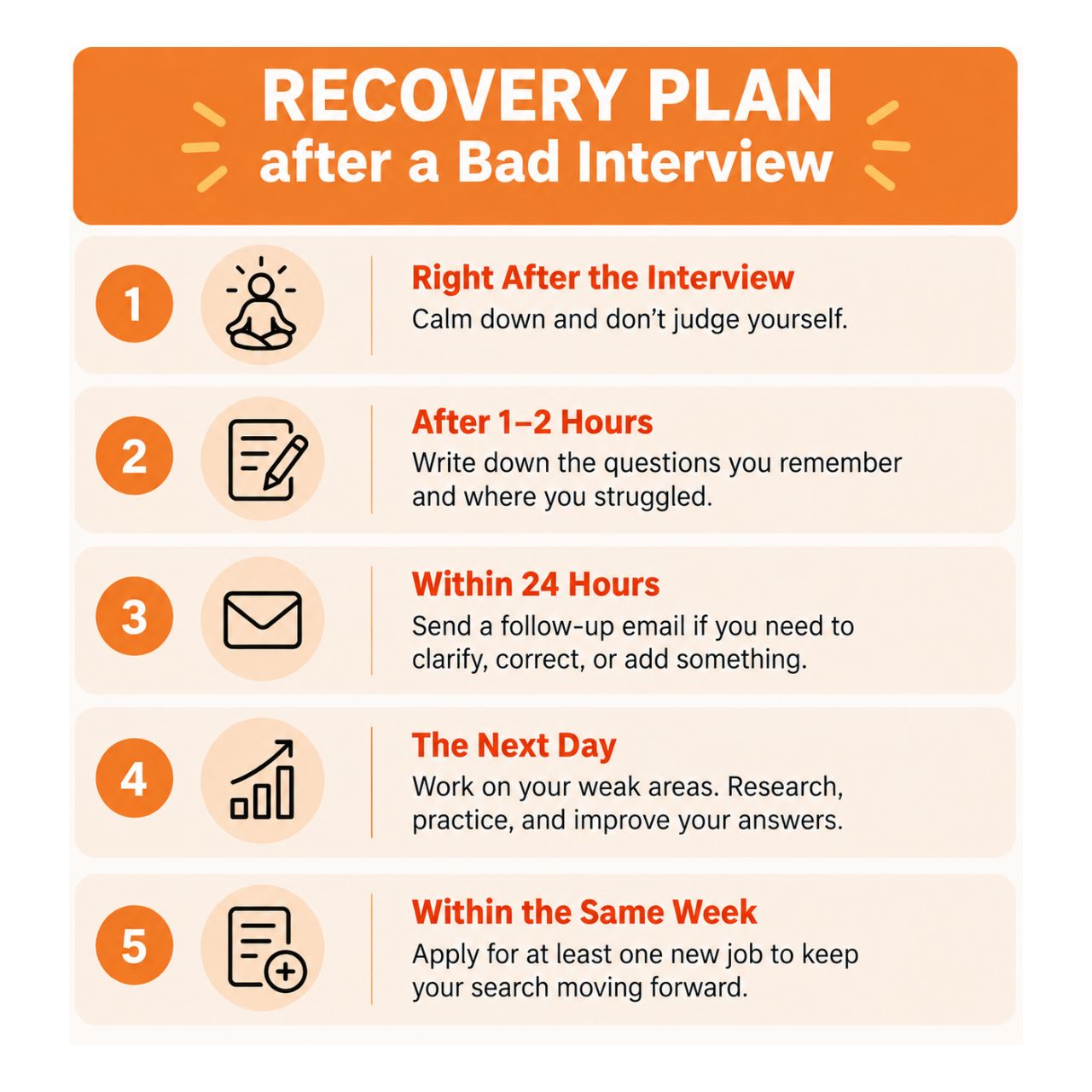
A Simple Recovery Plan After a Bad Interview
Follow this plan:
- Right after the interview: Calm down and avoid judging yourself.
- After 1 or 2 hours: Write down the questions you remember and identify the specific areas where you struggled.
- Within 24 hours: Send a follow-up email if there is something specific to clarify, correct, or add.
- The next day: Fix your problems using targeted practice, whether that means researching an answer, practicing STAR responses, or clarifying a mistake.
- Within the same week: Apply for at least one new job to keep your search moving forward.
This structure works because each step has a clear deadline attached to it, which prevents any single stage from stretching out and turning into extended worrying.
Related Interview Guides
- Signs an Interview Went Bad: Specific red flags to watch for during an interview, so you can tell the difference between a normal conversation and one that genuinely went poorly.
- What to Do If You Give a Wrong Answer in a Job Interview: A guide on handling factual mistakes in the moment and after the interview, useful if a wrong answer is your main concern.
- Follow-Up After Interview Checklist: A step-by-step checklist for timing and structuring your follow-up communication, helpful if you want a more detailed breakdown than what is covered here.
Conclusion
A bad interview feels like a closed door, but in reality it is usually just one data point in a longer process.
We gave you a full recovery plan, starting with separating anxious feelings from actual performance issues, then reviewing what happened while it was still fresh, deciding whether a follow-up email makes sense, and fixing specific problems such as rambling, wrong answers, or technical disruptions.
Recovery from a bad interview is rarely about erasing what happened. It is about understanding it clearly, correcting what you can, and continuing to move forward with your search instead of getting stuck.
Frequently Asked Questions (FAQs)
Q1: How long is too long to wait after a job interview?
Most companies respond within one to two weeks, so waiting beyond that without any communication is a reasonable point to send a polite follow-up. If the interviewer gave you a specific timeline during the interview, use that as your guide instead of a general rule.
Waiting longer than 3 weeks with no response at all is a sign you should follow up again or move on and focus on other opportunities.
Q2: How many times should I follow up after an interview?
A reasonable approach is one thank-you email within 24 hours, followed by one additional check-in if you have not heard back within the timeline the interviewer gave you.
Q3: How do I stop overthinking a bad interview?
Overthinking usually eases once you take concrete action. Writing down exactly what happened, identifying which mistakes were actually fixable, and taking one small step, such as sending a follow-up or applying to another job, redirects your energy toward something productive.
Giving yourself a short break immediately after the interview, before analyzing anything, also helps prevent the spiral from starting in the first place.
Q4: Do employers tell unsuccessful applicants first?
Not always. Many employers notify the successful candidate first and only send rejection notices to other applicants afterward, sometimes days or weeks later. Some companies also choose not to notify unsuccessful candidates at all.
Table of Contents
Related articles

How to Handle Unexpected Interview Questions Like a Pro
Caught off guard in an interview? Learn a simple 5-step framework to handle unexpected questions, even when you don't know the answer.
Parakeet AI vs Final Round AI Interview Copilot: Which Tool Should You Use?
Parakeet AI review: how it works, pricing ($39.50 for 3 credits), detection risks, and how it compares to Final Round AI Interview Copilot for live interview prep.
SubcueAI Review: Pros, Cons, and Honest Verdict for 2026
SubcueAI Review: Pros, Cons, and Honest Verdict for 2026
Why Behavioral Interviews Are Replacing Coding Rounds in 2026
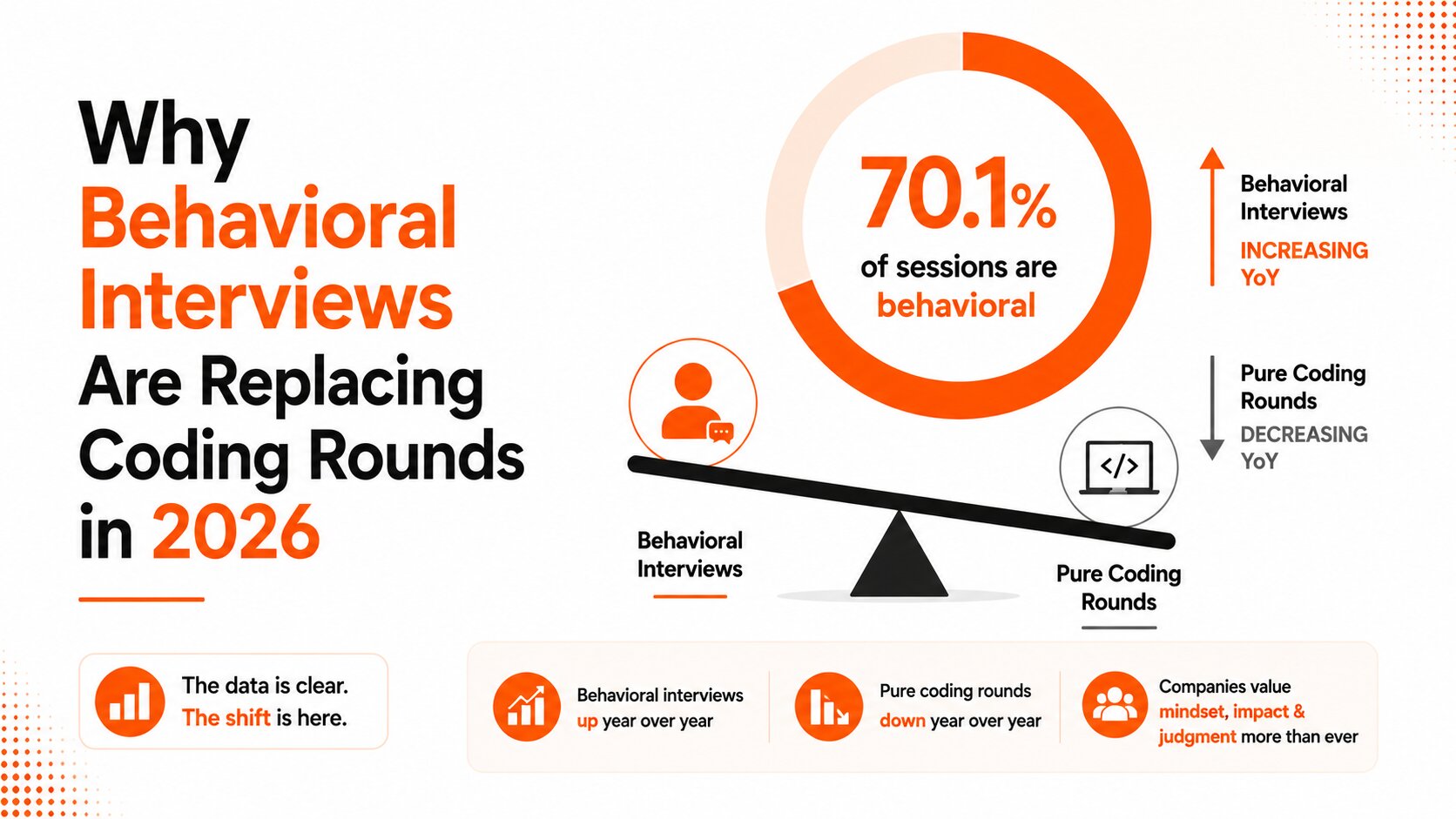
With 70.1% of tech interview sessions now behavioral, coding-only prep is no longer enough. Here's the data behind the shift and what it means for job seekers.