Big Tech companies - Tech Interview Trends Report for Q1 2026



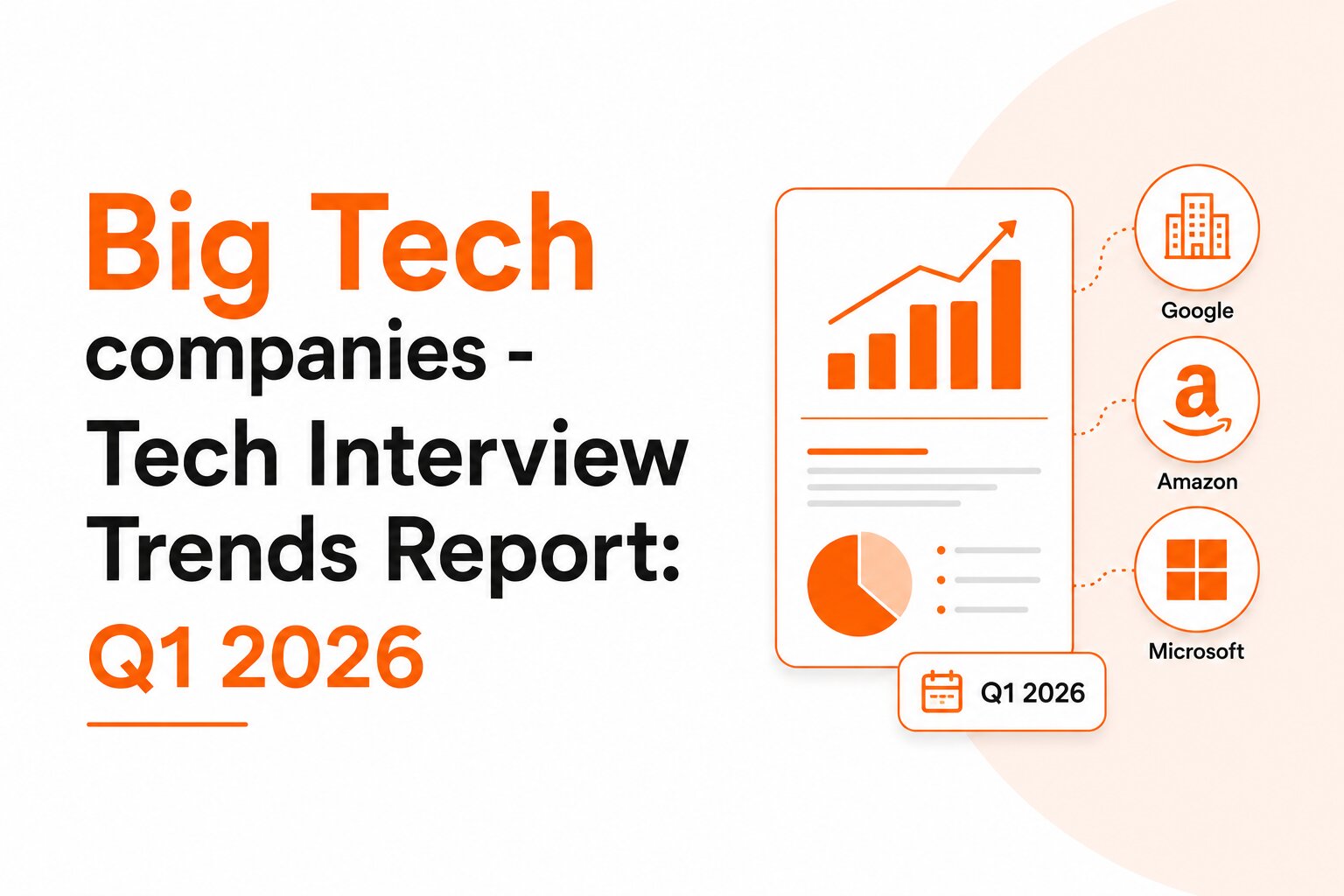
AI that answers interview questions analyzed data from 500,000+ real interview sessions conducted on our platform in Q1 2026. This report covers what's actually being asked, not predictions, not editorials, but patterns from real interview practice at scale.
Key Findings at a Glance
- Behavioral interviews are the dominant format, 70% of all sessions are behavioral/general, not technical
- Google is the most-practiced company (6,945 sessions in the last 30 days), followed by Amazon (5,776), Apple (3,349), and Microsoft (3,334)
- System design is the most-practiced technical question type, far outnumbering pure coding/algorithm sessions
Section 1: Which Companies Are Candidates Preparing For?
30-day session volume by target company, FinalRound AI platform
| Rank | Company | Sessions (30 days) |
|---|---|---|
| 1 | 6,945 | |
| 2 | Amazon | 5,776 |
| 3 | Apple | 3,349 |
| 4 | Microsoft | 3,334 |
| 5 | Meta | 862 |

What this tells us: Google and Amazon consistently generate the most interview activity, likely due to their high hiring volume, well-documented interview processes, and the strong brand signal that a FAANG offer sends to future employers.
Section 2: Behavioral vs. Technical, The Real Ratio
One of the most persistent myths in tech interview prep is that coding skills are the primary bottleneck.
Our data tells a different story.

Session breakdown by type (Q1 2026):
| Interview Type | Sessions | Share |
|---|---|---|
| Behavioral / General | 409,963 | 70.1% |
| Technical (System Design) | 17,382 | 3.0% |
| Coding / Algorithm | 6,526 | 1.1% |
| Other / Mixed | 151,229 | 25.8% |
Interpretation: 70% of candidates prioritize behavioral preparation. This aligns with what hiring managers increasingly report: candidates who fail final rounds are more likely to fail on communication and judgment than on technical skills.
The implication for candidates: if you're spending 80% of your time on LeetCode and 20% on behavioral prep, you're likely inverted.
Section 3: What Question Types Are Dominating Each Company
Google's interview sessions on our platform lean heavily toward:
- System design at scale, data validation frameworks, pipeline reliability, anomaly detection at Google Search scale
- LLM/ML infrastructure, questions about designing systems that support model training and serving
- Behavioral questions anchored in "impact", Google interviewers push for quantified impact more than at other companies in our data
Emerging pattern in Q1 2026: more questions involving AI/ML system design specifically, designing feature stores, model registries, and evaluation frameworks.
Amazon
Amazon's interview sessions concentrate on:
- Leadership Principle behavioral questions, Ownership, Bias for Action, and Deliver Results generate the most practice sessions
- Data infrastructure, capacity planning, energy efficiency, and large-scale pipeline design appear frequently in technical sessions
- Two-part questions, Amazon interviewers often follow a behavioral with a hypothetical ("and what would you do if the same situation came up but you had no authority?")
Apple
Apple's session data reflects a distinct profile:
- Security and QA testing, significantly more security-focused technical questions than other companies
- Process and program management, Apple interviews for cross-functional coordination skills more explicitly than most tech companies
- Hardware-software integration, questions about iOS/macOS kernel behavior, device testing, and HID interactions appear in technical rounds
Microsoft
Microsoft's session data shows:
- Distributed systems design, globally distributed messaging systems, Azure traffic management, Cosmos DB architecture
- Behavioral questions focused on collaboration, Microsoft's culture shift toward "growth mindset" shows up in its interview patterns
- Coding rounds are more present than at other companies, Microsoft is the only FAANG company in our data where coding mode sessions are a meaningful share (15%)
Meta
Meta's smaller session volume (862) still reveals patterns:
- Software engineering-focused, more algorithm and system design emphasis relative to behavioral compared to other companies
- Product sense questions appearing in engineer interviews, Meta engineers are expected to think about user impact, not just technical implementation
Section 4: The Hardest Questions (By Skip / Retry Rate)
One signal in our data that isn't often discussed: which questions do candidates skip, restart, or request multiple attempts on?
Behavioral questions with highest retry rate:
- "Tell me about a time you made a significant mistake. What did you do?", Candidates struggle to be specific enough about the mistake without sounding catastrophic
- "Describe a time you had to make a decision without enough information.", Most candidates either pick trivial examples or over-explain the context
- "Tell me about a time you had to change someone's mind.", The gap between "I explained my reasoning" and "I actually influenced them" is where most answers fall flat
Technical questions with highest retry rate:
- System design with explicit cost constraints, "Design this system for < $X/month in infrastructure costs"
- Design questions involving data consistency tradeoffs, "Design a system where some users can see stale data but no user can see incorrect data"
- API design with rate limiting and versioning requirements
Section 5: What's Changed in Q1 2026 vs. Q1 2025
Based on longitudinal patterns in our session data:
- More behavioral, less pure coding, The share of pure algorithm/coding sessions has declined relative to behavioral sessions year-over-year, consistent with industry reports that companies are adding behavioral rounds to compensate for LeetCode grinding.
- AI system design questions are now mainstream, Questions about designing AI infrastructure (feature stores, model serving, evaluation pipelines) that were rare 12 months ago now appear regularly in Google, Meta, and Microsoft sessions.
- "Scope of impact" has become a filter at senior levels, For Staff+ and senior roles, interviewers are explicitly probing for evidence that candidates have influenced work beyond their immediate team. Candidates who can only talk about their individual contributions are being screened out more aggressively.
- Behavioral questions have gotten harder to fake, Interviewers at top companies are increasingly using follow-up probes ("what specifically did you say?", "what was the other person's reaction in that moment?") that expose generic or fabricated STAR answers.
Methodology
This report is based on:
- 500,000+ interview sessions conducted on FinalRound AI in Q1 2026
- Session metadata including target company, interview type, and specialization
- Question pattern analysis across a statistically significant sample of sessions
- Retry and restart signals as a proxy for question difficulty
Data reflects candidates who are actively preparing for interviews, which skews toward motivated, experienced candidates targeting top-tier companies. It should not be interpreted as representative of all tech job seekers.
FinalRound AI is the interview preparation platform trusted by 1,000,000+ candidates. Every data point in this report comes from real sessions on our platform, not surveys, not estimates, not editorial judgment.
Frequently Asked Questions
What were the biggest changes in Big Tech interview formats in Q1 2026?
Q1 2026 saw an increase in AI-assisted interviews and a greater emphasis on system design for mid-level roles at companies like Google, Amazon, and Microsoft. Behavioral rounds became more structured with standardized rubrics, and several companies reduced the number of interview rounds from five to four to accelerate hiring timelines as competition for AI talent intensified.
Are Big Tech companies using AI to screen candidates in 2026?
Yes, several Big Tech companies use AI screening at the resume and initial recruiter stages. Automated systems filter applications based on skill keywords, years of experience, and educational background before human review begins. Some companies also use asynchronous video screening platforms at the phone screen stage, reducing the number of recruiter hours required for early-stage candidate evaluation.
What skills are Big Tech companies prioritizing in 2026 interviews?
Machine learning fundamentals, distributed systems design, and AI product thinking are the highest-priority skill areas in 2026 Big Tech interviews. For software engineering roles, proficiency with LLM APIs, agentic frameworks, and data pipeline tooling has become a common requirement. For product management roles, ability to define success metrics for AI features and evaluate trade-offs in model selection are increasingly tested.
How long does the Big Tech interview process take from application to offer?
The typical timeline from application to offer at Big Tech companies in 2026 ranges from four to ten weeks. Companies under hiring pressure for specialized AI roles sometimes complete the process in two to three weeks. The longest delays occur at the offer stage, where internal leveling discussions and compensation approvals can add two to three weeks after the final interview round.
Table of Contents
Related articles
Meta Interview Questions: What 3,220 Live Sessions Reveal
Meta interview questions from 3,220 live sessions: conflict resolution is the most asked behavioral category, University Grad SWEs score 10.5 points below experienced engineers, and Product Managers score highest.
Deloitte Interview Questions: Data from 3,304 Live Sessions
Deloitte interview difficulty varies by 40 points depending on division. Senior Salesforce Developer scores 37.5 while Cyber Security Business Analyst scores 77.7, based on 3,304 live sessions.
Tech Interview Difficulty Changed in 2025: FAANG Data
Meta interview difficulty rose sharply in 2025 while Apple got easier. Analysis of 42,472 live sessions shows the biggest year-over-year shift in big tech interview scores.
Security Engineer Interview Questions: 166 Live Sessions
Security engineers score 55.3 out of 100 across 166 live interview sessions. This data report covers the most common questions, company-by-company difficulty scores, and where candidates score below average.
Data Engineer Interview Questions: 566 Sessions Analyzed
Data Engineer and Software Engineer interviews score within 1 point of each other. Analysis of 566 live DE sessions and 14,096 questions reveals which technical topics score highest and where candidates struggle most.
Oracle Interview Questions: Data from 1,393 Live Sessions
Final Round AI analyzed 1,393 live Oracle interview sessions and found six distinct question tracks by role. Fusion Financials Consultants averaged 70.9 while Principal Technical Staff averaged 51.1 across live sessions.