Apple Layoffs: 200 Cut From Siri and Vision Pro Teams




Apple cut about 200 jobs across its Siri and Vision Pro organizations on August 21, 2026, split roughly evenly between the two groups, with around 100 roles from the Vision Pro teams and around 100 from Siri and the Intelligent Systems Experience group. Bloomberg reporter Mark Gurman broke the story on August 21, and Engadget, AppleInsider and TechCrunch each confirmed the same figure later that day. It is the second Apple reduction to surface in 2026, and the first to land inside the two organizations Apple has spent two years describing as the center of its future.
Quick Answer
- Apple cut about 200 roles on August 21, 2026, around 100 from the Apple Vision Immersive Video and Apple Vision Gaming teams and around 100 from Siri and the Intelligent Systems Experience group.
- Apple describes the change as a shift toward AI and new devices, yet the cuts landed inside its AI and spatial computing teams themselves, three weeks after Apple reported record quarterly revenue of $109.4 billion and research and development spending up 32% year over year.
- A California WARN notice filed at the end of August covers 147 of the roles, 79 at One Apple Park Way in Cupertino plus 68 across two Sunnyvale offices, all permanent, with separations dated October 19 and 20, 2026. The filing lists the affected job titles but never names AI as the reason.
What Apple disclosed about the August 2026 Siri and Vision Pro cuts
Apple made no press release and filed no Form 8-K. It did submit a California WARN notice, which surfaced in the state’s report at the end of August and covers 147 of the affected roles. Beyond that filing, the only other record is a statement Apple gave to reporters, which reads in full: “While we will create new roles as part of this change, it will also impact a limited number of existing roles. We are grateful to these team members for their contributions, and we are committed to supporting them throughout their transition, including opportunities to apply for other roles at Apple.” That is the entire official record.
The reported figure moved over two days, which is worth noting because both numbers are still circulating. An initial report on August 20 described roughly 60 people leaving the Vision organization. By August 21 the confirmed scope had widened to about 200 once the Siri cuts were included, which is the number TechCrunch and the rest of the technology press settled on. If you see 60 quoted somewhere, it is an early partial count rather than a competing estimate.
One genuine ambiguity remains unresolved in all the coverage. Apple is offering affected employees the chance to apply for other internal roles, and some of the people counted in the 200 will move rather than leave. Apple has not said how many. That means the net headcount reduction is almost certainly smaller than 200, and nobody outside Apple currently knows by how much.
Who was cut, and how Apple’s role mix shifted
The named teams are specific: Apple Vision Immersive Video, Apple Vision Gaming, Siri, and the Intelligent Systems Experience group. Those are content and platform teams, not corporate overhead. Immersive Video produced the first-party spatial video that shipped as a reason to own the headset, and Vision Gaming did the same for games. Cutting them is a statement about how much original content Apple still intends to fund for that platform.
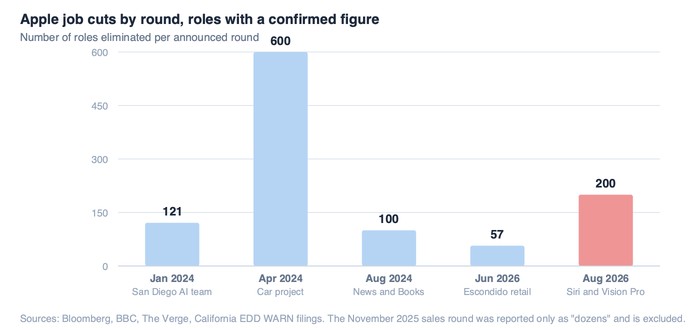
Set that against the composition of Apple’s earlier reductions and a pattern appears. The 2024 rounds fell on projects Apple had already decided to abandon: a 121-person artificial intelligence team in San Diego, roughly 600 roles when the self-driving car program was canceled, and about 100 positions across Apple News and Apple Books. The November 2025 round fell on go-to-market staff in enterprise, education and government sales. In every previous case, Apple cut something it was winding down or a function it was outsourcing.
August 2026 breaks that pattern. Siri is not being wound down. Apple introduced a rebuilt Siri at its 2026 developer conference and named it on the same earnings call where it reported $109.4 billion in quarterly revenue and a 32% year-over-year increase in research and development spending. Apple is reducing headcount inside a product it is simultaneously spending more to build. That is the detail most coverage of these cuts skipped, and it is the one that tells you what kind of reduction this is.
How this fits the pattern of Apple layoffs in 2026
Apple has now disclosed or been reported to make six distinct reductions since the start of 2024. Laid out chronologically, they show a company trimming continuously in small increments rather than announcing one large restructuring:
- January 2024: a 121-person artificial intelligence team in San Diego was shut down, with staff told to relocate to Austin or leave.
- April 2024: roughly 600 jobs were cut when Apple canceled its self-driving car program.
- August 2024: about 100 positions were eliminated across Apple News and Apple Books.
- November 2025: dozens of sales roles across enterprise, education, government and briefing center teams. Apple never confirmed a figure.
- June 2026: 57 retail roles ended with the closure of the Escondido, California store, covered by a California WARN filing effective June 24, 2026.
- August 2026: about 200 roles across Siri, Intelligent Systems Experience, Apple Vision Immersive Video and Apple Vision Gaming, 147 of them named in a California WARN filing with separations in October.
Two organizational changes sit underneath the most recent round. Apple dissolved the Vision Products Group earlier in 2026, moving visionOS software under Craig Federighi and leaving a smaller hardware group under Paul Meade to support the current headset. Separately, John Giannandrea left Apple in April 2026 after Siri had already been moved out of his remit, with Amar Subramanya taking the artificial intelligence vice president role. The August cuts are the staffing consequence of reorganizations that had already happened on paper.
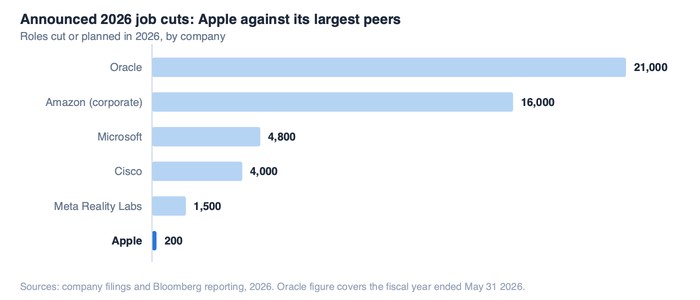
Apple’s restraint here is genuinely unusual, and it is easier to see next to the rest of the industry. Oracle shed 21,000 roles in the fiscal year ending May 2026, Amazon announced about 16,000 corporate cuts, Microsoft cut roughly 4,800, and Cisco planned around 4,000. Our analysis of what the 2025 and 2026 tech layoff data actually shows tracks these rounds against the reasons companies give for them, and Apple is a consistent outlier on volume while matching its peers on stated rationale.
That gap in volume is exactly why Apple rounds get read so closely. When a company cuts 21,000 people, the story is the number. When Apple cuts 200, the number tells you almost nothing and the team names tell you everything, because Apple only removes a team once it has already decided something about that team’s future. The useful question is never how many, it is which group, and this time the answer was the group building Apple’s assistant and the group making things to watch and play on its headset.
Apple has eliminated dozens of sales positions. What makes this particularly unusual is the timing. Apple just posted quarterly revenue of $102.5 billion, an 8% jump from last year. So why is Apple cutting jobs?
That $102.5 billion quarter is the number to hold on to, because it reframes every Apple reduction that followed. Apple has not been cutting to survive a downturn. It has been cutting while setting revenue records, which means each round is a deliberate reallocation rather than a response to pressure. The sales reduction in November 2025 was the first sign that Apple was willing to shrink a function it had spent a decade building, and the August 2026 cuts inside Siri and Vision Pro extended that logic into engineering. Understanding the earlier round explains what the newer one is really doing, so it is worth walking through what happened in the sales organization first. The two rounds share a mechanism even though they landed on completely different kinds of work.
Apple begins Layoffs in Sales Teams
Apple had started cutting dozens of jobs across its sales team, as reported by Bloomberg.
The layoffs specifically targeted people who sell Apple products to large organizations rather than individual consumers.
The affected employees include:
- Account managers who work with major businesses
- Sales representatives serving schools and educational institutions
- Staff who deal with government agencies
- Employees who operate Apple's briefing centers
One of the most affected groups is Apple’s government sales team, which sells to U.S. agencies like the Department of Defense and the Department of Justice.
The team had already been operating under difficult conditions following the 43-day U.S. government shutdown and the budget reductions implemented by the DOGE.
There were some longtime employees, including managers with 20 to 30 years of experience, among the employees laid off.
The tenure detail is the part that surprised people inside the company. Government and education account management is relationship work, and relationships of that length are not quickly rebuilt, which is part of why the round read as a strategic exit from the function rather than a trim.
However, Apple is offering affected workers until January 20, 2026, to find another position within the company. If they can’t secure a new role, they will receive a severance package.
What’s interesting is that Apple is still hiring for other sales positions. The company also told laid-off employees they could apply for these new openings.
Real Reason behind these job cuts
Apple claims it’s “To connect with even more customers, we are making some changes in our sales team that affect a small number of roles.”
The company appears to be shifting how it sells to big organizations. Instead of having its own employees manage every sale, Apple is pushing more business toward third-party retailers.
Cost savings can be the main reason behind this move. Paying your own employees is expensive. When third-party retailers handle sales, those costs shift elsewhere.
The cuts are described as a “rare” layoff for Apple, which typically avoids large-scale workforce reductions. The company’s previous layoffs were small and targeted:
- January 2024: Apple shut down a 121-person AI team in San Diego, telling them to relocate to Austin or face termination.
- April 2024: Approximately 600 jobs were cut when the company canceled its self-driving car project.
- August 2024: Roughly 100 positions eliminated from Apple News and Apple Books teams
It is worth being precise about what rare means here, because the word does a lot of work in coverage of Apple and rarely gets quantified. Apple has cut staff in six identifiable rounds since the start of 2024, so the frequency is not unusual at all. What is unusual is the proportion, and the proportion only means anything once you set it against the size of the company.
Apple has 166,000 full-time employees worldwide as of September 2025, making these sales cuts a small fraction of its total workforce.
Scale is the reason Apple can keep absorbing these reductions without the disruption its peers have experienced. A 200-role reduction is roughly one tenth of one percent of the company. For comparison, when Oracle shed 21,000 positions in the fiscal year that ended in May 2026, that was about 13% of its workforce, a difference in kind rather than degree. It also explains why Apple can offer internal transfers instead of severance in most cases: with 166,000 people and continuous hiring across other groups, there is usually somewhere for a displaced engineer to land, which is not true at a company cutting one role in eight. The transfer option is a function of scale rather than generosity, and it is the single biggest practical difference between being cut by Apple and being cut by almost anyone else on this list.
Apple generally relies less on layoffs than its peers. CEO Tim Cook has said that job cuts are only considered as a “last resort.”
Even when Apple eliminates roles, it typically structures it in a manner that avoids triggering notification requirements under U.S. labor law.
Why Apple’s AI reasoning never appears in a WARN filing
Apple attributes these cuts to a shift toward artificial intelligence and new devices, and AppleInsider described the Siri reduction specifically as an architectural change driven by AI integration. None of that reasoning appears in the government filing, even though the filing does exist, and that gap is the story. The California WARN form asks for headcount, addresses, job titles and dates. It does not ask why. So Apple listed software development engineers, machine learning and AI/ML roles, computer vision engineers, engineering program managers and AR/VR software developers, more than 30 of those AR/VR positions across the two Sunnyvale sites, without stating a cause anywhere on the form. The filing documents AI and machine learning specialists losing their jobs while saying nothing about AI as the reason.
The threshold explains why this round produced a filing at all. The California Employment Development Department publishes every notice it receives, and the state’s WARN Act is triggered when an employer of 75 or more people lays off 50 or more staff at a single site of employment within 30 days. The 79 separations at One Apple Park Way cleared that bar on their own. The rest of the round, spread across other buildings and functions with internal transfer offers attached, sits outside it, which is why the filed number is 147 rather than the roughly 200 reported. Apple has structured reductions to stay under that line before, and its WARN history reflects it: 16 notices covering 963 workers from 1990 through mid-2026, a remarkably small paper trail for a company of its size.
This matters practically rather than academically, and it now splits Apple’s affected staff into two groups. The 147 people named in the filing have what Salesforce’s 133 in August 2026, ServiceNow’s 404 and Google’s 52 in Washington had: a dated separation and a statutory notice period they can plan around. Anyone cut in this round but left out of the filing gets Apple’s usual arrangement instead, an internal application window rather than a statutory countdown. The November 2025 cohort was given until January 20, 2026 to find another role internally before severance applied, which is a longer runway than WARN provides but a far less certain one, because it depends on an internal req opening up.
What the 2026 layoff numbers actually show
Tech layoffs in 2026 passed the full-year 2025 total before August ended. Layoffs.fyi counted 125,759 tech workers cut by August 6, 2026, against 122,606 for all of 2025, spread across 264 companies rather than the 278 that cut staff last year. Fewer companies, more people each. Across all industries, 3,156 WARN notices covering 279,738 employees had been filed in 44 states by mid-August.
Artificial intelligence is now the single most cited reason, but it accounts for less of the total than the headlines suggest. Employers attributed close to 113,000 announced cuts in 2026 to AI, which is roughly a quarter of all announced reductions. The other three quarters were attributed to restructuring, cost reduction, demand shifts and consolidation. Apple sits awkwardly in this taxonomy: it named AI as the direction of travel without naming AI as the cause of anyone losing a job.
There is also a shift in how executives talk about this. Etsy’s chief executive said its 220 August cuts were not driven by AI while acknowledging the technology had changed what skills the company needs, and Patreon’s chief executive said much the same about a 20% reduction. Compare that to Salesforce’s Marc Benioff saying plainly in 2025 that AI let him run support with fewer people. The blunt version has gone out of fashion. You can follow how this language keeps moving in our technology and hiring news coverage, where the gap between stated reasons and filed reasons shows up round after round.
What to do if you were affected by the Apple cuts
Work out which group you are in first, because it sets your timeline. If your role is among the 147 in the California WARN filing, your separation date is October 19 or 20, 2026, which is roughly seven weeks of paid employment from the point the filing became public. That is a countdown you can plan against, and you should treat every week of it as search time rather than waiting time. If you were cut in this round but your role is not in the filing, you have Apple’s internal application window instead. That is usually longer than 60 days but has no fixed end, and Apple is actively hiring across other groups, so an internal move is a real possibility rather than a courtesy. The risk in the second case is spending the window waiting for an internal process to resolve instead of running an external search alongside it. Run both. An internal transfer that comes through is a good outcome; an internal transfer you assumed would come through is how people end up starting a search from zero in month four.
Do the retrieval work in your first week, while you still have system access. Export your last two performance reviews, save the specific metrics attached to your projects, whether that is shipped features, latency numbers, model evaluation results or content volume, and collect personal contact details for the managers and peers who will vouch for you. Access to internal tools ends faster than most people expect, and none of this is reconstructable afterwards. Our guide on how to land a tech job after a layoff covers how to sequence the search itself once that groundwork is done.
One practical note specific to this round: Immersive Video, Vision Gaming, Siri and Intelligent Systems Experience are all genuinely scarce skill sets. Spatial video production, on-device model integration and assistant architecture are being hired for aggressively at exactly the companies competing with Apple on these products. The market for what you were doing is not shrinking, even though the team doing it at Apple just did.
How to explain an Apple layoff in your next interview
Lead with the structural fact and keep it short. Something close to: “Apple consolidated the Vision Pro and Siri organizations in August 2026 and cut around 200 roles across those teams, and mine was one of them.” That sentence does three things at once. It gives a date, it gives a scale, and it makes clear the decision was about an organization rather than about you. Interviewers are not looking for an explanation so much as checking whether you can describe it without becoming defensive.
Resist the instinct to add performance context. Volunteering that you were rated highly, or that you were surprised, invites exactly the follow-up questions you do not want, because it moves the conversation from a company decision to an individual assessment. Company-wide context closes the topic. Individual context reopens it. This comes up most often inside standard behavioral interview rounds, usually as some version of why you left your last role, so it is worth having one clean version rehearsed rather than improvising it under pressure. Say it out loud a few times before the first call. The sentence that reads fine on a page often comes out sounding apologetic when spoken, and the difference between the two versions is usually just the word unfortunately creeping in at the front of it. Interviewers hear that word as a cue to dig, not as politeness, so it is worth cutting on purpose.
The harder question, and one that is specific to being cut from an AI team during an AI hiring boom, is what you make of it. Hiring managers at competing teams will ask. The strongest answer is technical rather than emotional: describe what the team was actually building, what shipped, what you learned about the constraints of the problem, and why that experience transfers. Candidates in the same position have been comparing notes on how to explain AI-driven cuts when interviews start, and the phrasing that works consistently is closer to a postmortem than an apology.
There is one advantage to this particular layoff worth using deliberately. Siri and Vision Pro are products the entire industry has opinions about, which means your interviewer will almost certainly be curious rather than cautious. A candidate who can explain why on-device assistant latency is genuinely hard, or why spatial video production does not scale the way flat video does, turns the layoff question into a technical conversation. That is a far better use of ten minutes than justifying why you are available.
If you want to rehearse that answer before it counts, Interview CoPilot™ in the Final Round AI desktop app runs the full loop: you set up a Goal for the specific role and company, add your resume and the job description, practice against an AI interviewer or get live guidance in the real session, then read the automatic debrief afterwards and drill whatever came out weak. Get Interview CoPilot™ if you would rather have the layoff question sorted before the first screen than work it out live.
Bottom Line
For employees, if you work in tech sales, especially in roles focused on institutional clients, companies are increasingly automating or outsourcing these functions.
For Apple, this is about positioning for the future. By reducing fixed labor costs, they are trying to maintain its competitive edge in a rapidly changing tech landscape.
What This Means for Your Job Search Strategy
Zooming out from Apple for a moment, the wider picture matters more than any single round when you are deciding where to aim a search, because the companies cutting hardest and the companies hiring hardest are not the same companies this year.
Tech layoffs have reshaped the hiring market, but demand for engineers and product professionals who can work alongside AI tools remains strong at companies actively building in the AI space. If you are affected by cuts at Apple or concerned about similar moves, this is the time to sharpen your positioning, and a lot of candidates start by looking at AI built for real interviews before they start applying. The hiring slowdown has been uneven rather than universal, and the teams still moving quickly are concentrated in a narrower set of companies than they were two years ago.
Update your portfolio to show projects where you used AI tools to increase output, reduce cycle time, or solve a meaningful problem. This matters more than credentials or tenure. Hiring managers at AI-first companies want to see evidence of adaptability, not just years of experience.
Target companies that are actively building, not just maintaining, and tailor every application to the specific team and product. A brief, specific note explaining exactly why you want to work on that team converts far better than a generic application. This is slower per application and considerably better per outcome, which is the trade most people get backwards at exactly the moment a search starts to feel urgent.
Prepare before interviews begin, not during them. Running a practice interview against an AI interviewer, using your own goal context, is the fastest way to find out which answers fall apart under pressure while there is still time to fix them. In a tight market, preparation is the one variable entirely within your control.
Author’s Comment
“Apple layoff searches behave differently from every other company we track. The volume is smaller, because the cuts are smaller, but the queries are far more specific: people search the team name, not the company. Vision Pro layoffs. Siri team cuts. That tells me the people searching are insiders trying to work out how far the reorganization goes, not observers reading a headline. They need the org chart explained, not the press statement summarised.”
Jaya Muvania, SEO Specialist at Final Round AI
Related Interview Guides
- Apple Interview Questions: what 4,528 live interview sessions reveal about what Apple actually asks.
- Apple Software Engineer Interview: why Apple’s loop differs from Google and Meta, and how to prepare for the difference.
- FAANG Interview Difficulty Trends: how the bar at Amazon, Google, Meta and Apple has moved over three years.
- Google Layoffs in Washington: a WARN-filed round at a peer company, and what the filing revealed that the press release did not.
Frequently Asked Questions
How many employees did Apple lay off in August 2026?
Apple cut about 200 roles, reported on August 21, 2026. Roughly 100 came from the Apple Vision Immersive Video and Apple Vision Gaming teams and roughly 100 from Siri and the Intelligent Systems Experience group. A California WARN filing later put 147 of those roles on the record, split across Cupertino and two Sunnyvale offices. Because Apple offered affected staff the chance to apply for other internal roles, the net reduction is likely lower than 200, and Apple has not published a figure.
Are the Apple layoffs because of AI?
Apple says the change is a shift toward AI and new devices, and the Siri reduction has been described as an architectural change driven by AI integration. But the cuts fell inside Apple’s own AI and spatial computing teams, in the same quarter it raised research and development spending 32% year over year, so this is a reallocation within AI work rather than AI replacing the workers.
Did Apple file a WARN notice for the Siri and Vision Pro cuts?
Yes, for part of the round. A California WARN filing covers 147 roles: 79 at One Apple Park Way in Cupertino, 40 at 605 W. Maude Avenue in Sunnyvale and 28 at 599 N. Mathilda Avenue in Sunnyvale, all permanent, with separations dated October 19 and 20, 2026. The 79 Cupertino separations alone cleared California’s threshold of 50 or more layoffs at a single site within 30 days. The remainder of the roughly 200 reported roles falls outside the filing. Apple’s other 2026 filing covers 57 retail roles at the Escondido store, effective June 24, 2026.
Is Apple still hiring after the August 2026 layoffs?
Yes. Apple’s own statement said it would create new roles as part of the change and invited affected employees to apply for other positions internally. Apple also reported record June-quarter revenue of $109.4 billion and increased research and development spending in the same period, and it continues to recruit across other groups.
Why did Apple lay off members of its sales team?
Apple's sales team restructuring reflects a shift in how the company approaches enterprise and retail channels, with greater reliance on digital sales, automation, and AI-assisted customer engagement. The cuts appear targeted at roles where productivity is measured by volume rather than relationship depth, areas where automation now delivers comparable output at lower cost.
Which Apple departments were most affected by the layoffs?
The layoffs primarily impacted sales and business development roles, with some reports indicating cuts in retail support operations and certain enterprise account functions. Technical and product teams appear largely unaffected, consistent with Apple's continued heavy investment in hardware development, software engineering, and the expansion of its services revenue segment.
What does Apple's restructuring signal about big tech hiring trends?
Apple's moves reflect a broader pattern where large tech companies are trimming go-to-market functions while expanding technical and AI teams. Sales roles that relied on volume calling, cold outreach, or transactional account management are increasingly vulnerable as AI sales tools and self-serve enterprise procurement reduce the need for large human sales organizations.
How should sales professionals respond to tech sector layoffs?
Sales professionals should differentiate by specializing in high-complexity enterprise deals, technical consulting, and relationship management at the C-suite level, areas where AI cannot replicate human judgment and trust. Building proficiency in AI-powered CRM tools and data-driven selling strategies also signals adaptability to employers looking to hire in this environment.
Table of Contents
Related articles

Estee Lauder Layoffs: 10,000 Jobs Cut as Profits Rose
Estee Lauder layoffs reached 10,000 net positions, about 17.5% of its workforce, while earnings rose. What was cut, why, and what to do if affected.
44% of Young Americans Fear AI Will Shrink Job Opportunities
A new Harvard Youth Poll shows 44% of young Americans worry AI will reduce job opportunities. Learn what students think about AI’s impact on careers.
Which Skills Are Most in Demand Amid Layoffs in 2025
While tech layoffs make headlines, some skills are more in-demand than ever. Discover which skillsets companies are desperately seeking in 2025 and whether you're on the list?
Chegg Lays Off 45% of Workforce as AI Destroys Homework Help Business
Chegg laid off 388 employees and replaced its CEO after students abandoned paid homework help for free ChatGPT. Company cut half its workforce in six months.