ANZ Job Cuts Hit 3,500 as NZ Tech Review Begins



Australia and New Zealand Banking Group (ANZ) announced plans to eliminate approximately 3,500 jobs by September 2026, marking one of the largest workforce reductions in recent Australian banking history.
The cuts represent about 8% of the bank's 43,000-strong workforce and will cost the company A$560 million in restructuring charges.
New CEO Nuno Matos, who joined ANZ in May 2025 from HSBC, spoke about the news at a Sydney conference: "I hate to do this but it's for the future of the company... Those decisions are very tough to take... It should be the last resort."
The Story Behind the Layoffs
This wasn't ANZ's first layoff disaster under Matos. Just weeks before the formal announcement, the bank faced a humiliating scandal when an automated email mistakenly disclosed terminations to hundreds of employees before formal notifications. Staff received "exit dates" and laptop return instructions before anyone told them they were actually fired.
The August email blunder forced ANZ to expedite planned layoffs, conducting emergency redundancy meetings the same day to address staff concerns.
The BBC reported the email blunder at the time. That incident already had the Finance Sector Union calling emergency meetings and criticizing ANZ's "chaotic pace of change." Now, with 3,500 additional cuts announced, the union's frustration has only intensified.
And the restructuring goes beyond just employee terminations. ANZ will also reduce engagements with consultants and third parties, affecting around 1,000 managed services contractors. The bank expects minimal impact on customer-facing roles, but that's cold comfort for the thousands facing unemployment.
Why is ANZ Laying Off?
Here's what's interesting about ANZ's justification. Matos insists "This is not about profits; this is about getting the basic things right." But if basic operations require 3,500 fewer people, what exactly were those employees doing for years?
The Finance Sector Union didn't buy the explanation, calling the cuts "out of control" and describing the situation as "chaos." Union President Wendy Streets added: "That's not a plan, that's chaos."
ANZ is Australia's smallest Big Four bank but employs more people than bigger rivals like Westpac and NAB. This shows the bank has been massively inefficient for years while competitors already cut their workforce.
This isn't just cost-cutting. It's ANZ admitting they've been bloated and wasteful for too long.
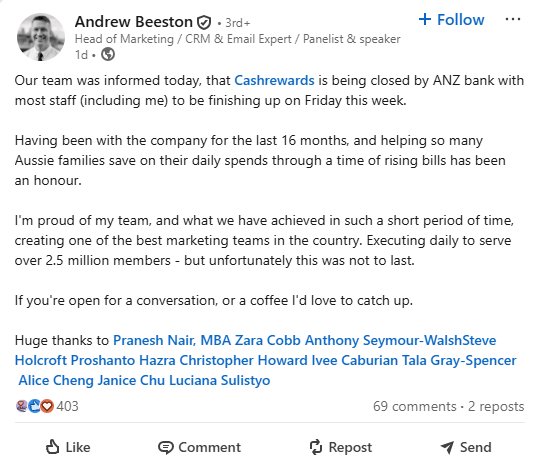
Andrew Beeston, an employee who was impacted went on LinkedIn to share his thoughts.
The timing of these layoffs is quite alarming. Digital banking is killing traditional jobs, and ANZ is scrambling to catch up instead of leading the change.
The bank will share more details on October 13, with full results coming November 10. For 3,500 workers getting fired, those dates matter for understanding what severance they'll get.
What ANZ disclosed about the New Zealand technology restructure
ANZ Bank New Zealand has proposed more than 100 redundancies in a restructure that places over 400 technology roles into consultation, with the changes due to be finalised in early October 2026. The Australian Financial Review reported the proposal on September 24, 2026, and New Zealand outlets confirmed the detail the following day. ANZ has issued no media release and no exchange announcement on the proposal, so every figure in circulation comes from reporting and from statements a bank spokesperson gave to journalists.
The two numbers are not the same thing, and the distinction matters if your role is in scope. The 400 affected and 100-plus redundant split is reported consistently by Radio New Zealand, the New Zealand Herald and BusinessDesk. The 400-plus figure counts roles affected by the consultation, which includes people who may be redeployed, retitled or moved between teams. The 100-plus figure is the number of redundancies actually proposed. No outlet has reported that 400 people are losing their jobs, and ANZ has not used that framing. Against roughly 7,000 ANZ New Zealand staff, 100 redundancies is about 1.4 percent of the bank. Measured against the roughly 1,500 technology roles in New Zealand, it is closer to 7 percent of that division.
The roles named in reporting are non-customer-facing and concentrated in engineering and delivery: quality assurance engineers, lead engineers, product owners and project managers. Software testing is reported to be consolidating under a single strategic partner rather than being run in house, which is the mechanism behind most of the proposed reductions. A separate decision to close the Dunedin call centre, affecting about 40 staff, was confirmed in the same month but is not part of this technology consultation.
One detail is worth flagging before anything else. ANZ has issued no media release and no exchange filing on this proposal (every number in circulation traces back to journalists and to a spokesperson statement), which is unusual for a change of this size at a listed bank.
Why ANZ naming AI does not mean AI caused these cuts
The bank statement given to New Zealand media contains the word AI, and that has been widely repeated. Read it closely, because it does not say what a quick scan suggests. The ANZ New Zealand spokesperson, who was not named by any outlet, said the bank is "currently considering changes to our technology team, including bringing together related functions like data, AI and engineering for greater consistency and to make the most of expertise across ANZ," and that "the proposed changes impact non-customer facing roles."
In that sentence, AI is a function being merged into a combined team. It is not given as a reason anyone is losing a job. Nowhere in the bank statement does ANZ attribute the proposed redundancies to automation, and no journalist covering the story has produced a source who does. The cause that union representatives and reporters have actually pointed to is the consolidation of testing work with an external partner. If you are preparing to explain this round in an interview, that difference is worth holding onto, because an interviewer who followed the story will know the cuts were a sourcing decision rather than a machine replacing a test engineer.
Workers First Union national organiser Callum Francis told the New Zealand Herald that "it is not the net loss alone that is the problem, it is the organisation trying to streamline and reduce duplication." Francis also noted the union has around 800 members across the wider ANZ business but only six to ten inside the technology team, so union visibility into this particular consultation is limited. The second spokesperson statement was narrower still: "Our immediate priority is supporting our people through this process. As this is an active consultation process, we are unable to comment further at this stage."
Two questions decide what you should do this fortnight. Is your role in the 100 proposed for redundancy or in the roughly 300 that are affected but likely to be redeployed? And if you cannot answer that, who inside your reporting line can tell you before the consultation closes in early October? Ask both in writing, because a verbal reassurance during a live consultation is worth very little once decisions are finalised.
Nobody in the technology division has been told yet. That is the whole problem with the timing.
What are the senior ANZ departures reported on September 25?
A second ANZ story broke the day after the New Zealand reporting, and it is a separate event. Bloomberg reporters Sheryl Tian Tong Lee and Chien Mi Wong wrote on September 25, 2026 that a group of senior ANZ bankers in Hong Kong, Singapore and Australia are leaving as the bank consolidates its corporate finance business. Their account rests on an internal memo Bloomberg saw and on people familiar with the plans.
The named departures are unusually senior and unusually long-tenured:
- John Corrin, head of corporate finance for the international business, more than 16 years at ANZ, based in Hong Kong. Leaving October 1, 2026.
- Andrew Harward, head of corporate finance for North Asia and head of structured asset finance for the international business, more than 16 years, Hong Kong. Leaving October 1, 2026.
- Ian Mathews, executive director in project, export and sustainable finance, roughly 30 years at the bank, Singapore. On gardening leave from early October.
- Aaron Ross, global head of project, export and asset finance, at ANZ since 2001, Sydney.
- David Roberts, executive director for innovative transition solutions, Sydney, departing as ANZ discontinues non-bank ESG origination.
One name in the coverage is not a departure. Kevin Corbally, ANZ's former chief risk officer, is named as leading the consolidated corporate finance unit, which is a reassignment. Harward and Ross declined to comment to Bloomberg. Corrin, Roberts and Mathews did not immediately respond, and ANZ did not respond either.
Now the part worth getting right, because several aggregator sites got it wrong within a day. This is not the New Zealand technology restructure, and the two should not be added together or described as one programme. The Bloomberg piece does not mention the 400 New Zealand technology roles at all, and the New Zealand reporting does not mention Hong Kong or Singapore. One is a consultation over engineering and delivery roles in a domestic technology division. The other is a handful of long-tenured institutional bankers exiting an offshore corporate finance business that is being folded together. If you see a headline bundling "senior leadership exits and tech job cuts" into a single ANZ restructuring number, it is an aggregation of two separate reports by two separate outlets, and the combined figure behind it does not exist.
How the New Zealand restructure fits the wider ANZ job cuts program
This proposal does not sit on its own. It lands inside the 3,500-role program described earlier on this page, which ANZ said was roughly 3,000 roles complete by June 30, 2026. The restructuring has been expensive in its own right: ANZ reported full-year 2025 profit down 10 percent to A$5.9 billion, a result that absorbed redundancy costs alongside a A$240 million penalty from the Australian Securities and Investments Commission. The bank paid A$414 million to departing workers over that period. Viewed against that backdrop, a New Zealand technology consultation in late 2026 reads as a continuation of the same program rather than a fresh decision.
It is also not an ANZ-only pattern. Australian and New Zealand banks have been reducing technology and operations headcount across 2026, and the Finance Sector Union says Commonwealth Bank job cuts have now passed 1,000 for the year, a cumulative tally the bank itself has not confirmed. The September round at that bank covered 172 redundancies with a further 232 staff affected. Westpac has moved on more than 1,500 roles, National Australia Bank on around 410, Bank of Queensland on 200 and Bendigo on 158. For a technology worker in Sydney, Melbourne, Auckland or Wellington, the practical consequence is that several employers who would normally absorb displaced engineers are contracting at the same time.
That clustering is the part most worth planning around. It is visible well beyond banking, and the short version for anyone in a bank technology team is that delivery, testing and coordination roles are being consolidated or sourced externally far faster than engineering roles tied directly to a revenue system. Which roles have disappeared and which have survived across the past two years is set out in our analysis of what the 2025 and 2026 layoff data actually shows about AI and job cuts.
ANZ is no longer the only big Australian bank cutting at this scale. National Australia Bank told the ASX on October 20, 2026 that it expects to remove up to 2,500 internal roles in its 2027 financial year, and our analysis of the NAB job cuts sets that round against NAB’s earlier ones and against ANZ’s 3,500.
What to do if your ANZ role is in the consultation
New Zealand has no equivalent of the United States WARN Act, so there is no statutory 60-day clock running in your favour. What you have instead is a consultation period defined by your employment agreement and by good-faith obligations under the Employment Relations Act, and in this case it is short. Reporting puts the consultation at roughly two weeks with decisions finalised in early October 2026. Treat that window as the whole runway, not as a warning shot before a longer process.
Use it for three things specifically. Submit written feedback during the consultation, because proposals do get changed and redeployment is a real outcome for a meaningful share of the 400 affected roles. Export what you cannot retrieve later, which means performance reviews, delivery metrics, release numbers and the contact details of managers who will act as referees once your access is switched off. Then start interviewing immediately rather than waiting for the decision, because the October timing puts you into the market at the same moment as everyone else in the consultation.
The mechanics of the first fortnight after a bank restructure, from severance review through to the first recruiter conversation, are covered step by step in our guide on how to land a tech job after a layoff. One practical note for this round in particular: a proposed redundancy that is still in consultation is not yet a termination, and you can begin a job search without waiting for confirmation. Most candidates lose weeks assuming they need a final answer first.
What This Means for Your Job Search Strategy
Finance and banking roles are competitive right now, with fewer openings and more candidates per position. If you are in the ANZ space or an adjacent sector, acting quickly matters because opportunities fill fast and hiring managers move to backup candidates without warning.
Update your resume to lead with measurable outcomes rather than job duties. For finance roles, quantify your work in dollar amounts, percentage improvements, or risk reduction wherever possible. Recruiters at financial institutions increasingly screen for candidates who understand AI tools, so frame your experience around data, automation, or analytical judgment.
Reach out to former colleagues and managers now, before you need anything from them. Warm outreach converts far better than cold applications. Most offers in finance come through people who already know your work, not through job boards.
Prepare before interviews begin, not during them. Final Round AI's Interview CoPilot™ is a desktop app that coaches you during the interview itself rather than debriefing you afterwards, which matters most in the first few loops when you are still rusty. In a tight market, preparation is the one variable entirely within your control.
What Affected Employees Should Do Next
Job losses at this scale disrupt more than income. They disrupt routine, identity, and confidence. Acting quickly and strategically in the first few weeks after a layoff makes a measurable difference in how fast you land your next role.
Update your resume within the first week. Highlight specific accomplishments with metrics: revenue generated, costs reduced, projects shipped on time. Avoid vague phrases like "responsible for" and replace them with action verbs that show ownership. A strong resume clears automated filters and gives recruiters a concrete reason to call.
Reach out to your network before you start applying broadly. Former managers, colleagues, and professional contacts can flag open roles, provide referrals, or make warm introductions to hiring managers. These connections bypass the applicant tracking systems that screen out most cold applications. Ask two or three of them now whether they are willing to act as a referee, because a reference check at offer stage moves a lot faster when the person picking up the phone already knew the call was coming.
Prepare your interview story now, not after you get a callback. Hiring managers will ask why you left, what you accomplished, and how you handle adversity. Practice your answers out loud until they stop sounding rehearsed. For a restructure this size the honest version is also the strongest one: the program was announced publicly, it covered about 8 percent of the bank, and it had nothing to do with your performance. Say that in two sentences, then move the conversation to what you actually built.
Talk to people going through the same thing instead of running the search alone. Other candidates cut in a bank technology restructure will tell you which recruiters actually reply, which interview loops changed this year, and how they answered the redundancy question without sounding defensive. One thread worth reading is this account of a bank technology division onsite and the behavioural questions it actually tested.
Expect the loop itself to look different from the one you last sat. Bank technology hiring in Australia and New Zealand has shifted toward shorter take-home work and longer live problem-solving, partly because so many candidates now arrive with polished written answers. The practical consequence is that you get judged on how you think out loud, under mild time pressure, in front of someone taking notes. That is a skill you lose quickly when you have been in the same job for years, and it is the single most common reason strong engineers stall at the second round after a restructure. It is worth rehearsing the boring parts too. How you describe a system you did not design, how you talk about a project that was cancelled above your head, how you answer when an interviewer asks what you would have done differently. Run a few timed practice rounds before the first real screen rather than treating the first screen as the practice, which is what mock interview practice is for.
One last thing. This round will not be the last one in Australian and New Zealand banking, and the people who land fastest are usually the ones who started while they still had a badge. Consultation periods feel like a pause, and they are not. They are the only stretch of the process where you are still being paid, still have access to your own work history, and still have colleagues sitting near you who can vouch for what you did. Every one of those advantages disappears on the day the decision lands, and none of them come back. Candidates who wait for certainty before updating a resume routinely lose four to six weeks they never recover. The market does keep moving underneath all of this, and some of the banks cutting in one division are still posting in another. If you want to track which employers are cutting and which are quietly hiring, our tech layoffs and job market news section follows it week by week.
Frequently Asked Questions
Why are companies conducting mass layoffs in 2025?
Companies are cutting jobs in 2025 primarily because of AI-driven efficiency gains, post-pandemic overcorrections in hiring, tighter access to capital, and pressure from investors to improve profitability. Many organizations that expanded headcount rapidly between 2020 and 2022 are now rightsizing. In some industries, AI tools are directly replacing roles in customer support, data entry, and basic software development.
What should employees do immediately after being laid off?
File for unemployment benefits right away and review your severance agreement before signing, as some packages can be negotiated. Update your resume and LinkedIn profile within the first week and reach out to your professional network early. Most jobs are found through referrals, so proactive outreach consistently outperforms cold applications. Focus your energy on roles that match your strongest and most current skills.
How long does a typical job search take after a layoff in 2025?
The average job search after a layoff takes two to four months, though this varies by industry, location, and experience level. Senior professionals in specialized fields may face longer timelines due to fewer open roles. Candidates who network actively, apply to targeted lists rather than mass-applying, and prepare thoroughly for interviews consistently reduce their search time compared to those who take a passive approach.
Are there industries that are still hiring during widespread layoffs?
Yes. Healthcare, cybersecurity, AI infrastructure, government contracting, and skilled trades continue to hire actively even during broader economic downturns. Within tech companies conducting layoffs, revenue-generating teams in sales, product engineering, and AI research often continue to grow. Candidates who can demonstrate skills in high-demand areas move faster through hiring pipelines than generalists with broader but less specific experience.
Table of Contents
Related articles
41% of Tech Hiring Now Lists AI as a Must-Have Skill
New data shows 41% of tech job openings now list AI as a must-have skill, highlighting how fast hiring priorities are shifting.

CBA Job Cuts: 232 Roles Go as Profit Hits $11bn
CBA job cuts hit 232 roles with 172 redundancies per the Finance Sector Union, while group headcount rose and cash profit reached $10.98 billion.

Claude Sonnet 4.5 - What Software Developers Are Saying After Testing
Anthropic says Claude Sonnet 4.5 is the best coding model yet, but software developers are finding a more complex story after testing it.

Federal Layoffs Settlement: What Expires December 31
Federal layoffs: the September 2026 shutdown RIF settlement reinstated 4,000+ workers, but its protection on agency layoff plans expires December 31.

Satya Nadella Admits Microsoft Needs to Show More Empathy During Layoffs
A voice recording was obtained by CNBC with Satya Nadella admitting to having 'lack of empathy' when an employee showed concern over the wave of layoffs and its psychological effects on everyone.