19 Dollars an Hour Is How Much a Year? Full 2026 Salary Breakdown


19 Dollars an Hour Is How Much a Year
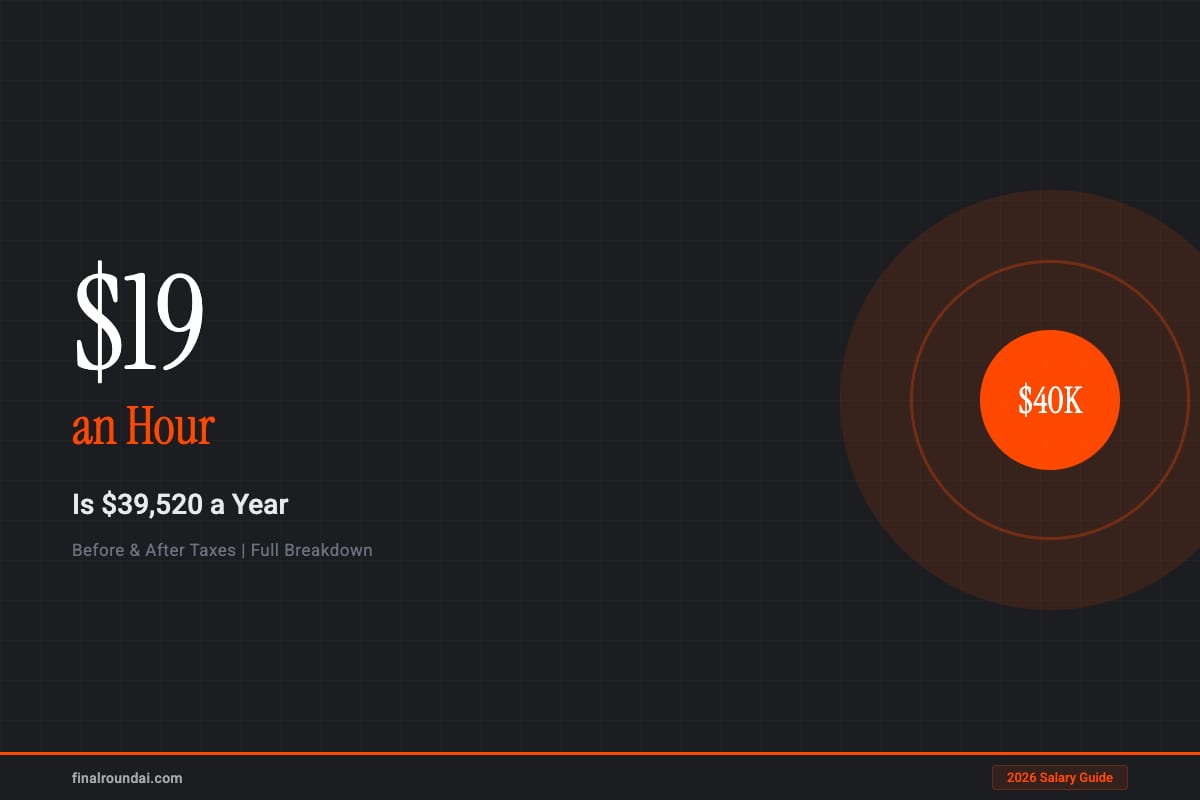
$19 an hour is $39,520 a year before taxes, if you work 40 hours a week for 52 weeks. That's $760 per week and about $3,293.33 per month on average.
Most people searching "19 dollars an hour is how much a year" want to know what that wage actually means for their bank account. The quick math ($19 x 2,080 hours) gives you the gross number, but your real take-home after federal taxes drops to roughly $33,793 as a single filer or $35,545 if married filing jointly. This guide breaks down every angle: paycheck amounts by frequency, after-tax estimates for W-2 and 1099 workers, part-time and full-time scenarios, careers at this pay level, and how to negotiate past $19/hour.
$19 an Hour Is How Much Per Paycheck (Gross)?
$19 an hour equals $760 per week, $1,520 biweekly, $1,646.67 semi-monthly, or $3,293.33 monthly before taxes. Your actual paycheck amount depends on your employer's pay frequency.
$19 an Hour Pay Frequency Breakdown
Weekly: $19 x 40 hours = $760.00
Biweekly: $760 x 2 = $1,520.00
Semi-monthly: $39,520 / 24 = $1,646.67
Monthly: $39,520 / 12 = $3,293.33
Biweekly gives you 26 paychecks per year at $1,520 each. Semi-monthly gives 24 paychecks at $1,646.67. The biweekly schedule means two months per year have three paychecks , an extra $1,520 that's easy to redirect toward savings or debt if you budget around two checks per month.
$19 an Hour After Taxes (Federal-Only Example)
After federal taxes, $19 an hour leaves you with approximately $33,792.82 per year as a single filer, or $35,544.72 if married filing jointly. That's roughly $2,816 or $2,962 per month depending on your filing status.
Federal Tax Calculation for $19/Hour
Step-by-step for a single filer:
- Gross annual: $19 x 2,080 = $39,520
- Standard deduction: $15,000
- Taxable income: $24,520
- 10% on first $11,925 = $1,192.50
- 12% on $11,926–$24,520 ($12,595) = $1,511.40
- Total federal tax: $2,703.90
- FICA (7.65%): $3,023.28
- Take-home: $39,520 - $2,703.90 - $3,023.28 = $33,792.82
Summary:
Single filer: Gross $39,520 → Deduction $15,000 → Taxable $24,520 → Fed tax $2,703.90 → FICA $3,023.28 → Net $33,792.82/yr ($2,816.07/mo)
Married filing jointly: Gross $39,520 → Deduction $30,000 → Taxable $9,520 → Fed tax $952.00 → FICA $3,023.28 → Net $35,544.72/yr ($2,962.06/mo)
Important: These are federal-only estimates. State income tax, local taxes, health insurance, 401(k) contributions, and other deductions will reduce take-home further. In no-tax states (Texas, Florida, Washington), you keep more. In California or New York, expect an additional 5–9% deducted.
Hours Worked vs Annual Pay at $19/Hour
At $19/hour, working 40 hours/week earns $39,520/year, but reducing to 30 hours drops that to $29,640, and 20 hours gives $19,760. Your annual income changes dramatically based on hours worked.
$19/Hour Pay Breakdown by Hours Worked (Before Taxes)
40 hours/week: $760/week → $39,520/year
35 hours/week: $665/week → $34,580/year
30 hours/week: $570/week → $29,640/year
25 hours/week: $475/week → $24,700/year
20 hours/week: $380/week → $19,760/year
The difference between 40 and 30 hours at $19/hour is $9,880 per year. If you're evaluating a part-time opportunity or a role with variable hours, this table shows exactly what each scenario means for your annual income. You might also want to see how $18 an hour compares annually or what $20 an hour adds up to.
19 Dollars an Hour Calculation
$19 per hour x 40 hours per week x 52 weeks per year = $39,520 per year before taxes. This is the standard full-time calculation used by employers and payroll systems.
Hourly rate x hours worked per week x weeks worked per year = annual income before tax
- Weekly: $19 x 40 = $760
- Monthly: $760 x 4.33 = $3,290.80 (or $39,520 / 12 = $3,293.33)
- Yearly: $760 x 52 = $39,520
Important Things People Forget When Calculating
- Taxes , Federal income tax + FICA alone take roughly $5,727 to $3,975 depending on filing status
- Unpaid time off , Each week without pay costs you $760
- Overtime , Hours over 40/week at $19/hour should pay $28.50/hour (1.5x) if you're non-exempt
- Benefits value , A $19/hour job with health insurance and retirement match can be worth $25–$28/hour in total compensation
19 Dollars an Hour Is How Much a Year Full Time
$19 an hour full time (40 hours/week, 52 weeks/year) equals $39,520 per year before taxes. That's $3,293.33 per month or $760 per week gross.
Full-time at $19/hour puts you near the U.S. median individual income and into the 12% federal tax bracket as a single filer. At $39,520, you're below the FLSA overtime exemption threshold of $43,888, meaning most $19/hour positions , even salaried ones , qualify for overtime pay when you work more than 40 hours per week.
Adjusted for Unpaid Time Off
52 weeks (no time off): $39,520
50 weeks (2 weeks off): $38,000
48 weeks (4 weeks off): $36,480
46 weeks (6 weeks off): $34,960
At $19/hour, many hourly roles offer limited or no paid time off, so the 50-week figure ($38,000) is often more realistic for budgeting. If you're comparing this to a salaried position, check out what $40,000 a year looks like per hour to see how the numbers stack up.
19 Dollars an Hour Is How Much a Year Part Time
At $19/hour part time, you earn $29,640 per year at 30 hours/week, $24,700 at 25 hours, or $19,760 at 20 hours.
30 hours/week: $570/week → $2,468.10/month → $29,640/year
25 hours/week: $475/week → $2,056.75/month → $24,700/year
20 hours/week: $380/week → $1,645.40/month → $19,760/year
At 20 hours per week, $19/hour still produces $19,760 annually , more than the full-time federal minimum wage income of $15,080. This makes $19/hour part-time roles attractive for students, parents, or anyone balancing multiple responsibilities.
What Does $19 an Hour Look Like After Taxes?
After all federal deductions, a W-2 employee earning $19/hour keeps roughly 85% of gross pay as a single filer, or about 90% if married filing jointly. That translates to $2,816/month or $2,962/month respectively.
A Realistic Take-Home Estimate (W-2 Employee)
Most W-2 employees earning $19/hour keep roughly 78–88% of gross pay after all deductions. The federal-only estimate puts single filer take-home at $33,792.82/year ($2,816.07/month) and married filing jointly at $35,544.72/year ($2,962.06/month). Add state income tax in places like California or New York, and take-home drops another $1,500–$2,500 per year.
If You Are a Contractor (1099/Freelancer)
As a 1099 contractor earning $19/hour, you pay the full 15.3% self-employment tax instead of 7.65%, which means an additional $3,023.28 per year in taxes compared to a W-2 employee.
- Self-employment tax: 15.3% on your net earnings ($6,046.56 total vs. $3,023.28 for W-2)
- Quarterly estimated payments: The IRS requires you to pay taxes four times per year
- No employer benefits: Health insurance, retirement matching, and PTO come out of your pocket
- Deductible expenses: Home office, equipment, mileage can offset some of the tax burden
A contractor earning $19/hour often needs to bill $23–$25/hour to match the take-home and benefits of a $19/hour W-2 position.
Common Mistakes People Make When Calculating $19 an Hour
1. Assuming full-time hours are guaranteed
$39,520/year assumes 40 hours every single week. If you average 35 hours instead of 40, your actual annual drops to $34,580 , a $4,940 difference that impacts rent, savings, and debt payments.
2. Ignoring taxes entirely
$39,520 gross is not $39,520 in your pocket. A single filer keeps about $33,793 after federal taxes , nearly $5,727 less than gross. Budgeting on the pre-tax number means overspending by roughly $477 per month.
3. Confusing contractor vs employee take-home
A W-2 employee at $19/hour pays 7.65% in FICA ($3,023). A 1099 contractor pays 15.3% ($6,047). That's an extra $3,023/year in taxes. If someone offers you $19/hour as a contractor, your real comparison to a W-2 job is closer to $16–$17/hour.
4. Forgetting cost of living varies by location
$19/hour ($39,520/year) goes much further in rural Arkansas than in Seattle. In a city where average rent is $2,000/month, housing alone consumes 61% of your gross income. In a city where rent averages $900, it's only 27%.
5. Rounding instead of calculating precisely
Rounding $19/hour to "$38,000 a year" (using 2,000 hours) underestimates by $1,520. That's two weeks of pay. Use the precise 2,080-hour figure to get $39,520.
How $19 an Hour Compares to Other Common Hourly Wages
$19/hour ($39,520/year) is slightly below the U.S. median hourly wage of $22–$23/hour.
$15/hour: $31,200/year
$17/hour: $35,360/year
$19/hour: $39,520/year
$21/hour: $43,680/year
$23/hour: $47,840/year
A $2/hour raise from $19 to $21 adds $4,160 per year. A $4/hour raise to $23 pushes you close to $48,000. For a comparison at a slightly lower rate, check out our $17 an hour salary breakdown.
Careers That Commonly Pay $19 an Hour
$19/hour is typical for experienced entry-level workers and mid-level hourly positions. Most roles require 1–3 years of experience or relevant certifications.
1. Healthcare & Medical
- Certified Nursing Assistant (CNA, experienced)
- Medical Receptionist
- Pharmacy Technician (entry-level)
- Home Health Aide (experienced)
- Medical Billing Specialist (entry-level)
2. Administrative & Office
- Administrative Assistant
- Data Entry Specialist (experienced)
- Receptionist (corporate/experienced)
- Office Coordinator
- Accounts Payable Clerk
3. Retail, Service & Hospitality
- Shift Supervisor
- Bank Teller
- Call Center Representative (experienced)
- Hotel Front Desk Manager
- Warehouse Lead
4. Skilled Trades & Construction
- Electrician Apprentice (entry-level)
- Construction Laborer (experienced)
- Painter (commercial)
- Landscaping Supervisor
- HVAC Helper
5. Education & Childcare
- Teaching Assistant (experienced)
- Daycare Worker (lead/experienced)
- After-School Program Coordinator
- Library Technician
- Substitute Teacher (some districts)
6. Technology & Support
If you're interviewing for tech roles, practicing with an AI mock interview can help you demonstrate technical knowledge and problem-solving skills clearly.
- IT Help Desk (entry-level)
- Junior Technical Support
- Computer Repair Technician
- Cable/Internet Installer
- Data Entry Operator (tech company)
Negotiation Strategies for $19 an Hour
$19/hour is negotiable in most roles. Negotiating effectively can push you toward $21–$23/hour , a difference of $4,160–$8,320 per year.
1. Treating $19/hour as a hard ceiling
$19/hour is a starting point in most pay bands. A $20/hour counter adds $2,080/year. Research your role's market range on Glassdoor, PayScale, or Indeed before assuming you can't ask for more.
2. Negotiating at the wrong time
The best time to negotiate is after you receive a written offer but before you accept.
3. Only negotiating the hourly rate
If the rate is firm at $19, negotiate everything else: shift differential, extra PTO, schedule flexibility, training opportunities, or tuition reimbursement. These can collectively add $2,000–$5,000 in annual value.
4. Not tying your ask to measurable impact
Saying "I want more" is weak. Saying "I improved customer satisfaction scores by 20% and reduced call handle time by 15%" is strong. Quantify your impact.
5. Accepting the first offer without countering
A professional counter , "I was hoping we could discuss $20–$21/hour" , is expected. No reputable employer rescinds offers over a reasonable counter.
6. Not practicing the conversation beforehand
Practicing with an AI mock interview helps you build confidence for these conversations. For real-time help during the actual negotiation, real-time interview assistance can suggest phrasing as you talk.
Candidates who use AI interview help to practice before the real interview typically feel more prepared and confident going in.
Related Interview Guides
If you're evaluating a $19/hour job offer or preparing to negotiate:
- Questions to Ask the Interviewer , Know the right questions to ask when evaluating a $19/hour role, from benefits to growth potential.
- How to Dress for a Job Interview , Dress code guidance by industry and format to make a strong first impression.
- How to Tailor Your Resume to a Job Description , Optimize your resume for the specific roles that pay $19/hour and above.
- How to Explain a Layoff in an Interview , Handle tough questions about gaps with confidence.
Related Salary Guides
Compare $19/hour against other wage and salary levels:
Hourly to Annual:
- 15 Dollars an Hour Is How Much a Year?
- 17 Dollars an Hour Is How Much a Year?
- 18 Dollars an Hour Is How Much a Year?
- 20 Dollars an Hour Is How Much a Year?
- 21 Dollars an Hour Is How Much a Year?
- 22 Dollars an Hour Is How Much a Year?
- 23 Dollars an Hour Is How Much a Year?
- 25 Dollars an Hour Is How Much a Year?
- 26 Dollars an Hour Is How Much a Year?
- 27 Dollars an Hour Is How Much a Year?
- 30 Dollars an Hour Is How Much a Year?
- 35 Dollars an Hour Is How Much a Year?
- 40 Dollars an Hour Is How Much a Year?
- 45 Dollars an Hour Is How Much a Year?
- 50 Dollars an Hour Is How Much a Year?
Annual to Hourly:
- 40k Dollars a Year Is How Much an Hour?
- 50k Dollars a Year Is How Much an Hour?
- 60k Dollars a Year Is How Much an Hour?
- 80k Dollars a Year Is How Much an Hour?
More Salary Content:
Conclusion
$19 an hour equals $39,520 per year before taxes, working 40 hours a week for 52 weeks. That's $760 per week, $1,520 biweekly, and $3,293.33 per month gross.
After federal taxes, a single filer takes home approximately $33,792.82/year ($2,816.07/month), while married filing jointly keeps about $35,544.72 ($2,962.06/month). Contractors paying the full 15.3% self-employment tax should expect $3,023 less than W-2 employees at the same rate.
$19/hour is a solid starting wage that's well above the federal minimum. With experience, certifications, and strong interview skills, moving to $21–$23/hour is realistic and adds $4,000–$8,000+ to your annual income.
Ready to ace your next interview? Try Final Round AI Free , 100% invisible, real-time answers, 10M+ users.
Frequently Asked Questions
1. Is $19 an hour a good wage?
$19/hour ($39,520/year) is above the federal minimum wage by a wide margin and provides a livable income in low-to-moderate cost areas but may feel tight in expensive cities.
2. Is $19 an hour better than a $38,000 salary?
Yes, slightly. $19/hour full-time equals $39,520/year , $1,520 more than $38,000. However, salaried positions often include benefits that can close or reverse that gap.
3. How much does $19 an hour get reduced by taxes?
Federal taxes and FICA reduce $39,520 by approximately $5,727 for a single filer (to $33,793) or $3,975 for married filing jointly (to $35,545).
4. What if I don't get paid time off at $19/hour?
Each week without pay costs $760. Two weeks off drops your annual from $39,520 to $38,000. Four weeks off brings it to $36,480.
5. Can I make $19/hour work as a contractor?
Yes, but your take-home will be noticeably lower. Contractors pay 15.3% self-employment tax ($6,047) instead of the employee's 7.65% ($3,023). Many contractors bill $23–$25/hour to match $19/hour W-2 take-home.
6. Is it realistic to negotiate above $19/hour?
Yes. Asking for $20–$21/hour with data from Indeed, Glassdoor, or PayScale is standard. Even if the rate holds, you can negotiate shift premiums, extra PTO, or schedule flexibility.
7. How much is $19 an hour biweekly?
$1,520 before taxes. With biweekly pay, you receive 26 paychecks per year. After federal taxes for a single filer, each biweekly check is approximately $1,300.
8. How much is $19 an hour annually after taxes?
Approximately $33,792.82 for a single filer or $35,544.72 for married filing jointly, after federal taxes only.
9. How does $19/hour compare to other wages?
$19/hour is about 2.6x the federal minimum wage ($7.25), slightly below the national median hourly wage ($22–$23), and equivalent to a $39,520 annual salary. A $2/hour raise to $21 adds $4,160/year.
10. What jobs pay $19 an hour?
Common roles include certified nursing assistants, administrative assistants, bank tellers, shift supervisors, pharmacy technicians, teaching assistants, electrician apprentices, and IT help desk technicians.
11. How much is $19 an hour monthly after taxes?
Approximately $2,816.07 per month for a single filer or $2,962.06 for married filing jointly, after federal taxes only.
12. Can you live comfortably on $19 an hour?
In low-to-moderate cost U.S. cities, $19/hour can cover rent, transportation, food, and basic savings for a single person. In expensive metros like San Francisco, New York, or Boston, it's very tight without roommates or dual income.
13. Is $19/hour enough to buy a house?
In some markets, yes but challenging. At $39,520/year, mortgage lenders typically approve loans of $118,000–$158,000 (3–4x income). In the most affordable U.S. markets, this can cover a starter home.
Table of Contents
Related articles
10,000 Dollars a Year Is How Much an Hour
$10,000 a year is $4.81/hour (before taxes). See the full 2026 breakdown: weekly, monthly, after taxes by filing status, and jobs that pay $10k.
31 Dollars an Hour Is How Much a Year?
$31 an hour equals $64,480 per year. See the 2026 after-tax breakdown for single and married filers, plus monthly, biweekly, and weekly pay calculations.
California Minimum Wage: Rates, Rules and Industries
California minimum wage is $16.90 per hour in 2026. Fast food workers earn $20/hour, healthcare workers $23/hour. Learn city rates, exemptions, and how to negotiate above the floor.

Australia Minimum Wage: Current Rate and Annual Review
Australia's national minimum wage is A$24.10/hour from July 2025. Most workers are covered by modern awards paying more. See who is covered, how the rate is set, and how to negotiate.