Zscaler Layoffs: 3% Cut as Margins Hit a Record



Zscaler committed to cutting approximately 3% of its worldwide headcount on September 1, 2026, and booked $30 million to $33 million in severance charges, more than three times the charge it took for an identically sized reduction in 2023. The company disclosed the plan in a Form 8-K filed with the Securities and Exchange Commission on September 3, 2026, under Item 2.05, in the same filing that carried its fourth quarter and full year fiscal 2026 results. That timing is the part worth sitting with, because the quarter it reported alongside the cuts was the strongest in company history, with revenue up 25% and the highest operating margin Zscaler has ever posted.
Quick Answer
- Zscaler is reducing worldwide headcount by approximately 3%, which works out to roughly 260 people against the more than 8,700 employees reported in its fiscal 2026 annual report, at a cost of $30 million to $33 million.
- This is the second 3% cut Zscaler has made in three years, but the severance charge per affected employee rose from roughly $51,000 in 2023 to roughly $121,000 in 2026, which points to far more senior roles being eliminated this time.
- The filing names AI, however it names it as the destination for the money rather than the reason the roles went away, which is a different claim from the one most coverage reports.
What Zscaler disclosed in the Form 8-K filing
Zscaler committed to the restructuring plan on September 1, 2026, and the exact language in the filing is narrow. The company said it expects to "reduce our worldwide headcount by approximately 3%" and to incur "aggregate non-recurring charges of approximately $30.0 million to $33.0 million," made up primarily of employee severance and benefit costs, with the majority recognized in the first half of fiscal 2027. The stated purpose, quoted in full, is that Zscaler is "strategically reallocating resources to provide additional capacity to support our AI and growth initiatives."
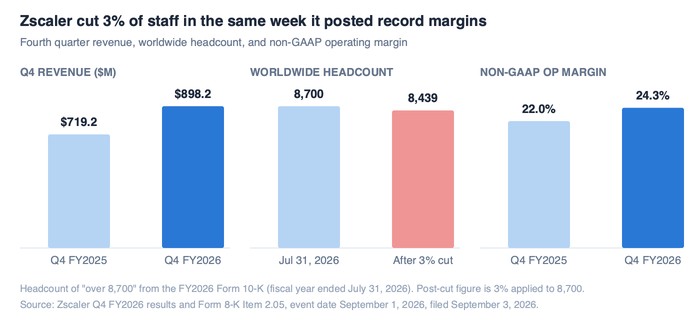
The disclosure arrived bundled with results. The same 8-K carried Items 2.02 and 9.01 alongside the Item 2.05 restructuring note, which is why the layoff and the earnings beat hit the wire within minutes of each other. Fourth quarter revenue reached $898.2 million, up 25% from $719.2 million a year earlier. Annual recurring revenue reached $3,771 million, also up 25%, with $246 million of net new ARR in the quarter. Non-GAAP operating income was $218.4 million, a record 24.3% of revenue and roughly 220 basis points better than the 22% Zscaler managed in the same quarter of fiscal 2025. The GAAP net loss narrowed to $3.4 million from $17.6 million. Every one of those figures is available in the Form 8-K Zscaler filed with the Securities and Exchange Commission on September 3, 2026.
What moved the stock was not the cut. It was guidance. Zscaler pointed to fiscal 2027 revenue of $3.908 billion to $3.938 billion and ARR of $4.396 billion to $4.426 billion, which implies roughly 17% growth against the 25% it just delivered. Free cash flow margin for the quarter also fell to 6.8% from 16% the prior quarter as the company pulled forward data center equipment purchases ahead of rising hardware costs. A deceleration from 25% to 17% is the number investors reacted to, and the restructuring read as confirmation rather than cause.
Who was actually cut, and what the filing does not say
Zscaler has not disclosed which teams, roles, or locations were affected, and it is worth being direct about that rather than filling the gap with guesses. The 8-K names a percentage and never a headcount. No state WARN notice listing job titles and addresses has surfaced, which is what usually happens when a 3% reduction is spread thinly across many countries instead of concentrated at one site. Team-level claims circulating on Blind, TheLayoff and Glassdoor are unverified and should be treated that way. The one hard denominator available is the fiscal 2026 Form 10-K, which reports more than 8,700 employees worldwide as of July 31, 2026, up from 7,923 a year earlier. Three percent of 8,700 is about 261 people, and that is where every headcount figure in circulation actually comes from.
The filing does leave one usable signal, though, and it is in the money rather than the words. Zscaler has now run two reductions of the same stated size three years apart, which makes the severance charge directly comparable. In March 2023 the company cut approximately 3% of a workforce its then CFO Remo Canessa had described as roughly 5,900 people, so about 177 employees, and took a charge of $8.0 million to $10.0 million. That is somewhere between $45,000 and $56,000 per affected person. In September 2026 the same 3% covers about 261 people at a charge of $30.0 million to $33.0 million, or roughly $115,000 to $126,000 per person. Using the midpoints, the cost per departing employee went from about $51,000 to about $121,000.
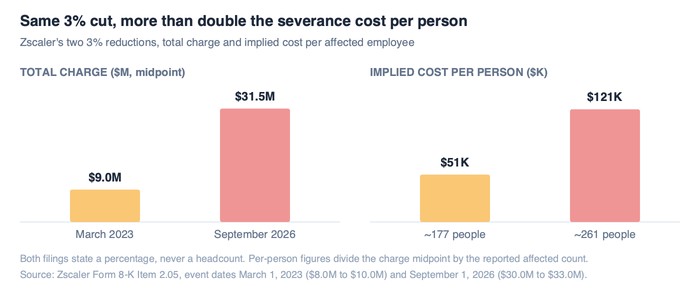
That multiple deserves a caveat before anyone treats it as a payout figure. The charge covers severance and benefits together, and benefit costs per head rise on their own over three years, so this is a proxy rather than a severance cheque. Even allowing for that, a per-head charge that roughly doubles is not explained by benefits inflation alone. In practice, what a jump like that usually reflects is seniority, because severance formulas scale with tenure, base salary and notice period. A 3% cut weighted toward directors, principal engineers and senior go-to-market staff costs far more per person than a 3% cut weighted toward recent hires and support functions. Zscaler has not said that is what happened. The arithmetic is simply harder to explain any other way.
How this fits the pattern of Zscaler layoffs since 2023
Zscaler has disclosed two restructuring plans in the last four years, and the stated reasons for them are almost opposites. Here is the sequence as the filings describe it.
March 1, 2023: approximately 3% of the worldwide workforce, about 177 people, with charges of $8.0 million to $10.0 million. The 2023 Form 8-K gives the reason as a plan to "streamline operations and to align people, roles and projects to the Company's strategic priorities." On the earnings call, management tied it to new customers deliberating longer over large purchases in January 2023 and the resulting slowdown in billings growth. Revenue was still growing 52% year over year at the time. The stock fell 11.8% after hours.
September 1, 2026: approximately 3% of the worldwide workforce, about 261 people, with charges of $30.0 million to $33.0 million. The reason given is "strategically reallocating resources to provide additional capacity to support our AI and growth initiatives." Revenue growth was 25% and operating margin was at a record.
Read together, those two filings describe different situations wearing the same 3% label. The 2023 round was defensive, triggered by deals slowing down. The 2026 round is being presented as offensive, funded by a business that is growing and profitable on a non-GAAP basis. For anyone who was affected, that distinction matters more than it sounds, because it changes the story you are walking into interviews with. Being cut from a company that missed is a different conversation from being cut from a company that beat and reallocated anyway.
The pattern is not unique to Zscaler either. Cybersecurity peers have been running the same play, cutting into strength rather than weakness. Rapid7 did it at a larger scale, and the details of the 12% reduction Rapid7 made while raising its profit outlook track closely with what Zscaler just did on a smaller percentage. Once a sector starts treating restructuring as a portfolio reallocation tool rather than an emergency measure, headcount stops being a reliable signal of company health in either direction.
Why the filing names AI but does not blame it
The Zscaler filing does name AI, and it is worth reading the sentence carefully because the distinction is easy to lose. The company said it is "strategically reallocating resources to provide additional capacity to support our AI and growth initiatives." AI is the place the money is going. It is not the reason the roles disappeared. Zscaler has not claimed that AI systems now do the work those roles used to do, and nothing in the 8-K supports that reading.
Where the money is actually going is documented, and most of it is people. On the earnings call, CEO Jay Chaudhry described the action as "essentially rebalancing, reallocation of some of our resources with better leverage." The reallocated spend funds specialty account executive teams organized by product and by geography, plus salespeople covering smaller enterprise customers, and additional channel resources for the mid-market. Chaudhry said the top end of the enterprise market is well covered while coverage further down market "has been thinner." CFO Kevin Rubin described the sales take-up teams as "dedicated new logo hunters." Chief Revenue Officer Mike Rich is adding headcount for both new-logo and upsell roles, against a target list where Zscaler has reached roughly 4,600 of 20,000 companies. Chaudhry also framed the demand side plainly, saying "AI represents one of the most significant opportunities in Zscaler's history," and Security for AI bookings rose more than 50% sequentially with pipeline up 75%.
That is a sales coverage problem being solved with a sales hiring budget, and the budget came from somewhere. Compare it with a company that made the opposite claim explicitly. When Cloudflare cut 20% of its workforce and named AI as the cause, the framing was that the technology had absorbed the work. Zscaler is saying something narrower and, for affected employees, more useful: these roles were funding a bet, not being replaced by one. If you were cut, you are not carrying an implicit claim that software does your job better. That is a materially easier position to explain, and in 2026 it is a rarer one.
What the 2026 layoff numbers actually show
Zscaler landed in a crowded week. Uber disclosed a roughly 10% reduction covering about 3,300 people, The Trade Desk announced a 15% cut, and PagerDuty announced 15%, all within a few days of each other in early September 2026. Trackers counted 365 layoff events across 2026 affecting more than 209,000 workers as of September 4, which averages out to roughly 846 people per day. Two things are true at once here: the tech sector is running ahead of last year on job cuts, while economy-wide WARN filings were actually tracking slightly below the same point in 2025, at 3,191 notices covering 284,035 employees as of August 25.
The more useful pattern in 2026 is not the volume, it is which companies are cutting. Zscaler beat estimates and posted a record margin. Rapid7 raised its profit outlook. PagerDuty nearly tripled profit. These are not distressed businesses shedding cost to survive, which is what the 2022 and 2023 rounds mostly were. They are healthy businesses moving money between line items, and the people in the line item being reduced absorb the whole cost of a decision that had nothing to do with their performance. Our analysis of what the 2025 and 2026 tech layoff data actually shows works through how often AI gets named as a cause versus how often it gets named, as Zscaler named it, as a destination for reallocated budget.
What to do if you were affected
Start with the calendar, because your leverage is highest while you still have company access. Zscaler is recognizing the majority of these charges in the first half of fiscal 2027, which for a company whose fiscal year ended July 31, 2026 means roughly August 2026 through January 2027. If you are inside a notice period rather than separated immediately, treat every remaining paid week as search time rather than wind-down time. One thing worth doing in that window, before anything else on the list below, is to say your layoff explanation out loud to something that will push back. The first live conversation should not be the first time you have tried the sentence. Booking a low-stakes round where you can rehearse the answer against the actual job description is the cheapest way to discover that your version runs too long or sounds defensive, which is almost always what goes wrong on a first attempt.
Five things are worth doing in the first week, in this order:
- Export your last two performance reviews and any written manager feedback before your accounts are deactivated. You cannot reconstruct these later and they are the raw material for every behavioral answer you will give.
- Write down your metrics while you still remember them precisely. ARR you influenced, incidents you resolved, latency you cut, deals you supported. Specific numbers survive interviews; adjectives do not.
- Collect personal contact details for three people who would vouch for you, including at least one who is not your direct manager.
- Read your severance agreement for the non-compete, non-solicit and reference-policy clauses before you sign anything. Know what you have agreed to say.
- Save copies of any project documentation you authored that is not confidential, so you can talk about your work concretely without relying on memory.
Then get to the market faster than feels comfortable. Severance creates a false sense of runway, and the gap between finishing your last day and sending your first application is the single thing most people underestimate. Applications sent in the first two weeks land while your context is sharp and your references still remember the specifics of what you shipped. The practical mechanics of the search, from sequencing applications to handling the employment gap question on your resume, are covered in our guide on landing a tech job after a layoff, which is built around the search itself rather than the emotional aftermath. The sequencing advice there matters more than usual in a case like this one, because a September reduction puts you into the market at the same time as everyone cut by Uber, The Trade Desk and PagerDuty in the same week. Applying early is worth more than applying broadly when the candidate pool for enterprise software roles thickens that fast.
How to explain a Zscaler layoff in your next interview
Lead with the scope of the decision, not with yourself. The sentence that works is short and factual: "Zscaler reduced its worldwide headcount by about 3% in September 2026 to reallocate budget toward AI and sales coverage, and my role was part of that reduction." That is three pieces of information, all verifiable, and it takes eight seconds. An interviewer who hears a company-level number stops evaluating whether you were managed out, because 3% of a workforce is visibly not a performance decision.
Resist the pull to over-explain. This almost always arrives as a behavioral interview prompt rather than a factual one, usually phrased as "why did you leave your last role" or "walk me through your last transition," and the phrasing is a clue about what is being measured. The most common failure pattern on the question is not a bad reason, it is length. Candidates who feel the need to justify themselves talk for ninety seconds, and the length itself signals that they think something needs defending. A pattern we see constantly in practice sessions runs like this: a candidate opens with the one-line version, which lands fine, then reads the interviewer's silence as doubt and starts adding context about their manager, the reorg, the quarter. By the time they stop, the interviewer has learned nothing new and the candidate sounds like they are litigating something. The silence was just the interviewer writing notes. State the scope, state that your role was included, then stop talking and let them ask the next question. If you are asked a follow-up, the Zscaler specifics genuinely help you, because the company beat revenue estimates and posted a record operating margin in the same quarter. There is no version of this story where the business was failing and you were part of the failure, and that is a rarer position than most laid-off candidates get to occupy.
That framing also means the interviewer is scoring your composure as much as your content, which is why rehearsing the delivery matters more than refining the wording. Candidates coming out of cybersecurity roles hit an extra wrinkle on top of this. Zero trust and identity interviews tend to run heavy system design rounds alongside the behavioral screen, so the layoff conversation is rarely the hard part of the loop. It is worth reading how others handled that combination in this thread on the zero trust system design round in Okta security engineer interviews, where the gap between standard engineering prep and what actually gets asked comes up repeatedly.
For the live conversation itself, the FinalRound desktop app covers the whole loop rather than just the moment you are sitting in. You set up a Goal for the specific role and company you are targeting, load in the job description and your own materials, then drill the answers you expect to fumble before the round happens. During the actual interview you get real-time support, and afterwards a Debrief walks back through what you said and flags which answers ran long and where you hedged. For a layoff explanation specifically, the Debrief is the part that earns its keep. The fix is almost always cutting the answer in half, and that is exactly the thing you cannot hear yourself doing while you are in the room. See how Interview CoPilot™ supports you during a live interview if you want the mechanics before you download the app.
Author's Comment
"The thing I keep noticing across the layoff articles I write is that candidates undersell the percentage. People say 'I was laid off' and stop, when saying 'the company cut 3% and I was in it' does almost all the work for them in one clause. Zscaler is an unusually clean case for this, because the same filing that ended those jobs also reported record margins, and that is a fact you can hand an interviewer instead of an explanation."
Jaya Muvania, SEO Specialist at Final Round AI
Zscaler is one of several profitable companies that reduced headcount during 2026 while reporting growth, and the pattern is clear enough now that each new filing mostly confirms it rather than surprising anyone. We track these disclosures as they land, working from the 8-K or the WARN notice rather than the press summary, because the filing and the headline often say different things. You can browse our latest layoff and hiring news coverage for the rest of them.
Related Interview Guides
- PagerDuty Layoffs: 15% Cut as Profit Nearly Tripled: the closest parallel to Zscaler in structure, a SaaS company cutting deeper while profit rose sharply.
- Nutanix Layoffs: 5% Cut as Operating Income Rose 45%: useful if you want to see how common the profitable-company reduction has become in enterprise infrastructure.
- How to Explain a Layoff in an Interview: the full scripting for the conversation this article only covers in outline, including the follow-up questions.
- AI Tech Layoffs USA (August 2026): Which Companies Cut Jobs?: the month immediately before the Zscaler disclosure, for anyone mapping the wider sequence.
Prepare for the interviews that come next
A 3% reduction is a company-level decision, and the interviews you walk into next will treat it that way once you learn to say it in one sentence. Interview CoPilot™ in the FinalRound desktop app lets you prepare against the exact role you are targeting, practise the answers you expect to stumble on, get support during the live conversation, and review what actually landed afterwards. Download the app to start preparing for the next round.
Frequently Asked Questions
How many employees did Zscaler lay off in September 2026? Zscaler said it would reduce worldwide headcount by approximately 3%, and the filing never states a number of people. Against the more than 8,700 employees reported in its fiscal 2026 annual report, that works out to roughly 260 positions. Every specific headcount figure in circulation is arithmetic against that base rather than a disclosed number.
Why is Zscaler laying off employees? The company said it is reallocating resources to add capacity for its AI and growth initiatives. In practice the freed-up budget is funding sales coverage, specifically specialty account executive teams and salespeople aimed at smaller enterprise customers, after CEO Jay Chaudhry said coverage further down market had been thinner than at the top end.
Are the Zscaler layoffs because of AI? Not in the sense most people mean. The filing names AI as the destination for reallocated spending, not as the reason the roles were eliminated. Zscaler has not claimed AI systems replaced this work, which distinguishes it from companies that named AI as the direct cause of their reductions.
Which roles did Zscaler cut? Zscaler has not disclosed the affected teams, functions, or locations, and no WARN notice listing job titles has surfaced. The one available inference is financial: the severance charge per affected employee roughly doubled versus the 2023 round, which is consistent with more senior and higher-paid roles being included this time.
Is Zscaler still hiring after the layoffs? Yes. The stated purpose of the reduction is to fund hiring elsewhere, with Chief Revenue Officer Mike Rich adding headcount for new-logo and upsell sales roles plus additional channel resources for the mid-market. Zscaler also guided to fiscal 2027 revenue of $3.908 billion to $3.938 billion, so the company is planning for growth.
Table of Contents
Related articles
Google Layoffs: 52 Cut the Week Its AI Leaders Quit
Google layoffs hit 52 Washington jobs across Kirkland, Redmond and Seattle. What the WARN filing says, why it never mentions AI, and what to do next.

87% of HR Leaders Planning Layoffs Because of These 2 Reasons
A new report reveals 87% of HR leaders have conducted or plan layoffs in 2026. See what the key reasons are driving the cuts.

Vimeo Confirms Sweeping Layoffs Globally After $1 Billion Sale
Vimeo begins cutting jobs globally following its $1.38 billion sale, as the video platform undergoes major restructuring

Fiverr Lays Off 30% of Workforce to Become AI-First Company
Fiverr fired 250 workers because AI can now do their jobs. The CEO says the company doesn't need as many people anymore.