Xbox Layoffs: CEO Asha Sharma Plans Job Cuts to ‘Reset’



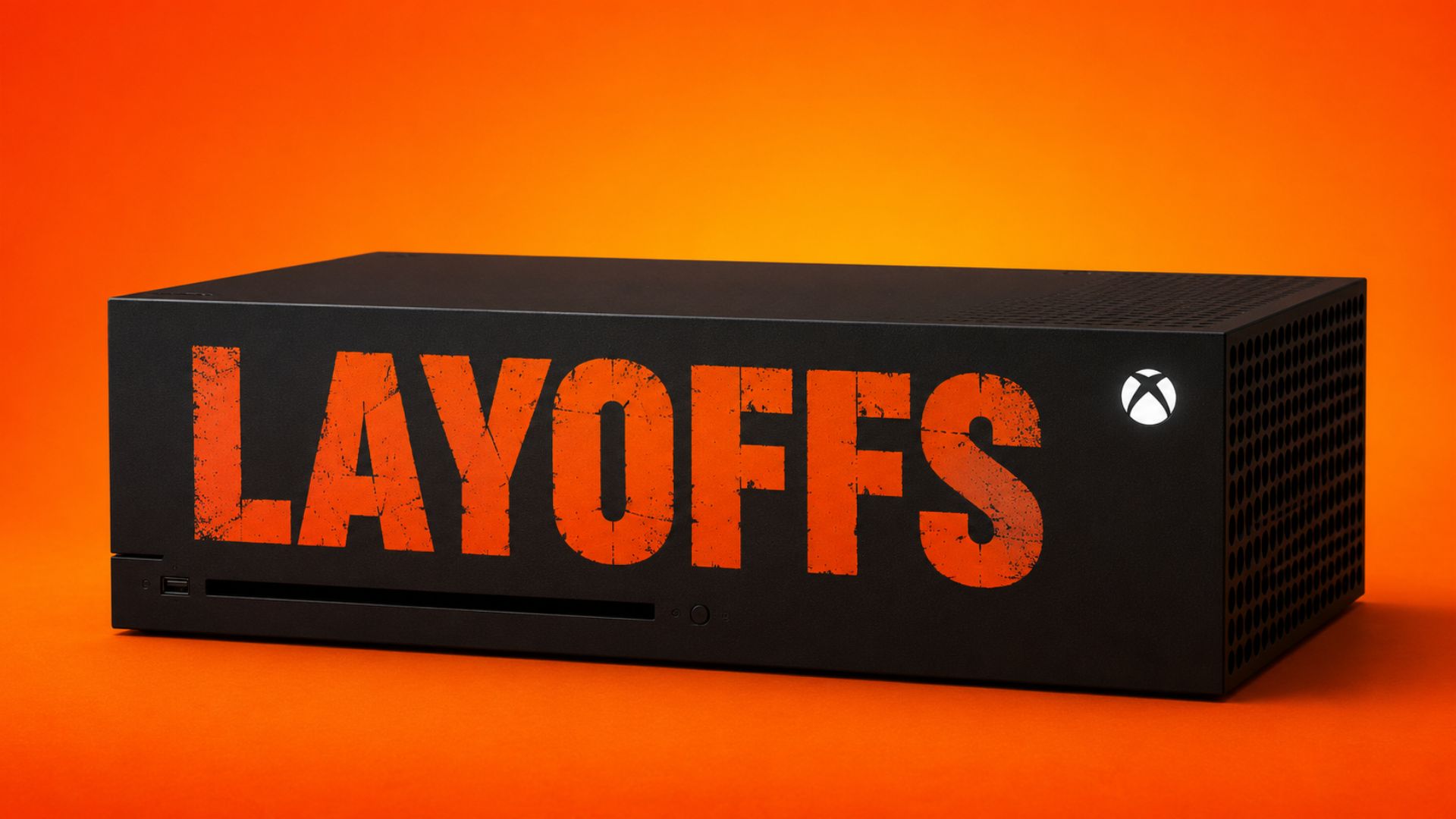
Microsoft's Xbox division is reportedly preparing major layoffs and budget cuts as new CEO Asha Sharma launches a business reset.
The restructuring follows years of heavy spending, declining revenue, shrinking profitability, and rising hardware costs.
Update, September 23, 2026: the cuts described below are no longer a plan. Microsoft has since carried out two rounds. This article has been expanded with the confirmed figures, the studio reorganization announced on September 22, 2026, and what the filings do and do not say.
Quick Answer
- Microsoft eliminated 268 roles across Halo Studios, other first-party studios and Xbox Game Studios management on September 22, 2026. That figure is global and specific to Xbox Game Studios. Microsoft separately confirmed roughly 300 affected employees in Washington state across all divisions, and a companywide total it described as fewer than 600.
- This was the second Xbox round of 2026, not the first. The July 6, 2026 action cut about 4,800 people companywide and filed a Washington notice covering 605 Redmond positions. Xbox chief content officer Matt Booty wrote that the actions completed since July, including studio divestitures, bring Microsoft "roughly three-quarters of the way through previously announced restructuring."
- Neither the September memo nor the Xbox Wire post mentions artificial intelligence anywhere. The stated reason is structural, namely operating fewer business units. Microsoft has separately and explicitly denied that AI replaced the eliminated roles.
Xbox Layoffs in July 2026?
Just days after Xbox hosted Games Showcase 2026, the division is planning major job cuts expected to arrive in July, as reported by Bloomberg.
On top of job losses, Xbox is also planning to slash budgets for marketing and several other areas of the business.
The exact number of workers affected has not been officially confirmed, but a report mentions around 1,000 jobs are on the chopping block. That figure was the pre-announcement estimate. The confirmed numbers arrived later and are set out in the September 2026 sections below.
The cuts are expected to hit multiple parts of the business at once. It might even result in a studio closure or changes to the Xbox Game Studios lineup.
That would be a particularly painful development for game developers inside the Xbox ecosystem, many of whom have already lived through previous rounds of cuts.
The layoffs are expected shortly after the close of Microsoft's fiscal year on June 30.
New CEO, New Layoffs
Asha Sharma was appointed Executive Vice President and CEO of Microsoft Gaming in February 2026, replacing Phil Spencer.
Spencer retired from the role, leaving Sharma a division that has struggled with persistent challenges around revenue growth and profitability.
Sharma did not waste time sugarcoating the situation. In internal communications issued in April and May, she told staff the gaming division would need to make hard choices to revitalize growth.
On June 10, Sharma and Xbox chief content officer Matt Booty sent a memo to staff laying out the financial reality. The leadership has launched a 100-day "Xbox Reset" initiative focused on improving profitability.
The memo, which was posted publicly on Xbox Wire, did not use the word "layoffs," but it did not need to:
"We expanded our studio system when we needed a pipeline of content to meet multiple strategies across subscription, streaming, and devices. In the process, we have found ourselves overextended as we executed on changing strategies in a landscape of more readily available content. We need to reassess the balance between these and our investment priorities for the next 5 years."
The memo explained that Xbox has spent over $20 billion on content, platform, and hardware investments over the past five years, only to see annual revenue decline by almost $500 million over that same period.
That is a company spending at scale while shrinking its income. And Sharma said plainly: "Going forward, this cannot continue."
The memo also pointed to a hardware component crisis. The price Xbox was paying for console storage components when Sharma joined in February was already over double what it had been the previous fall and has since doubled again.
By the 2027 holiday season, Xbox expects those costs to exceed five times what they paid just two years earlier. Memory costs have followed a similar trajectory.
Sharma also acknowledged that Xbox's accountability margin would end the fiscal year at just 3%, down year over year. For a division of Microsoft's size, that is a razor-thin margin that cannot sustain current spending levels.
On the studio side, Xbox had expanded its studio network aggressively to fill a content pipeline for subscriptions, streaming, and devices. But with the gaming landscape now flooded with content and strategies shifting, that expansion left Xbox overextended with franchises that have not been funded well enough to compete.
What Microsoft disclosed in the September 22 memo
On Tuesday, September 22, 2026, Xbox chief content officer Matt Booty sent a staff memo titled "Continuing Our Reset" that Microsoft published the same day on Xbox Wire. The memo is the primary source for every number in this section. It is worth being precise about who wrote it, because several outlets attributed it to Asha Sharma. Sharma wrote the July 6 memo. Booty wrote this one.
"First, we are eliminating 268 roles across Halo Studios, other first-party studios, and the XGS management and central functions layer. The actions completed since July, inclusive of the studio divestitures, bring us roughly three-quarters of the way through previously announced restructuring."
Three different numbers circulated within hours of that memo, and they are not interchangeable. The 268 figure is global and covers Xbox Game Studios only. Microsoft chief communications officer Frank Shaw confirmed a separate figure of roughly 300 affected employees in Washington state, spanning every division rather than gaming alone. Microsoft characterized the companywide global total as fewer than 600. A fourth number, 286, appeared in at least one headline and has no source behind it. Treat it as a transposition of 268.
One detail has been widely misreported and matters if you are trying to work out your own notice period. There is no Washington WARN filing behind the September round. The 605-position Redmond notice that appears in the state database was received on July 6, 2026 and took effect on September 4, 2026, which makes it the Washington slice of the July action, not this one. Anyone checking the Washington State Employment Security Department notice list and finding that entry is looking at the earlier round. Washington requires 60 days of notice for a mass layoff, and July 6 to September 4 is exactly 60 days. If Microsoft files for the September action, the arithmetic points to an effective date near November 21, 2026.
Which studios changed hands, and what happened to Halo
The reorganization is the larger story, and unlike the headcount it is fully documented in the memo. Activision now oversees Rare and World’s Edge, the studio behind Age of Empires, and it will develop the next Halo game with what Booty described as a new, purpose-built team kept separate from Call of Duty development. A small team remains at Halo Studios to support the Halo community and the games already in market. Rob Kostich, president of Activision, said the company was "thrilled to welcome Halo, Rare, and World’s Edge to Activision."
Elsewhere in the memo, Obsidian moves under Bethesda while continuing work on Grounded and a new Fallout project. Turn 10 and Playground Games merge into a single studio covering Forza and Fable. Microsoft Casual Games moves under King. Undead Labs returns to independence with its intellectual property, back catalog and runway funding, and State of Decay 3 remains a day-one Game Pass title under a new publisher. Compulsion Games and Double Fine had already returned to their own management teams in August 2026 on similar terms.
Two outcomes are unresolved rather than final. Booty wrote that two separate agreements for Ninja Theory fell through and that Microsoft will "begin consultation with employees on a proposed closure while continuing to explore other paths forward." Consultation over Arkane Lyon continues under French law and is expected to run through the end of 2026. Blizzard was told in an internal email that it is not affected by this round. For anyone in the industry updating their materials, shipped credits and systems work still carry more weight than titles do, which is worth remembering when you rebuild a portfolio alongside a resume and start preparing for the technical rounds gaming studios actually run.
What surfaced after the memo: the studio-level detail Microsoft didn't publish
The September 22 memo gave a company-wide number and a list of studio moves. It didn't say which teams absorbed the cuts or how deep they went. That detail arrived over the following two days, and it came from the people who were let go rather than from Microsoft.
The sharpest example is World's Edge, the team that stewards the Age of Empires franchise. Creative Director Adam Isgreen, who had been at Microsoft for 16 years, wrote on September 23 that "World's Edge was not spared completely - just under half the studio was let go - myself included." Microsoft has not published a headcount for World's Edge, and Isgreen did not give one, so "just under half" is the most precise figure that exists.
A day later, senior software engineer Andrew Martz confirmed on LinkedIn that an upcoming World's Edge project had been cancelled in the same restructuring. He was laid off roughly a week after a promotion that took effect on September 15. The project has not been named by anyone with direct knowledge, and the widely circulated guess that it was a mainline Age of Empires sequel is speculation, not reporting. Worth knowing if you are reading coverage this week: World's Edge is a stewardship and coordination team rather than a conventional development studio, since Relic built Age of Empires IV, so cuts there do not automatically cancel work happening at external partners. Kotaku collected both posts as they appeared.
The most widely shared post from the round came from Halo Studios itself. Josh Daniels, a cinematic director there who joined in 2024 after nine years on Forza Motorsport at Turn 10, wrote that being "promoted and laid off in the same week is pretty wild," and said he was one of many hit by the Halo Studios cuts. The promotion landed on the Monday. The layoff landed on Tuesday, September 22. It is a small detail and it is worth holding onto if you are in this round, because a promotion days before a cut is documentary evidence that the decision was structural rather than performance-based. That is a distinction hiring managers care about, and Daniels now has it in writing.
Two numbers circulating about Halo Studios, and which one to trust
You will see a claim that Halo Studios is down to about 20 developers. Where did that figure come from, and has anyone at Microsoft confirmed it? It traces to a professional Halo player, relayed through a fan account on X citing an unnamed source, and no. Microsoft has not broken out a Halo Studios number at all. Windows Central's Jez Corden, who covers Xbox closely, separately characterised the cuts there as being in the hundreds, which is a looser claim but a far better sourced one. If you are citing a figure for Halo Studios, cite Corden's, or cite none.
Undead Labs, the State of Decay studio, is the other team where the detail matters more than the headline. It is becoming an independent, employee-owned studio, and it confirmed a significant number of layoffs alongside that split. "Independent" is doing a lot of work in that sentence. A studio going employee-owned after a corporate parent steps back is not the same event as a studio being spun out with funding, and anyone writing about the move as a straightforward liberation is skipping the layoffs that came with it.
Why a rival CEO endorsing the reshuffle isn't the same as endorsing the cuts
Epic Games chief executive Tim Sweeney drew attention on September 22 by responding to criticism of Microsoft moving Halo, Rare and World's Edge under Activision. He wrote that "putting the best performing studios in charge of the projects with the most potential makes sense, and gives those projects the best chance of success." Several outlets framed that as Sweeney defending the layoffs. Read it again: he is endorsing the org chart, not the 268 job losses, and he says nothing about the people cut. Epic itself let go of around 1,000 staff in 2023.
None of this changes the AI picture set out earlier on this page. No source in the September round, memo or otherwise, ties these 268 roles to automation. They are portfolio and consolidation cuts. Treating them as a story about AI would be inventing a cause the evidence doesn't support, and an interviewer who works in games will know the difference.
What the September 24 Washington WARN filing disclosed
Microsoft’s notice under the Worker Adjustment and Retraining Notification Act is dated September 22, 2026, the same day Booty published the memo, and the Washington State Employment Security Department received it that day. The state posted it publicly on the afternoon of Thursday, September 24, and Todd Bishop at GeekWire reported the contents that evening. Those are three different dates for one event, and the one that matters if you are counting notice periods is September 22.
The filing puts an exact number on cuts Microsoft had described only in round terms. It covers 277 positions in Washington: 252 at One Microsoft Way in Redmond, and 25 held by remote employees living in the Puget Sound region. The notice states that Microsoft "has decided to reorganize and restructure operations," that "all 277 positions will be permanently eliminated as of November 21, 2026," and that the decision "is final and is expected to be permanent." It also records that "the facilities will not be closed as a result of this decision," and that affected staff "are not entitled to an opportunity to ‘bump’ or trade places with individuals who are not affected by the decision." One line leaves a narrow door open: "Some of the affected positions may be moved to Microsoft entities in other locations." The letter is signed by Michael Mattmiller, general manager for Washington state and global employee engagement, and it notes that Microsoft emailed affected employees and local elected officials on September 22.
Why 277, 268 and 300 are three different numbers, not one number reported badly
Three figures have circulated this week and none of them contains the others, which is why coverage that treats them as versions of the same count keeps producing arithmetic that does not work. The 277 is a Washington state figure covering every business unit at Puget Sound worksites, and it exists because a statute requires it. The 268 is a global figure covering Xbox Game Studios only, and it includes staff outside Washington and outside the United States while excluding every Washington cut that sat in cloud, AI, marketing or research. The roughly 300 was Microsoft’s own pre-filing approximation for Washington, given on September 22 before the paperwork was finalised, and the WARN reconciles it downward because the notice counts only employment losses that meet the legal definition. The global total across all units stays below 600. Writing that 268 of the 277 were Xbox roles would be wrong.
The job-family breakdown, and what it says about who Microsoft kept
Attachment A of the notice lists every eliminated position by job family and level band, and the distribution is the most useful thing in the document. Software engineering is the single largest category at 60 positions. Game-craft roles come next as a cluster: art at 29, game producers at 19, game design at 16, technical art at 8 and audio design at 5, which is 77 positions, or 28 percent of the filing, drawn from the disciplines that actually make games. Technical writing loses 20, product marketing 16, product management 13, technical program management 12, business management 10, and data science and business program management 8 each. The remaining 53 are spread thinly across more than 20 other families including site reliability engineering, product design, community management, research sciences and legal counsel.
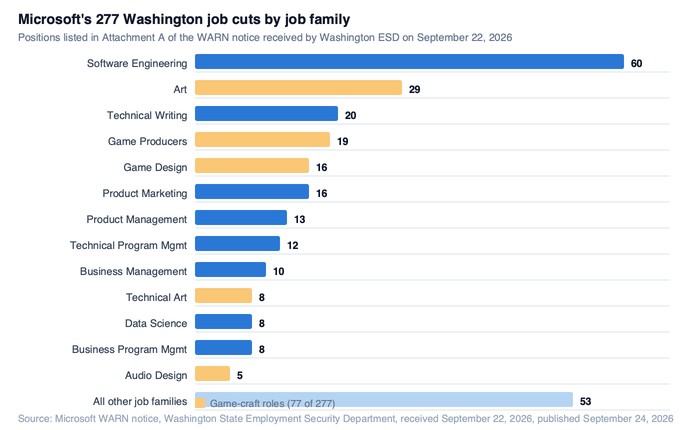
The level bands complicate the usual reading of a games layoff. Most of the cuts sit at IC4, a mid-career individual contributor band, which is what you would expect. But the filing also removes senior managers, including M8 positions in software engineering and product marketing and M7 positions across product management, service engineering, business development, financial analysis and integrated marketing. This was not a round that spared the management layer, and if you are writing a resume for a lead or principal role, that is the part of the disclosure worth knowing before an interviewer implies your level was the safe one.
Sixty days exactly, and what that gives you
The notice date of September 22 and the separation date of November 21 are exactly 60 days apart, which is around 8.6 weeks. That is the statutory floor under Washington’s Securing Timely Notification and Benefits for Laid-Off Employees Act, not a cushion above it. Anyone in the 277 has two months of paid notice and then the separation lands three weeks before the December holidays, in the quietest stretch of the hiring calendar. Practically, that means the useful interview window is October and the first half of November, while you are still employed, not January. You can read the underlying record yourself in the Washington State WARN notice database, which is searchable by employer and publishes the filed notice as a PDF.
One trap is worth naming because it is circulating. A second Microsoft figure, 605 Redmond positions, has been posted this month as though it were new September activity. It is not. That is the July 6, 2026 filing reaching its September 4 separation date, which is the same event Sharma announced in the summer, showing up again as an effective date rather than an announcement. Microsoft has filed exactly one Washington WARN notice in September 2026, and it is the 277.
Is Xbox planning more layoffs after September?
Yes, according to Fortune's reporting, though Microsoft has not confirmed it. Asha Sharma is planning the next rounds of Xbox layoffs for October, November and January, and the plans could still change. That timing comes from people familiar with the plans who spoke to Fortune, and The Verge and other outlets have since repeated it, all citing the same report rather than separate sources. The report gives no dates, teams, studios or headcounts for those rounds.
The same report, published on October 20, 2026, gives the clearest running total yet. Sharma "has cut 1,868 people as part of plans to reduce headcount by 3,200 during the next year," Fortune's Sebastian Herrera wrote in his profile of Sharma. On our arithmetic, that leaves about 1,332 roles of the stated 3,200 target still to go, if the target holds. Fortune does not say whether the October, November and January rounds fall inside that 3,200 or come on top of it, so treat the remaining figure as a ceiling implied by the plan, not a forecast.
If you work at Xbox and were not hit in July or September, this changes your planning window. Three more rounds over roughly four months means the wait-and-see approach is expensive. Update your resume and portfolio now, collect the metrics for the titles and systems you shipped while you still have access to the dashboards, and ask two colleagues today whether they would be references. That way, a notice in November or January starts a job search you have already prepared for, not one you begin from scratch.
How this fits the pattern of Microsoft layoffs since 2025
Reporting on this round has repeatedly dated Microsoft’s largest cuts to 2026. They were 2025. Setting the sequence out properly changes how the September number reads, because 268 is a small action inside a much larger programme that has been running for nearly two years.
- January 2025: roughly 2,000 to 2,200 performance-based cuts across the company.
- May 13, 2025: about 6,000 people, under 3% of the workforce, concentrated in management layers, engineering and product management, plus LinkedIn. The Washington notice covered 1,985 Redmond positions.
- June 2025: about 300 further cuts at the Redmond headquarters.
- July 2, 2025: about 9,000 to 9,100 people, under 4% of the workforce, hitting Xbox, ZeniMax and King. Perfect Dark and Everwild were cancelled and The Initiative was closed. The Washington notice covered 830 positions.
- Early 2026: Microsoft ran its first voluntary retirement programme, offered to roughly 9,000 eligible US staff at level 67 and below. About 30% accepted.
- July 6, 2026: about 4,800 people, roughly 2.1% of the workforce, across sales, consulting and Xbox. Microsoft also announced a plan to reduce about 3,200 Xbox roles across the 2027 fiscal year, which is a plan rather than a completed round.
- September 22, 2026: 268 Xbox Game Studios roles globally, about 300 in Washington across all divisions, fewer than 600 companywide.
Across 2025 alone that is roughly 15,000 to 15,300 people. Microsoft’s own headcount disclosure gives the net effect: about 223,000 full-time employees as of June 30, 2026, down from 228,000 a year earlier. Research and development fell from 80,000 to 77,000 over the same period. The September action is the tail end of the July programme, not a new one, which is exactly what Booty’s "three-quarters of the way through" line is telling readers. Similar sequencing has played out at other large employers this year, and the wider pattern is worth reading alongside our ongoing coverage of hiring and layoff news.
What did Satya Nadella say about the Xbox layoffs?
Microsoft chairman and chief executive Satya Nadella addressed the round publicly three days after the memo, in an interview with Alex Heath on the Sources podcast. His words were reported on September 25, 2026 and they travelled fast, mostly in a form he did not use.
"There's some amount of streamlining the team is doing, and Asha is doing, which is great to see. And then we have to invent the right sustainable business model that allows us to deliver gaming to more and more people."
Read that sentence carefully before you repeat it, because a lot of headlines rendered it as Nadella saying the Xbox layoffs are great to see. He never says the word layoffs. "Great to see" attaches grammatically to "streamlining," and "Asha" is Asha Sharma, the CEO of Microsoft Gaming. Several outlets also trimmed "the team is doing, and" out of the middle, which tightens the quote into something blunter than what was said. The paraphrase is an editorial reading. It is not a quotation, and putting it inside quotation marks is the kind of error that will be caught if you cite it in a room full of people who work in games. Nadella separately said he feels fantastic about the intellectual property Microsoft holds right now. Kotaku published the full exchange, and it is short enough to read in a minute.
What the remark is actually useful for is calibration. The chief executive of the parent company described a round that cost 268 people their jobs as streamlining he is glad to see, and in the same breath admitted the business model underneath it has not been invented yet. That is the honest summary of where Xbox sits: the cost side has a plan and the revenue side does not. If you are interviewing at Microsoft Gaming or anywhere in its orbit over the next year, that gap is the thing to have a view about.
Why the September memo never mentions AI
It is the first question most people ask about a 2026 layoff, and for this round the honest answer is that Microsoft did not make the claim. Neither the word "AI" nor "artificial intelligence" appears anywhere in the Xbox Wire post. The stated rationale is structural: operating fewer business units, aligning groups that already work closely together, and concentrating publishing expertise.
Microsoft has gone further than silence. Chief people officer Amy Coleman said of the July 2026 round that the eliminated roles were not being replaced by AI, while acknowledging that AI is changing how work gets done. That is an on-the-record denial, and it deserves to be reported as one rather than quietly ignored because a different framing would be more dramatic.
What remains true, and what makes the juxtaposition uncomfortable rather than causal, is the financial backdrop. Microsoft closed its 2026 fiscal year with revenue of $331.8 billion, up 18%, and net income of $133.7 billion, up 31%. In the June quarter alone it spent $41 billion on capital expenditure, up 69% year over year. Gaming is the exception inside that picture: Xbox content and services revenue fell 10% in the quarter, the More Personal Computing segment declined 4%, and Microsoft took an impairment charge on the Xbox gaming business. Asha Sharma put the division’s problem plainly in July, saying the business was "not healthy" and operating at margins "3-10x lower than comparable platform and publishing businesses." A profitable parent company cutting inside its one shrinking division is a different story from a company automating jobs away, and it is worth keeping the two apart.
How to explain an Xbox layoff in your next interview
The scale of this restructuring is the most useful thing you have in an interview, because it removes the question of individual performance entirely. A hiring manager who reads that 268 roles went in one action, inside a programme that has moved roughly 15,000 people since 2025, does not need convincing that the decision was structural. Say the number, name the programme, and move on to what you shipped. "My role was eliminated when Xbox Game Studios consolidated its management layer in September, one of 268 positions cut across first-party studios" does the work in a sentence.
Practising the delivery matters more than polishing the wording, because the sentence itself is short and the difficulty is saying it without defensiveness. Record yourself answering it twice, listen back, and cut anything that sounds like an apology. The version that works is flat and factual, and it ends by handing the interviewer something to ask about next. Our guide to answering the "why did you leave" question after a layoff covers the phrasing that holds up under follow-up questions.
Two specifics help in gaming interviews in particular. If your studio was divested rather than closed, say so, because Undead Labs returning to independence with its intellectual property and back catalog and Ninja Theory entering closure consultation are very different situations, and interviewers in this industry know the difference. Divestiture reads as a business decision about portfolio shape. Closure reads, wrongly but persistently, as a judgement on the team. Naming which one applies to you closes off an assumption before it forms. And if you were part of a team whose franchise moved to another publisher, as Halo, Rare and World’s Edge did in September, that is portfolio context rather than a gap in your record. You shipped what you shipped, and the reporting line changing afterwards does not alter the work.
Expect the conversation to start earlier in the process than you might assume. Most gaming and technology employers surface the question during the initial screening rather than saving it for the hiring manager, so the answer needs to be ready before your first call rather than rehearsed between rounds. Recruiters at that stage are not evaluating the substance of your answer so much as checking that you have one and that it does not consume five minutes. Keep it to two sentences on the phone screen and save the detail for the people who will actually work with you.
It also helps to hear how people a few weeks ahead of you are handling it, because the second and third rounds of a restructuring produce a cohort of candidates interviewing at the same studios in the same window. Recruiters at Sony, EA, Riot and Amazon Games already know this cohort exists and are actively looking for it, which is a meaningfully better position than interviewing alone against a quiet market. Developers who went through the earlier Xbox rounds have been comparing notes on exactly this in our community thread on interviewing straight after Xbox infrastructure cuts, which is worth reading if you are heading into loops in the next few weeks.
Bottom Line
For the thousands of people employed across Xbox and its studios, these will be troubling times. The internal speculation about July layoffs has been circulating since at least April, which means staff have been living with uncertainty for months.
But Xbox is not in crisis in the way a failing startup is. Microsoft is still one of the largest and most profitable companies in the world. Within the gaming division, however, there is a genuine reckoning underway.
Asha Sharma has been direct about this in a way her predecessors were not. Whether that honesty translates into a genuine turnaround, or just another round of painful cuts that fails to fix the underlying problems, is the question that will define Xbox's next chapter.
The news has triggered a largely negative reaction across gaming communities, where many users see the move as the culmination of years of strategic missteps rather than an unavoidable business necessity.
People are questioning why workers should lose their jobs when Microsoft remains one of the world's most profitable technology companies.
What Gaming Industry Workers Should Do After Xbox Layoffs
If you were part of the Xbox or Microsoft Gaming restructuring, the gaming job market remains active despite headline-level cuts. Sony Interactive Entertainment, EA, Riot Games, Amazon Games, and Ubisoft all have open engineering, production, and design roles.
The challenge is that gaming interviews tend to be long and structured. Technical roles at companies like EA or Riot involve multiple rounds covering game engine knowledge, systems design, and behavioral competencies. Walking in cold is expensive in both time and opportunity cost.
Here is where to focus in your first two weeks:
- File for unemployment benefits on day one. California, Washington, and most states with large gaming hubs have processing delays, so start immediately.
- Review your severance and any non-compete clauses before signing. Gaming non-competes vary widely by state enforceability.
- Update your portfolio alongside your resume. Game credits, shipped titles, and GitHub projects carry weight in gaming hiring in a way that pure resume bullet points do not.
- Practice your interviews now. Use Interview CoPilot™ to get real-time guidance during live practice sessions and actual interviews. Final Round AI runs it as a desktop app, so it sits alongside whatever conferencing tool the studio uses rather than inside the browser tab you are already sharing. The loop it is built around is preparation first, then live support during the conversation, then a written debrief afterwards so you can see which answers landed and which ran long. That debrief is the part most candidates skip on their own, and it is where the improvement between a first screen and a third one actually comes from. Treat the first two screens you take as reconnaissance rather than as chances you cannot afford to lose, because the questions repeat across studios and the second telling is always better than the first. Write down every question you are asked in each one, since the overlap between studios is far larger than most candidates expect. Once you know which answers need work, drill them with Practice Interview against behavioral and technical questions specific to gaming and technology employers.
- Connect with gaming industry communities on Discord and LinkedIn. Many gaming roles are filled through referrals before they are posted.
Xbox layoffs are visible across the industry. Recruiters at competing studios know to look for candidates from this cohort. Lead with your shipped work and your systems experience.
Ninja Theory layoffs begin as closure moves from consultation to confirmed cuts
Update, October 6, 2026: The closure consultation at Ninja Theory, flagged in the September 23 update above, has moved into active redundancies. Staff at the Cambridge studio confirmed job losses beginning October 5, 2026, with multiple developers publicly noting they would not be able to finish the projects they were working on. The studio remains at risk of full closure after two separate spinoff or acquisition agreements fell through.
The sequence matters for anyone from Ninja Theory now in the job market. The September memo from Matt Booty used the phrase "proposed closure while continuing to explore other paths forward," which left the outcome ambiguous. The October confirmations remove that ambiguity for most employees. Under UK employment law, the consultation period gives affected staff advance notice, which is a more structured situation than a US-style same-day separation. That process, and the shipped credits on Hellblade: Senua's Sacrifice and Hellblade 2, are both worth foregrounding in any application.
Candidates coming from a studio closure often face skepticism about project continuity. The framing that works is straightforward: the studio's financial situation was Microsoft's business decision, not a reflection of the team's output. Hellblade 2 shipped to strong critical reception. For anyone navigating that conversation in interviews, Final Round AI's Interview CoPilot™ lets you practice exactly those kinds of framing-heavy questions before you face them live.
Frequently Asked Questions
Why is Xbox laying off employees?
Xbox is cutting jobs as part of a 100-day reset initiative under new CEO Asha Sharma. The gaming division spent over $20 billion on content, platform, and hardware over five years while annual revenue fell by nearly $500 million. Rising storage component costs and a 3% accountability margin made restructuring unavoidable.
What happened to Asha Sharma at Xbox?
Asha Sharma was appointed Executive Vice President and CEO of Microsoft Gaming in February 2026, replacing Phil Spencer. She launched a financial reset initiative and issued a public memo in June 2026 warning that the division needed to make hard choices to return to growth.
Is Microsoft cutting more jobs in gaming?
Yes. Around 1,000 Xbox jobs are reported to be at risk as part of the July 2026 restructuring, potentially including studio closures or changes to the Xbox Game Studios lineup. Both rounds have now happened. The July 6, 2026 action cut about 4,800 people companywide, and on September 22, 2026 Microsoft eliminated a further 268 Xbox Game Studios roles globally alongside a studio reorganization. Microsoft has said it is roughly three-quarters of the way through the restructuring it announced in July.
What should I do if I was laid off from Xbox or Microsoft?
File for unemployment benefits immediately and review your severance agreement. Gaming and tech roles remain open at Sony, EA, Riot Games, and Amazon Games. Use Interview CoPilot™ for real-time interview support and AI Mock Interview to prepare for behavioral and technical rounds before applying.
For the full picture of 2026 tech layoffs and how to navigate them, see our running tracker of every major tech layoff in 2026.
That tracker is the wider context this article sits inside, and it is worth reading if you are trying to work out whether the gaming cuts are part of a general contraction or something specific to Microsoft. The short version is that they are specific. Most of the large 2026 reductions have come from companies reporting flat or rising revenue, whereas Xbox content and services revenue fell 10% in the June quarter. That distinction matters for how you pitch yourself, because a candidate leaving a shrinking division has a different story to tell from one leaving a profitable team that was cut anyway, and interviewers respond better when the story matches the numbers they can look up themselves.
It is also the reason the timeline section above lists every round rather than only the most recent one. Hiring managers remember the July 2025 cuts and the July 2026 cuts as separate events, and being able to place yourself precisely within that sequence is more persuasive than a vague reference to restructuring.
Candidates who use real-time interview AI to practice before the real interview typically feel more prepared and confident going in.
How many Xbox employees were laid off in September 2026?
Microsoft eliminated 268 roles across Halo Studios, other first-party studios and Xbox Game Studios management, announced in a September 22, 2026 memo from chief content officer Matt Booty. That number is global and covers Xbox Game Studios only. Microsoft separately confirmed roughly 300 affected employees in Washington state across all divisions, and fewer than 600 companywide.
Are the September 2026 Xbox layoffs because of AI?
No. The memo and the Xbox Wire post do not mention AI at all, and the stated reason is operating fewer business units. Microsoft chief people officer Amy Coleman said of the July 2026 round that the eliminated roles were not being replaced by AI. Xbox content and services revenue fell 10% in the June 2026 quarter, which points to a demand problem inside the gaming division rather than automation.
Related Interview Guides
- How to Land a Tech Job After a Layoff - A step-by-step guide for navigating the job market after a tech layoff, from resume refresh to offer negotiation.
- How to Stay Motivated During a Long Tech Job Search - Practical strategies for keeping momentum when the search takes longer than expected.
- How Long Does a Tech Job Search Take? - What the data says about average timelines and how to shorten yours.
- Is AI Replacing Jobs? - Which roles are most at risk and what workers can do to stay ahead of automation.
Table of Contents
Related articles

Boston Scientific Layoffs: Up to $300M Budgeted for Job Cuts
Boston Scientific layoffs are underway with no headcount disclosed. See the 8-K numbers, affected sites, the AI angle and what to do if you got notice.
ByteDance Interview Process: 6 Stages and How to Pass
ByteDance runs 4 to 6 interview stages for US roles. Here is what each round tests, how hard the coding is, and what the ByteStyle values mean for your behavioral prep.

US Layoffs in 2025 Hit 5 Year High as Hiring Drops to 2009 Levels
946,426 job cuts announced through September 2025, while hiring plans fall 58% to the lowest level in 16 years, according to a new Challenger report.
Google Lays Off 100+ Cloud Design Staff in AI Restructuring
Google has eliminated 100+ cloud UX jobs in a new AI restructuring move, reflecting its ongoing budget shift toward artificial intelligence.