Washington Post Cuts 33% of Its Staff in Major Layoffs



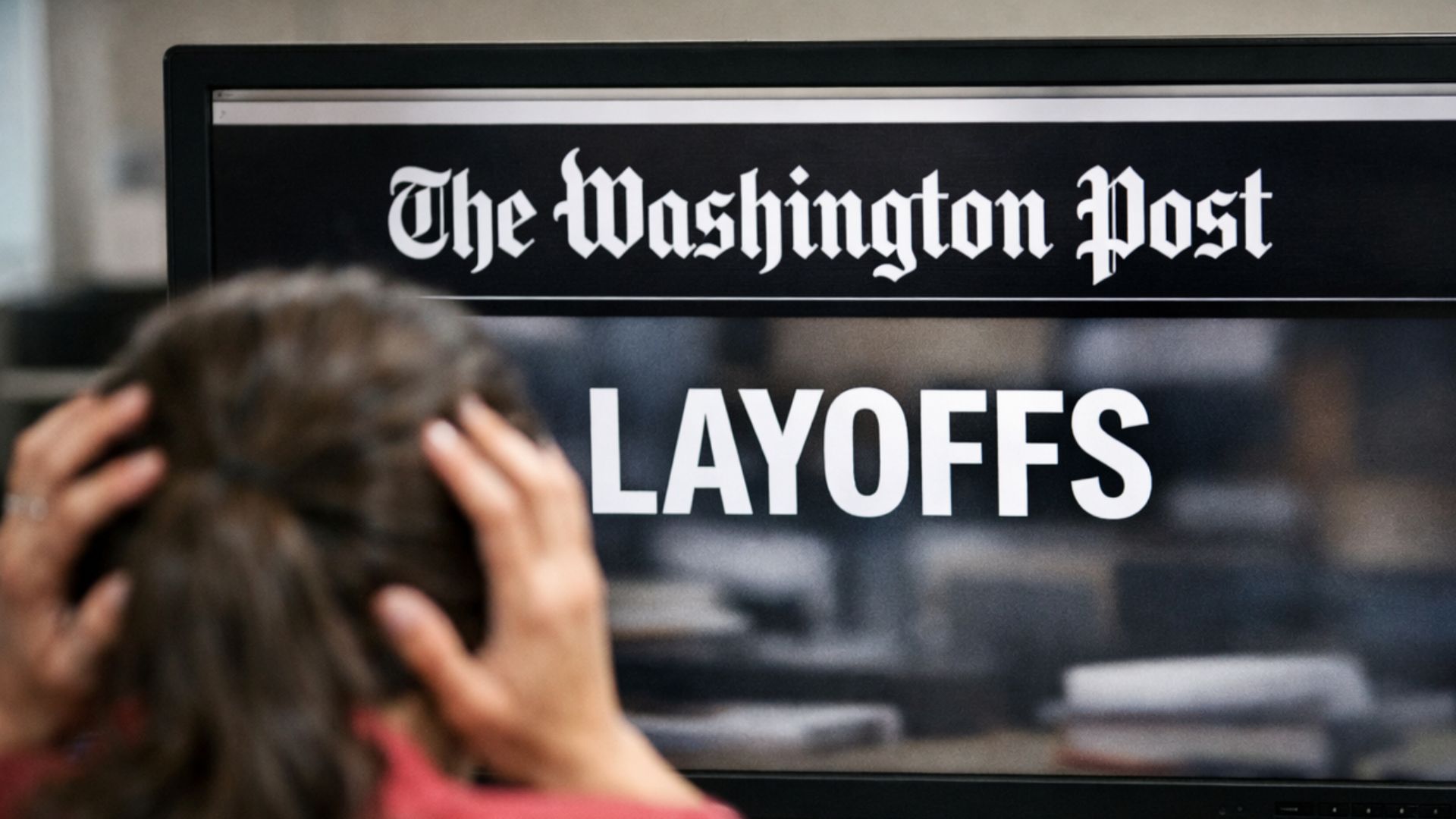
The Washington Post laid off 300 out of its 800 reporters in February 2026.
Why the Washington Post Eliminated 300 Job Roles?
On the morning of February 4, journalists at The Washington Post woke up to devastating news. Approximately 33% of its staff were trimmed in one of the biggest layoffs in the newspaper’s history.
During a newsroom Zoom call, Executive Editor Matt Murray described the decision as a “strategic reset” aimed at helping the paper compete in the age of AI.
The newspaper is eliminating its sports desk, sharply reducing international staff, and canceling its daily podcast.
Here’s who and what will be affected:
- Sports and books news has closed completely.
- “Post Reports” daily podcast is discontinued.
- Caroline O’Donovan, who covered Amazon, was laid off, ironically losing her job at a newspaper owned by Amazon’s founder.
- Several foreign bureaus, including the Middle East and Europe desks, were reduced or closed.
- A correspondent in Ukraine said that she was in the middle of a warzone when she found out about her firing.
- The metro section, which focused on the D.C. region, has been cut from about 40 staffers to about 12.
The restructuring means less coverage of local Washington D.C. news, international events, and sports.
What’s the reason behind the Layoffs?
It’s not like The Washington Post has been losing money. It was more about the traffic. Online traffic from organic search has dropped by nearly 50% in recent years.
Analysts have long criticized The Washington Post’s business model for relying heavily on traffic from third-party platforms such as Facebook and Google.
This dependence made the paper vulnerable to sudden algorithm changes, while limiting its ability to build strong relationships with paying subscribers who provide more stable, long-term revenue.
Matt Murray told staff that online traffic had plummeted nearly 50% in the last three years, partly because of AI changing how people find news.
But there’s more to this story than just business troubles.
The problems got much worse after a controversial decision last fall. Right before the 2024 presidential election, Bezos blocked the newspaper from endorsing a presidential candidate. This breaks decades of tradition. The backlash was swift, and thousands of subscribers canceled their subscriptions.
Now, Murray promised the cuts would bring “stability” and position the paper for the future. The restructured Post will focus heavily on politics, national security, business, health, and technology. These are the areas they believe readers care most about.
But not everyone sees it that way. The Washington Post Guild said that these layoffs could have been prevented, and this will havea huge impact in the future:
“These layoffs are not inevitable. A newsroom cannot be hollowed out without consequences for its credibility, its reach and its future.”
Former executive editor Marty Baron called it “among the darkest days in the history of one of the world’s greatest news organizations.”
Baron expresses skepticism about the executive editor's claim that these changes will diminish the brand, reduce coverage, and likely lead to fewer subscribers.
Readers are also blaming these layoffs on years of incompetent leadership and poor planning in a rapidly changing media landscape as the main factors in the Post's decline. But in the end, only the regular employees will suffer.
What does the October 2026 printing plant WARN notice add?
It adds a second, separate round of Washington Post job cuts, this time on the production side rather than in the newsroom. On October 7, 2026, the Post filed a WARN notice with Virginia Works listing 118 affected employees at its Springfield, Virginia printing plant, with a December 31, 2026 effective date, according to the Washington Business Journal as reported by TheWrap's media editor A.J. Katz. The listed workers include press operators, machinists, maintenance employees and circulation drivers.
Who's affected this time? Not reporters. The February cuts hit the newsroom, while this notice covers the people who physically print and move the paper. That difference matters if you're one of the 118, because your next job search runs through manufacturing, logistics and skilled-trades hiring, not through media.
The closure itself isn't new. The Post said in January 2026 that it would leave the plant at 7171 Wimsatt Road, just inside the Capital Beltway, for a much smaller leased facility near the Loudoun Gateway Metro station in Loudoun County, FFXnow reported at the time. A Post spokesperson told FFXnow then that January 2027 was the earliest printing would move. What the October notice adds is the headcount, the job types and a firm date.
Here are the numbers that explain the move, all from the Business Journal reporting cited by TheWrap:
- The Springfield plant opened in 1980 and covers roughly 500,000 square feet on more than 40 acres.
- The Post said in January it was considering selling the property, which was assessed at $38 million.
- Daily print circulation fell to about 97,000 in 2025, with Sunday circulation at 160,000, according to Alliance for Audited Media figures.
- The Post said in September 2026 that it was on track to break even in 2026 after years of losses.
"We've been in optimization mode on the print side probably for the last 10 or 15 years to match our circulation declines, to match the changing habits of readers," Gregg Fernandes, the Post's chief of print operations, told the Washington Business Journal in January. That line is the clearest explanation the company has given, and it frames the plant closure as a capacity decision tied to falling print demand.
Not everyone at Springfield is losing their job. A source familiar with the plans told TheWrap that about half of the plant's overall workforce is relocating to the new facility. It isn't clear how many, if any, of the 118 people named in the notice will be among them, so if you're on the list, ask HR in writing whether a transfer is on offer and by what date you have to decide.
How much notice do Springfield workers get?
About 12 weeks. A notice filed October 7 with a December 31 effective date gives affected staff 85 days, which is more than the 60 days the federal WARN Act requires before a plant closing or mass layoff. Editor and Publisher reported that a letter to employees described the closure as permanent and covering the entire facility.
Use that runway as paid search time. Press operators and maintenance technicians with web-press or industrial electrical experience are hireable at commercial printers, packaging plants, distribution centers and utilities across Northern Virginia, and circulation drivers with clean records have options in last-mile delivery and wholesale distribution. Union members should also ask their local about recall rights, retraining funds and whether any transfer offer follows seniority.
If you haven't interviewed in a decade (common for long-tenured plant staff), the questions will feel different now. Expect a phone screen first, then a structured interview where a supervisor asks for specific examples of troubleshooting, safety and shift coverage. Have two or three concrete stories ready, each with a number attached: a press downtime you cut, a safety record you kept, a route you ran without a missed delivery.
When an interviewer asks why you're leaving the Post, keep it to one factual sentence. Something like, "The Post closed its Springfield printing plant at the end of 2026 and moved to a smaller facility, and my role wasn't part of the move." Then go straight to what you can do on day one. Hiring managers in the trades care far more about your certifications, your safety record and whether you'll show up for the overnight shift than about why a newspaper is printing fewer copies.
Two rounds in one year also tell you something about where the Post is heading. The February cuts reshaped what the paper covers, and the October notice reshapes how it physically produces the paper. For workers in either group, the practical takeaway is the same: the company is shrinking around a smaller print product and a narrower newsroom, so plan your search on the assumption that your old role isn't coming back.
Bottom Line
The human cost is staggering as the reporters who have dedicated their careers to covering important stories are now out of work.
The layoffs also reflect wider weakness in the job market. Hiring activity has slowed sharply across multiple sectors, and the media is one of the hardest hit. Companies are taking a more cautious approach to staffing.
What Affected Employees Should Do Next
Job losses at this scale disrupt more than income. They disrupt routine, identity, and confidence. Acting quickly and strategically in the first few weeks after a layoff makes a measurable difference in how fast you land your next role.
Update your resume within the first week. Highlight specific accomplishments with metrics: revenue generated, costs reduced, projects shipped on time. Avoid vague phrases like "responsible for" and replace them with action verbs that show ownership. A strong resume clears automated filters and gives recruiters a concrete reason to call.
Reach out to your network before you start applying broadly. Former managers, colleagues, and professional contacts can flag open roles, provide referrals, or make warm introductions to hiring managers. These connections bypass the applicant tracking systems that screen out most cold applications.
Prepare your interview story now, not after you get a callback. Hiring managers will ask why you left, what you accomplished, and how you handle adversity. Practice your answers until they feel natural. Interview Copilot provides real-time feedback during practice sessions so you can refine your responses before they count.
Connect with others navigating the same transition through the AI Mock Interview to share job leads, get feedback on your applications, and stay accountable during a job search that can otherwise feel isolating.
Frequently Asked Questions
What should you do immediately after being laid off?
Update your resume and LinkedIn right away. File for unemployment benefits in your state within the first week. Reach out to your professional network to let people know you are looking. Start with companies you already have connections at because referrals significantly increase hiring odds. Use the first two weeks to gather references and organize your job search.
How long does it typically take to find a new job after a layoff?
The timeline varies by industry and role level, but most professionals find a new position within two to four months. Senior roles often take longer, around three to six months. Staying active with daily applications, interviews, and networking shortens this window. Using AI-assisted tools like the AI interview tool Interview Copilot can help you prepare faster for each opportunity.
Does being laid off affect your chances in future job interviews?
Layoffs are common and hiring managers understand that. Being transparent about a company-wide reduction does not hurt your application. What matters is how you frame the experience. Focus on what you contributed, what you learned, and what you are looking for next. Avoid criticizing the former employer and stay factual about why the position was eliminated.
Should you negotiate severance after a layoff?
Yes, severance is often negotiable. Review what the company offers against your tenure and contribution level. You can ask for additional weeks of pay, extended health insurance, or outplacement services. Having an employment attorney review the severance agreement before signing is worthwhile if the package is large or contains non-compete clauses.
Table of Contents
Related articles

WiseTech Cuts 2,000 Jobs as They Invest in AI
WiseTech is cutting 2,000 jobs as it shifts heavily toward AI. Here’s what the layoffs mean for workers and the tech industry in Australia.

Salesforce CEO Marc Benioff says AI enabled him to cut 4,000 jobs
Salesforce CEO Marc Benioff confirmed 4,000 support jobs were cut as AI agents now handle half of customer service.

AI Jobs Australia: Roles, Salaries, and How to Get Hired
AI jobs in Australia are growing fast in 2026. This guide covers ML Engineer and Data Scientist salaries in AUD, top employers including CSIRO, Atlassian, Canva, and Defence AI contractors, and how to get hired in the Australian AI market.

99% CEOs Expect AI-Driven Layoffs Within 2 Years
99% of CEOs expect AI-driven layoffs within 2 years. Here's what the data says and who gets hit first.