120,000 Jobs Cut by Small US Companies Raise Alarms




ADP released its monthly Employment Report, and the numbers are shocking. Small businesses in the US cut 120,000 jobs in November 2025.
This parallels the trend in the entire private sector’s job, since the overall private sector shed 32,000 jobs during the same month. That means the drop was driven almost entirely by small firms.
The ADP Employment Report is one of the first major signals we get each month about what’s happening in the U.S. job market.
Why Are Small Businesses Struggling in the US?
When you walk down your local street and see family-owned shops, your neighborhood pizza place, or that small auto repair shop, you are looking at the backbone of America’s economy. But these mom-and-pop businesses are facing some serious trouble right now.
While small businesses were cutting thousands of jobs, larger companies actually added about 90,000 workers.
Here is the exact breakdown of employment status:

- 1-19 employees: -46,000
- 20-49 employees: -74,000
- 50-249 employees: +31,000
- 250-499 employees: +20,000
- 500+ employees: +39,000
Comparing this to October’s numbers, where there was job growth of 42,000, the small businesses still lost 10,000 jobs. Even in September, they laid off 40,000 people. Small firms had reduced headcount in 6 out of the last 7 months.
US small business employment is collapsing:
, The Kobeissi Letter (@KobeissiLetter) December 4, 2025
US small firms cut -120,000 jobs in November, the most since May 2020, according to the ADP Employment Report.
Companies with 1–19 employees cut -46,000 jobs, while those with 20–49 employees cut -74,000 jobs.
This also marks the 6th… pic.twitter.com/S1hG2xoKIS
This is happening because small businesses have fewer financial reserves to fall back on when times get tough. They don’t have the same resources as corporations to handle rising costs from things like tariffs, higher utility bills, and increased expenses.
Dr. Nela Richardson, chief economist at ADP, explained this on CNBC:
“This is really a small-firm story, more specifically, a mom-and-pop story. The job losses came from businesses with fewer than 50 employees, and when you map that to the broader economy, it aligns with industries like construction, where small firms dominate. Think about the mindset of a small business owner: they rarely announce a formal 10% workforce cut. Instead, they simply choose not to replace a retiring employee, allow natural attrition to reduce headcount, pause hiring, or skip bringing on a few seasonal workers during the holidays.”
This creates what economists call a “two-track economy”. It is a situation where different parts of the economy are moving in opposite directions: one group is doing well while another is struggling. It creates an imbalance within the same economy, which may widen the income inequality.
Note that companies have announced 1,170,821 job cuts in 2025 through November.
Which Industries Are Struggling?
The job cuts weren’t limited to one type of business. The losses spread across multiple industries:
- Professional and business services took the biggest hit, losing 26,000 jobs
- Information services (think tech companies, publishers, and telecommunications) cut 20,000 positions
- Manufacturing shed 18,000 jobs
- Construction and financial services each lost 9,000 jobs
Only a few bright spots emerged. Education and health services actually added 33,000 jobs, and the hospitality industry (restaurants, hotels, entertainment venues) hired 13,000 workers.
Even going by, the pay growth is lower in small companies. According to the ADP report, among small businesses, pay growth remains modest at 2.5% for employees at firms with 1–19 workers, while it is 4.0% at firms with 20 to 49 employees.
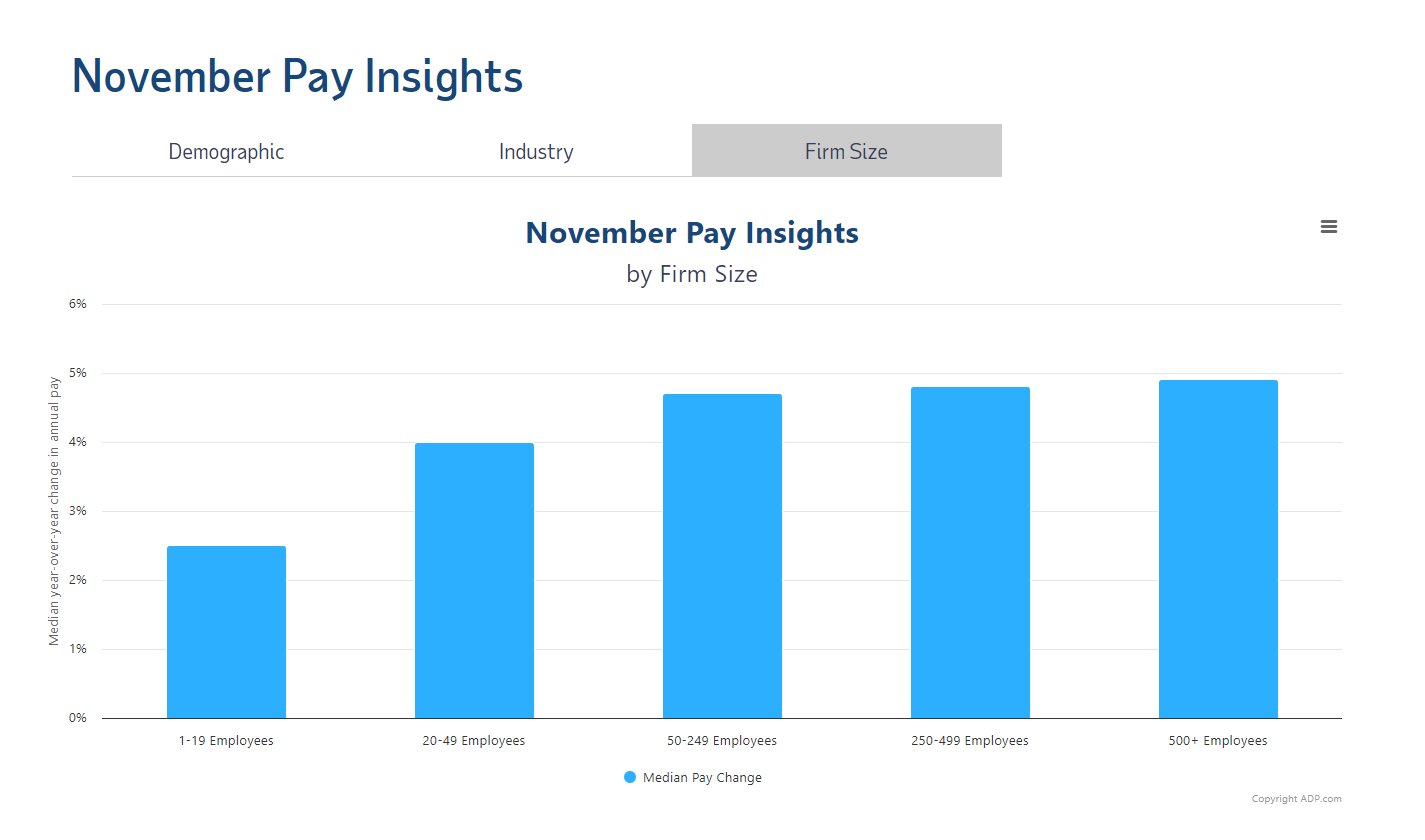
This is lower compared to mid-sized and large companies, where wage growth is at least above 4.7%.
Bottom Line
So what’s causing all this? Economists are saying caution among consumers is the key reason behind such major job losses. Regular people (especially those with lower and middle incomes) are being more careful about how they spend their money.
This matters because when consumers stop spending, businesses that depend on that spending have to make tough choices. Small businesses operate on thin profit margins, so when sales drop even a little, they often have no choice but to cut workers to survive.
The loss of 120,000 small business jobs in November represents real families facing real challenges. It highlights a growing divide between America’s biggest corporations, which continue to hire and grow, and the small businesses struggling to survive in an uncertain economy.
What Small Business Job Cuts Mean for Workers and Job Seekers
The ADP data on small business job cuts is significant because small businesses account for nearly half of US private-sector employment. When small companies cut, the effects are geographically distributed in ways that large-company layoffs are not. A plant closure in a small town or a neighborhood business reducing staff affects local labor markets that do not have the depth to absorb those workers quickly.
For job seekers affected by small business cuts, the realistic options often involve geographic flexibility or sector transitions. Small business cuts tend to cluster in sectors facing cost pressure, including retail, local services, and administrative support, which are also the sectors where AI tools are being adopted fastest.
Moving from a small business to a larger employer requires translating your experience in ways that make sense at scale. Responsibilities that were broad at a small company need to be framed as expertise in specific areas rather than generalist coverage of everything. A hiring manager at a 500-person company is looking for someone who can do one thing very well, not someone who did eight things at once at a company of 12.
Preparing for that translation in interviews matters as much as the resume. Practice framing your small-business experience in terms that resonate with larger company roles using Interview Copilot before your actual conversations. The framing that worked at your previous employer often needs adjustment before it lands with a new audience.
Many candidates use AI for job interviews to prepare for questions exactly like these.
Frequently Asked Questions
Will AI replace most jobs in the near future?
AI is more likely to transform jobs than eliminate them entirely, though certain routine and repetitive roles face a higher risk of automation. Research consistently shows that the fastest-growing occupations require judgment, creativity, and interpersonal skills that AI cannot replicate reliably. Workers who learn to use AI as a tool tend to become more productive rather than displaced.
Which jobs are most resilient to AI automation?
Jobs that require complex human interaction, physical dexterity in unpredictable environments, creative judgment, and ethical decision-making are most resilient. These include healthcare providers, skilled tradespeople, therapists, lawyers, and senior engineers. Roles that blend technical knowledge with leadership and communication are especially well-positioned over the next decade.
How should professionals prepare for an AI-driven job market?
Professionals should invest in learning how to use AI tools in their specific field, whether that means prompt engineering, data literacy, or understanding how automation affects their workflow. Building a portfolio of projects that demonstrate AI collaboration is increasingly valued by employers. Staying current through online courses, industry events, and peer networks helps maintain competitive skills.
What do economists say about AI and long-term employment trends?
Most economists agree that AI will cause significant job displacement in certain sectors while creating new categories of work in others. The concern is not elimination of all jobs but the pace of transition and whether workers have access to retraining opportunities. Policies around education funding, social safety nets, and workforce development are seen as critical to managing this shift.
Table of Contents
Related articles

McKinsey Lays Off 200 Tech Employees as AI Takes Over Roles
McKinsey eliminates 200 tech jobs amid a strategic push toward AI-driven operations, reflecting broader changes in the consulting sector.

Oracle Lays Off Hundreds in Cloud Division as AI Spending Rises
Oracle eliminates hundreds of jobs worldwide in its Cloud Infrastructure unit to fund AI expansion. Layoffs hit multiple countries including 161 positions in Seattle, as the tech giant shifts focus from traditional cloud services to artificial intelligence investments.

12,000 Job Cuts at Oracle Shakes Up India Tech Sector
Oracle lays off thousands of employees in India, raising fresh concerns about job security and the future of tech jobs.

Robinhood Cuts 10% of Its Staff But Doesn't Blame AI
Robinhood is cutting about 10% of its workforce, as CEO Vlad Tenev restructures the company to boost efficiency.

9 Entry-Level Jobs Are Disappearing Fast Because of AI
AI is eliminating entry-level jobs at record speed. Discover which 9 fields are most at risk and how to protect your career from automation in 2025.