Starbucks Layoffs 2026: 224 Jobs Cut, Every Round So Far




Starbucks is separating 224 employees from its Seattle Support Center at 2401 Utah Avenue South, with the first separations on October 19, 2026 and every affected worker out by November 1, 2026. The company disclosed the cuts in a WARN notice filed with the Washington Employment Security Department on August 20, 2026, signed by EVP and Chief Partner Officer Sara Kelly and addressed to Seattle Mayor Katie Wilson and King County Executive Girmay Zahilay. KING 5, KOMO, GeekWire and the Lynnwood Times each reported the filing in the days that followed. Starbucks says this is not a new round at all, but the final piece of the global restructuring it announced in May 2026.
Quick Answer
- Starbucks filed a Washington WARN notice on August 20, 2026 cutting 224 permanent positions at its Seattle Support Center, with separations running from October 19 to November 1, 2026.
- Only about 104 of the 224 are actual role eliminations. The other 120 were offered continued employment in Nashville and turned the move down, so the headline number overstates eliminated work by roughly a factor of two.
- Neither the WARN notice nor Starbucks names artificial intelligence anywhere. The stated drivers are cost savings and geographic consolidation toward a $2 billion target by the end of fiscal 2028.
What did Starbucks disclose in the August 2026 WARN filing?
The filing covers 224 permanent job losses at a single address: the Starbucks Support Center at 2401 Utah Avenue South in Seattle. Separations begin October 19, 2026 and finish by November 1. Starbucks dated the notice August 20, 2026 and says it gave every affected employee a full 60 days of notice ahead of their termination date.
Two details in the filing matter for anyone affected. There is no union representation covering these positions, and there are no bumping rights, meaning no employee can move into a colleague's job by seniority to avoid separation. Both facts remove negotiation paths that exist in unionized reductions, and they explain why the separation dates in the notice are firm rather than provisional.
The Washington Employment Security Department WARN database lists the row plainly: Starbucks, Seattle, layoff start date 10/19/2026, 224 workers, type "Layoff", classified "Permanent", received 8/20/2026. A WARN notice is a filing employers must submit to a state labor agency in advance of a mass layoff or plant closing. It is a government record rather than a press release, which is why its numbers are usually more precise than the ones in company statements, and why it is the right document to read before any news coverage of a layoff.
A Starbucks global communications representative told KOMO News the filing reflects changes already underway under the restructuring announced in May, and is not an additional round of job cuts. That framing is worth taking seriously rather than dismissing as spin, because it explains both why the number is smaller than the May announcement and why the affected roles are concentrated so narrowly in one part of the business.
Who was actually cut, and how many just declined the Nashville move?
About 104 of the 224 employees are losing roles that were genuinely eliminated. The remaining 120 were offered continued employment at Starbucks' new Nashville office and declined to relocate. In the company's own words, employees electing to relocate are not being separated, which means more than half of this filing is relocation refusal rather than eliminated work.
That distinction changes what the number means. A reader who sees "224 Starbucks layoffs" reasonably assumes 224 jobs disappeared. In practice the work attached to 120 of those jobs still exists, roughly 1,900 miles away in Tennessee, and Starbucks intends to fill it. Only the 104 store design and construction roles were removed outright, following a leadership reorganization of the team that designs, sites and builds coffeehouses.
The job titles in the notice are unusually concentrated. Managers, directors, store design leads and real estate representatives account for 124 of the 224 positions, or 55% of the total. The filing also names store designers, administrative assistants, lead application developers and various engineers. Set that against the May 2026 round, which hit marketing, human resources and supply chain management, and the shift is clear: Starbucks moved from trimming general corporate overhead to cutting the specific function that opens new stores.
For anyone in that function, this is the detail worth sitting with. A real estate representative who negotiates leases and a store design lead who sites a drive-through are not interchangeable with the marketing and HR roles cut in May, and they do not compete for the same openings. The affected group is small, senior and specialised, which usually means fewer local vacancies but far less competition for each one.
The economics of the Nashville offer explain why 120 people said no. Employees who accepted were offered stock grants worth tens of thousands of dollars, but Bloomberg reported they were also told their pay would drop by at least 5%, with Starbucks citing lower living costs in Nashville. Employees who declined were offered retention packages starting at $15,000, contingent on staying into at least 2027. Weighed against a pay cut and a cross-country move, a majority of the affected group took the retention money and the exit.
How does this fit the pattern of Starbucks layoffs in 2026?
August's filing is the latest in a sequence of Washington notices Starbucks has submitted this year, and part of the third major corporate reduction since CEO Brian Niccol took over in late 2024. Each round has been smaller and more narrowly targeted than the one before it.
- February 2025: Starbucks said it would cut 1,100 corporate jobs and leave several hundred open positions unfilled.
- September 2025: Another 900 non-retail job losses, part of a $1 billion restructuring plan.
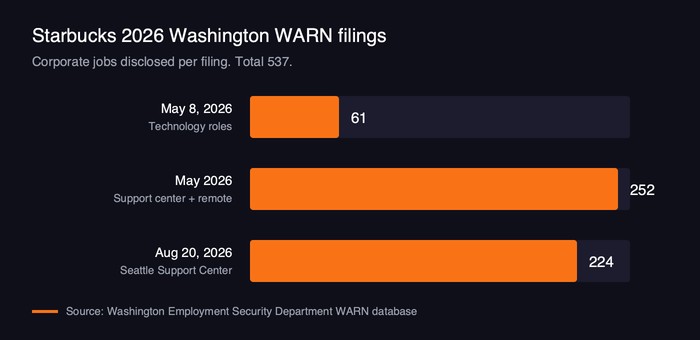
- May 8, 2026: A Washington filing covering 61 technology positions, with separations starting in June.
- Mid May 2026: A filing covering 252 support-center roles, plus remote employees nationwide.
- May 15, 2026: The public announcement of roughly 300 US corporate cuts and the closure of four regional offices in Atlanta, Dallas, Chicago and elsewhere.
- August 20, 2026: The 224-position filing at the Seattle Support Center covered in this article.
The Lynnwood Times put the running 2026 total at 537 Starbucks corporate jobs as of August 24, counting the 313 disclosed across the May filings plus the 224 in August. Across a longer window the figure is larger still, because the August notice is the eighth Washington layoff filing Starbucks has submitted in two years, covering 2,538 employees in total.
Starbucks set the cost of all this out in its May 2026 filing with the SEC: about $400 million in charges, including a $280 million non-cash write-down on impaired long-lived assets and $120 million in cash charges tied mostly to severance. Because severance sits inside a charge the company already booked, employees separating in October and November are being paid from money that has already hit the accounts rather than from a new provision.
Read across the six entries above and the trajectory is not a company in crisis cutting indiscriminately. It is a company that has cut a different function every time: general corporate in early 2025, non-retail broadly in late 2025, technology and support in May 2026, and store development in August 2026. Anyone tracking Starbucks as an employer should read that as a rolling function-by-function review rather than a single event with an end date.
Why do the Starbucks layoff filings never mention AI?
Neither the August WARN notice nor any Starbucks statement about these cuts names artificial intelligence. The reasons the company gives are cost savings and geographic consolidation into Nashville. For a corporate layoff of this size in 2026 that silence is the notable part, because US job cuts attributed to AI this year have already passed the full-year 2025 total.
Starbucks had an easy opportunity to attribute these reductions to automation, given how much it has publicised AI-assisted ordering and inventory work, and it did not take it. The likely reason is that the story here genuinely is not automation. You cannot automate a real estate representative who negotiates a lease or a store design lead who sites a drive-through. What changed is that Starbucks decided it needs fewer of them, and wants the ones it keeps sitting in Tennessee.
That makes Starbucks an outlier rather than a typical 2026 case, since roughly half the layoff events tracked this year name AI automation or AI infrastructure spending somewhere in the explanation. If you are interviewing after this round, the distinction is worth using: your role was cut by a real estate and consolidation decision, not replaced by a model, and you can say so without hedging or apologising for it.
What do the 2026 Starbucks layoff numbers actually show?
They show a company cutting corporate headcount while its stores perform better. Same-store sales accelerated through 2026, including 7.9% growth in the most recent quarter, and Starbucks employed roughly 381,000 people globally as of September 2025. Against that base 224 positions is a rounding error, and against Seattle's corporate population it is not. The same combination of healthy operations and shrinking corporate teams runs through every 2026 layoff round and the reason each company actually gave for it.
Niccol's turnaround, branded "Back to Starbucks", targets $2 billion in cost savings by the end of fiscal 2028. The plan runs in two directions at once: more investment in cafes, staffing and menu, paired with sustained reduction in corporate support functions. The Nashville build is the clearest expression of that, at $100 million invested, roughly 250,000 square feet downtown, and as many as 2,000 support jobs over five years once the office opens in 2027. Starbucks has been explicit that Nashville complements Seattle rather than replacing it, and that Seattle remains both the global and the North America headquarters.
Rapid7 raised its full-year profit outlook the same day it cut 300 roles. Salesforce filed WARN notices in California and Washington while continuing to hire in AI. Starbucks is posting accelerating same-store sales while separating 224 people in Seattle. Profitable operations paired with corporate cuts is the defining shape of 2026 rather than a Starbucks quirk, and the eight Washington filings the company has made in two years describe that trend better than any single headline number does.
The practical read for a job seeker is that a layoff on your record now says very little about the company you left, and even less about you. Employers filing these notices are frequently beating their own guidance in the same quarter, and interviewers across this market know it. If you want to watch the filings as they land rather than after the fact, our news coverage tracks each one as it is disclosed.
What should you do if you were affected by the Starbucks layoffs?
Count your runway first. The notice was dated August 20 and the earliest separation is October 19, which is a full 60 days of continued pay. If your date is November 1, you have closer to ten weeks from the filing. That is a materially different position from being walked out of the building the same day you find out, and the single biggest mistake in this group is treating the notice period as waiting time instead of search time.
Treat your severance and any retention offer as two separate things. Severance for this round was already provisioned inside the charge Starbucks booked in May, so it does not depend on how quietly you leave. If you declined Nashville and hold a retention offer starting at $15,000 for staying into at least 2027, that is a paid runway rather than a reason to pause, and nothing in it stops you interviewing while you serve it. A structured approach to turning a notice period into offers before your separation date is worth more here than to someone with no notice at all.
Use the access you still have, because all of it disappears the day your laptop is deactivated. Export your last two performance reviews. Save the specific numbers attached to your work: stores opened, square footage delivered, lease terms negotiated, budget managed, timelines hit against plan. Collect personal email addresses and phone numbers for the managers and peers who will act as references, since the internal directory goes dark with your account.
Then widen the target list, because store design, construction and real estate skills are not confined to coffee. Restaurant groups, grocery chains, quick-service franchises, fitness operators, retail REITs and the development arms of general contractors all hire the same profile, and most of them are still opening locations. The affected group is small, senior and specialised, which means fewer postings than a generalist would see and far less competition for each one. Running timed rounds against the actual job description in Practice Interview is how you find the gaps while there are still weeks to close them.
Expect longer loops than you may be used to. Director-level store development roles are interviewed through panels that include a portfolio walkthrough, a market or site-selection exercise, and at least one conversation with a finance or construction lead who will press on numbers you have not looked at in a year. The first loop is always the worst loop, which is an argument for deliberately scheduling a role you care less about first. Ask the recruiter for the panel structure in advance, because most will tell you, and knowing whether the site-selection exercise is live or take-home changes how you prepare for it entirely.
It also helps to compare notes with people at the same point in the process rather than guessing. The phrasing that worked in a 2023 interview does not land the same way now, because interviewers in 2026 have screened dozens of candidates from restructurings and have developed a fairly low tolerance for vagueness. This thread on what interviewers actually respond to when they ask why you left has candidates from several of this year's rounds working through exact wording line by line.
How do you explain a Starbucks layoff in your next interview?
Lead with the scale of the restructuring, not with yourself. "My role was eliminated as part of a restructuring that affected 224 people across Starbucks' support organization" tells the interviewer in one sentence that this was structural, before they have a chance to wonder whether it was not. Any version that opens with your own performance, however confidently you deliver it, invites a question about your performance.
Name the function, then stop talking. Saying the store design and construction team was reorganised is concrete, verifiable and closes the question instead of opening three more. Vague phrasing does the opposite, because "there were some changes" reads as something being held back, and interviewers reliably push on exactly the part you skipped. Expect the question in the behavioral round rather than the technical screen, usually phrased as some version of why you left your last role.
If you declined the Nashville relocation, say so directly rather than folding it into the word "layoff". Turning down a cross-country move that came with a pay cut attached is a decision any interviewer will recognise, and it is a stronger story than a restructuring you were merely subject to. It also removes an awkward gap later, because a state filing showing you were offered continued employment is a matter of public record, and a hiring manager who reads it after your interview should not be learning anything you left out.
Keep the whole answer to roughly 30 seconds and end on what you are looking for next. Length reads as defensiveness no matter how reasonable the content is, and the most common failure in this situation is a candidate who answers well and then keeps going for another 40 seconds. There is a full breakdown of what to say and what to leave out when a layoff comes up worth reading before your first loop.
The follow-up is harder than the opener, and it is where this group tends to come unstuck. Interviewers push on why your function specifically was cut, and the answer they are listening for is business logic rather than grievance: Starbucks consolidated support functions into Nashville and reorganised the team that builds stores. Say that plainly. Most interviewers already know these layoffs happened, because they were covered by every major outlet in August 2026, so treating the topic as delicate signals more discomfort than the facts warrant. The one thing to avoid is speculating about decisions you were not in the room for, which is the point at which a composed answer starts to sound like a grudge.
Delivering that calmly in a live conversation is a different skill from writing it down, particularly when the follow-up arrives somewhere you had not rehearsed and you have three seconds to decide how much detail to give. Interview CoPilot™ works alongside you during the real interview and helps you keep the answer tight when that happens, which matters most in the first two loops before the story has settled.
Related Interview Guides
- Qualtrics layoffs: another Seattle headquarters reduction disclosed through a Washington WARN filing in 2026, useful for comparing notice periods and severance treatment.
- Google Washington layoffs: how a smaller Washington filing was structured, including the same October 2026 separation window.
- Walmart layoffs: the closest retail-sector comparison, covering corporate and technology cuts filed across nine California notices.
- US layoffs in 2026: the national picture behind the individual filings, including which sectors are cutting hardest and which are still hiring.
Frequently Asked Questions
How many employees did Starbucks lay off in August 2026?
Starbucks filed a Washington WARN notice on August 20, 2026 covering 224 permanent job losses at its Seattle Support Center at 2401 Utah Avenue South. The first separations take effect October 19, 2026 and all of them are complete by November 1, 2026.
Why is Starbucks laying off employees?
Starbucks attributes the cuts to cost savings and consolidation of support functions into its new Nashville office, under CEO Brian Niccol's "Back to Starbucks" turnaround. The company is targeting $2 billion in cost savings by the end of fiscal 2028.
Are the Starbucks layoffs because of AI?
No. Neither the August 2026 WARN notice nor any Starbucks statement about these cuts mentions artificial intelligence. The stated reasons are cost reduction and geographic consolidation, which makes Starbucks an outlier among 2026 layoffs that frequently cite AI.
Which roles did Starbucks cut in the 2026 layoffs?
Managers, directors, store design leads and real estate representatives account for 124 of the 224 positions. The filing also names store designers, administrative assistants, lead application developers and engineers. No coffeehouse or barista roles were affected.
Is Starbucks still hiring after the layoffs?
Yes. Starbucks is investing $100 million in a Nashville corporate office of roughly 250,000 square feet, expected to house up to 2,000 support jobs over five years once it opens in 2027. Seattle remains the global and North America headquarters.
Table of Contents
Related articles
Uber Layoffs: 3,300 Jobs Cut, 10% of Staff
Uber layoffs hit 3,300 roles, about 10% of global staff. What the cuts target, why AI was not named, and how to explain it in your next interview.
Google Interview Warmup Shut Down, What To Use Now?
Google Interview Warmup shut down in April 2026. Here are 8 free and paid alternatives tested for behavioral, technical, and live interview support in 2026.

6 Best Undetectable AI Interview Tools in 2026
We reviewed the best undetectable AI-powered interview tools to use in live interviews. These tools have privacy and stealth mode to work discreetly.
GitHub CEO Thomas Dohmke Warns Developers: "Either Embrace AI or Get Out of This Career"
GitHub CEO warns developers to embrace AI or quit, he said on X, referencing new research. The study reveals how AI is reshaping developer roles and workflows.