New Zealand Minimum Wage: Rates and Annual Review




New Zealand's adult minimum wage is NZ$23.95 per hour from April 1, 2026, up 2 percent from NZ$23.15 the prior year. New Zealand consistently ranks among the highest minimum wage countries in the OECD by absolute dollar amount, and the annual April review process makes it one of the most predictable wage systems for workers and employers alike. This guide covers the three-tier rate structure, who is covered, how compliance is enforced, and how to use the minimum wage as a realistic benchmark when negotiating any salary in New Zealand.
Quick Answer
- New Zealand's adult minimum wage is NZ$23.95 per hour from April 1, 2026, up from NZ$23.15 in 2025.
- The starting-out and training rates are NZ$19.16 per hour, set at 80 percent of the adult rate.
- The voluntary living wage for 2026/27 is NZ$29.90 per hour, approximately NZ$5.95 above the legal minimum.
Current Minimum Wage Rates in New Zealand (2026)
Adult minimum wage is NZ$23.95 per hour from April 1, 2026. It applies to all employees aged 16 and over who do not qualify for the starting-out or training rates. This is an increase of NZ$0.80 from NZ$23.15 in 2025, continuing the government's pattern of incremental annual adjustments.
Starting-out wage is NZ$19.16 per hour, set permanently at 80 percent of the adult rate. It applies to workers aged 16 to 19 in their first six months with a specific employer, and to 16 and 17 year olds who have not yet completed six months of continuous employment with any single employer. Once a worker completes six months at one employer, the adult rate applies automatically regardless of age.
Training minimum wage is NZ$19.16 per hour. It covers workers aged 20 or over engaged in genuine industry training registered with the Tertiary Education Commission, capped at 60 training credits per year. This is not a general lower rate for entry-level roles; it applies only within authenticated training relationships. Before your first interview for any role in New Zealand, it helps to review the average salary benchmarks across New Zealand industries so you can tell at a glance whether an offer sits at, near, or well above the statutory floor.
All three rates are reviewed each year by the Ministry of Business, Innovation and Employment (MBIE). The government announces new rates by March each year, giving employers and payroll systems time to update before the April 1 change date.
How New Zealand's Annual Minimum Wage Review Works
MBIE publishes an advisory report drawing on employment data, Consumer Price Index changes, the Household Living-Costs Price Index, business viability surveys, and submissions from unions and employer groups including the New Zealand Council of Trade Unions and BusinessNZ. The minister for workplace relations considers this advice and sets the new rate. Unlike Australia's Fair Work Commission process or Canada's federal formula, New Zealand has no statutory mechanism automatically linking the minimum wage to median earnings or inflation. Each year's decision is a fresh ministerial policy choice.
The April 2026 increase of NZ$0.80 per hour reflects a modest but consistent uplift. Annual increases since 2022 have ranged from 6.7 percent to just over 2 percent, tracking lower inflation in 2024 and 2025 and reflecting employer advocacy from hospitality and retail groups that argued aggressive increases were squeezing margins for small operators. Workers on 40 hours per week at the new rate earn NZ$49,816 per year before tax, up from NZ$48,152 at the 2025 rate.
Who Is Covered by New Zealand's Minimum Wage?
The Minimum Wage Act 1983 covers all employees in New Zealand, including those on casual contracts, part-time arrangements, fixed-term agreements, and zero-hours arrangements. Coverage extends to workers paid on commission, piece rates, or daily rates, provided their total pay for the period divided by hours worked averages at least the applicable minimum rate for every hour worked in that pay period.
Commission-only sales staff are a common point of confusion. If a commission worker earns NZ$1,200 across a 60-hour week, their effective hourly rate is NZ$20 per hour, above the adult minimum. If they earn NZ$900 for the same 60-hour week, their effective rate falls to NZ$15, below the floor, and the employer must top up the difference for that pay period. The obligation is per period, not per annual average.
Volunteers working without any expectation of payment are not covered. However, if any regular payment is made, even framed as a koha or expense reimbursement, MBIE may treat the relationship as employment. Unpaid commercial internships have faced increasing scrutiny, with MBIE's guidance indicating most commercial internships lasting more than a few days would be classified as employment. Understanding your rights before accepting any offer is easier if you first read through a comparison of the minimum wage and the living wage in New Zealand, which explains where the legal floor ends and community expectations begin.
What a Minimum Wage Income Covers in New Zealand
A full-time worker at NZ$23.95 per hour for 40 hours per week earns approximately NZ$49,816 per year before tax. After income tax and ACC levy, take-home pay is around NZ$41,200 per year, or roughly NZ$3,433 per month, assuming no Working for Families credits or student loan repayments.
Rental costs set the constraint. In Auckland, the median rent for a one-bedroom apartment in 2026 sits at approximately NZ$2,200 to NZ$2,400 per month, leaving NZ$1,000 to NZ$1,200 for food, transport, utilities, and everything else. Wellington rents are broadly similar. In smaller cities such as Palmerston North, Hamilton, and Dunedin, rents are substantially lower, making the minimum wage more liveable for a single person but still difficult for anyone supporting dependents.
The Living Wage Movement Aotearoa New Zealand sets an independently calculated living wage each year. The 2026/27 rate is NZ$29.90 per hour from September 1, 2026, up from NZ$28.95 in 2025/26. Around 340 employers are accredited Living Wage employers in New Zealand, including Auckland Council, several major banks, universities, and healthcare providers. The gap between the statutory minimum and the living wage now sits at approximately NZ$5.95 per hour.
Sectors With High Concentrations of Minimum Wage Workers
Statistics New Zealand data identifies retail trade, accommodation and food services, horticulture, and home and community care as the sectors with the highest proportions of minimum wage workers. Pacific and Maori workers are overrepresented relative to their workforce share, reflecting structural inequities in credential recognition and hiring practices that persist across industries.
The horticulture sector, which relies on seasonal workers from Pacific Island nations under the Recognised Seasonal Employer (RSE) scheme, has been a focus of wage enforcement action. MBIE and Unite Union documented cases where accommodation and transport costs charged by employers to RSE workers effectively reduced net pay below the statutory floor, prompting clarifications to the RSE code of practice.
Post-pandemic labour shortages led several large New Zealand employers to voluntarily raise starting wages above the minimum in 2022 and 2023. Woolworths NZ, Pak'nSave operators, and Hospitality New Zealand members reported above-minimum starting rates during that period. Whether those rates persist depends on sector conditions and individual employer decisions in 2026. If you are job hunting in any of these sectors, practising how to respond to a low salary offer before an interview puts you in a better position when the first number is below what you expected.
Salary Negotiation Beyond the Minimum Wage
New Zealand's workplace culture is receptive to direct salary conversations. Asking about pay progression, performance review timelines, and salary ranges for more experienced workers during or after an interview is standard practice and is unlikely to disadvantage your candidacy. The salary negotiation process in New Zealand typically involves citing market data from a specific, recognised source rather than making a general request for more.
New Zealand salary benchmarking data is published annually by Hays, Robert Half, Seek, and MBIE's Labour Market Statistics portal. Citing a specific range from any of these gives your negotiation concrete grounding. For step-by-step tactics on how to structure the conversation, the guide to negotiating a salary offer effectively covers framing, timing, and specific language that works in New Zealand-style interviews. Candidates who have also looked at AI tools for salary negotiation often find that practising with live coaching before the conversation makes a measurable difference.
Use the FRAI salary calculator to benchmark what your role pays in Auckland, Wellington, or Christchurch before any interview. For real-time coaching on compensation questions during a live interview, Interview CoPilot gives you practitioner-level answers without underselling your value. Community members sharing their salary negotiation strategies have noted that preparing a specific number backed by data consistently outperforms leaving it vague, as you can see in the salary negotiation discussion in the interview prep community.
Frequently Asked Questions
What is the minimum wage in New Zealand in 2026?
New Zealand's adult minimum wage is NZ$23.95 per hour from April 1, 2026, up from NZ$23.15 in 2025. The starting-out and training rates are both NZ$19.16 per hour. Rates are reviewed and set each April 1 following an annual MBIE advisory process.
Who qualifies for the starting-out wage in New Zealand?
Workers aged 16 to 19 in their first six months with a specific employer, and 16 to 17 year olds who have not yet completed six months with any single employer. Once a worker completes six months at one employer, the adult minimum wage applies automatically regardless of age.
Is the minimum wage the same across all of New Zealand?
Yes. New Zealand has a single national minimum wage applying uniformly across all regions. There are no regional variations, unlike Australia where modern awards set sector-specific rates, or the United States where state and city minimums differ widely.
What happens if a New Zealand employer pays below the minimum wage?
It is unlawful under the Minimum Wage Act 1983. MBIE's Labour Inspectorate can require back payment of arrears and impose financial penalties. Workers can file a complaint through Employment New Zealand, which offers both informal resolution and formal enforcement pathways.
How does New Zealand's minimum wage compare to Australia's?
Australia's national minimum wage is A$24.10 per hour from July 2025. New Zealand's adult minimum is NZ$23.95 per hour from April 2026. Both rank among the highest minimum wages in the OECD. New Zealand's rate is set by the minister; Australia's is determined by the independent Fair Work Commission through its annual wage review.
Related Salary Guides
- Australia Minimum Wage: Current Rate and How It Is Set: Compare New Zealand's ministerially set minimum to Australia's Fair Work Commission annual review process.
- Ireland Minimum Wage: Current Rate and Increases: How Ireland's national minimum wage framework compares to New Zealand's April review system.
- Canada Minimum Wage: Federal and Provincial Rates: A comparison of Canada's decentralised provincial system against New Zealand's single national rate.
Browse more salary advice articles to research what your specific role pays across different countries before any interview negotiation.
Table of Contents
Related articles
58 Dollars an Hour Is How Much a Year? (Before & After Taxes 2026)
$58 an hour is $120,640 a year before taxes. See the full 2026 breakdown: weekly, biweekly, monthly, after-tax take-home for single and married filers, plus jobs that pay $58/hr.
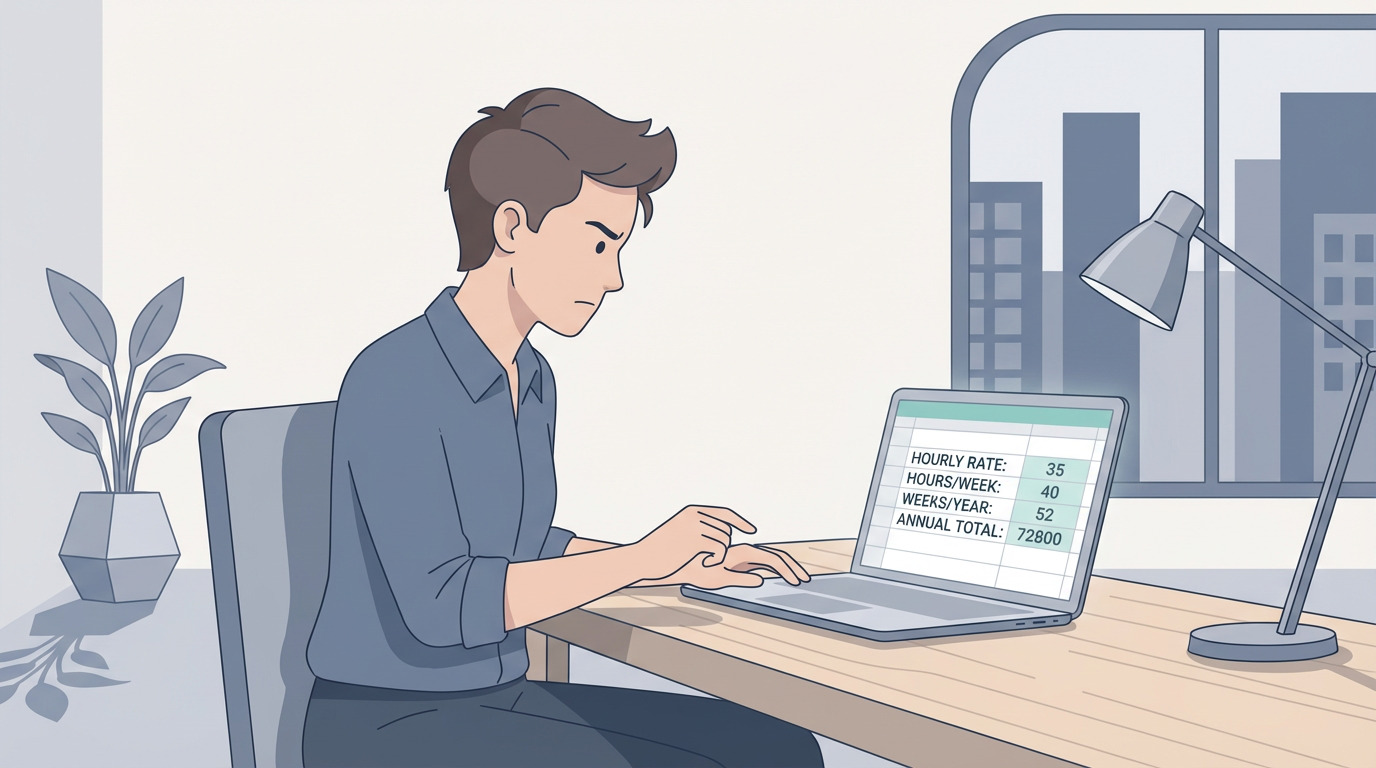
35 Dollars an Hour is How Much a Year?
$35 an hour equals $72,800 per year before taxes. Learn exact breakdowns for full-time, part-time, after-tax pay, and budgeting tips for realistic financial planning.
46,000 Dollars a Year Is How Much an Hour
46k a year is $22.12/hour (before taxes). See the full 2026 breakdown: weekly, monthly, after taxes by filing status, and jobs that pay $46k.
100 Dollars an Hour Is How Much a Year?
$100 an hour equals $208,000 per year. See the full 2026 after-tax breakdown for single and married filers, plus monthly, biweekly, and weekly figures.