January Layoffs in the US Hit Highest Level Since 2009




Over 108,000 US workers lost their jobs in January 2026. This is the highest layoff for the month of January since 2009.
What’s driving this alarming trend?
Note that this data didn’t come from social media rumors. They came directly from the companies themselves through formal announcements made to investors, regulators, and employees. That means these are real, documented plans to reduce headcount, gathered by Challenger, Gray, and Christmas.
A new report by them for January 2026 states that 108,435 jobs were cut by US employers.
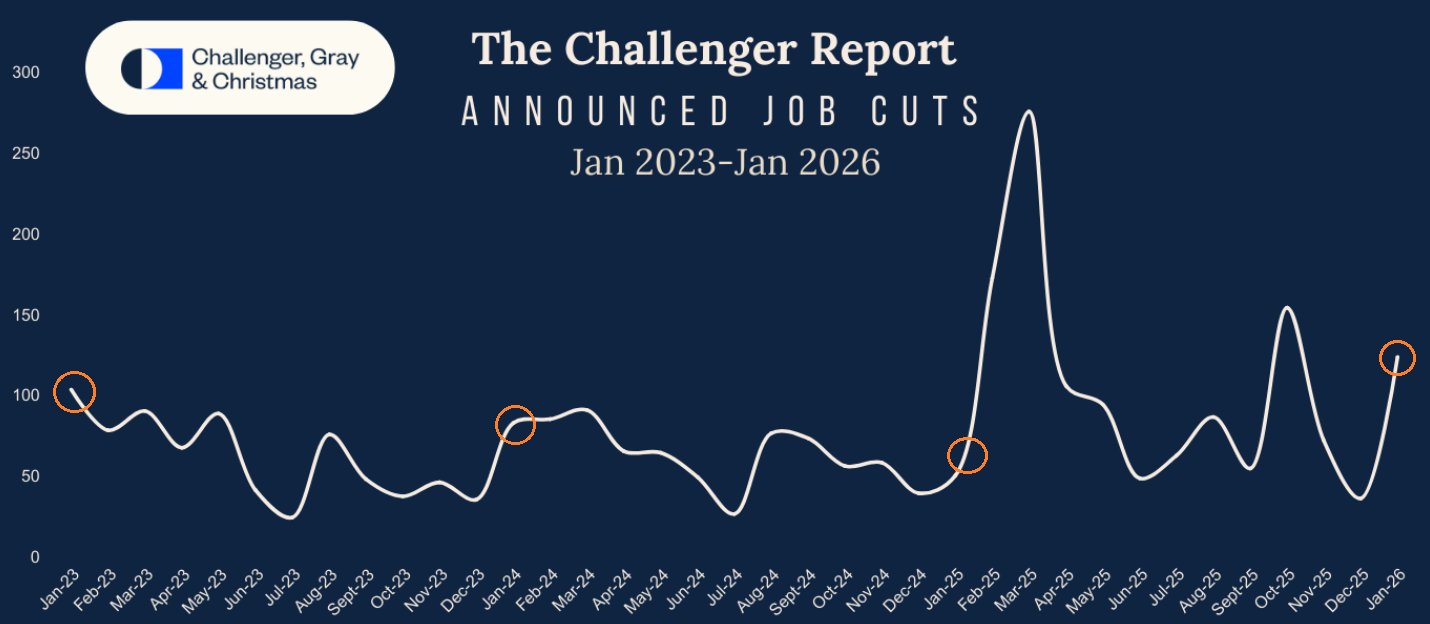
To put this in perspective, that’s a 118% increase from last year and a staggering 205% jump from December 2025.
The last time January layoffs were this severe, the country was facing its worst economic crisis since the Great Depression, with 241,749 job cuts announced in January 2009. Back then, unemployment crossed 10%, and the US economy shrank by about 4.3%.
The layoffs for January stayed below the 100,000 mark, except in 2023.
We have seen these plans before. Layoffs don’t hit the economy all at once. They happen in stages. This is usually how it plays out. First, companies announce job cuts. Then hiring freezes quietly kick in. After that, job openings and postings start shrinking.
Only after all of that does the unemployment rate begin to rise. That’s why layoff announcements matter so much.
While layoffs typically rise in January as companies adjust their budgets for the new year, this spike is unusually high.
Andy Challenger, chief revenue officer at the firm, told CNBC about this:
“Generally, we see a high number of job cuts in the first quarter, but this is a high total for January. It means most of these plans were set at the end of 2025, signaling employers are less-than-optimistic about the outlook for 2026.”
Adding to the concern, companies announced just 5,306 new hires in January. That is also the lowest hiring total for the month since Challenger began tracking this data in 2009.
This combination of mass layoffs and minimal hiring creates what economists call a “low-hire, low-fire” economy, making it extremely difficult for laid-off workers to find new jobs.
Who’s Cutting Jobs?
Two corporate giants dominated January’s layoff announcements, accounting for roughly 40% of all job cuts:
- UPS: The delivery company announced plans to cut 48,000 jobs. They are ending their delivery partnership with Amazon, which was its largest customer but reportedly unprofitable.
- Amazon: The tech giant announced 16,000 job cuts, primarily affecting corporate employees. CEO Andy Jassy attributed the cuts to restructuring management layers.
Roughly 40% of January's layoffs were from Amazon (16,000 jobs) and UPS (30,000 jobs).
The layoffs weren’t limited to just delivery and tech companies. Here’s the breakdown by industry:
- Transportation: 31,243 job cuts (mostly from UPS)
- Technology: 22,291 job cuts (led by Amazon)
- Healthcare: 17,107 job cuts (highest for the industry since April 2020)
- Chemical Manufacturing: 4,701 job cuts (primarily from Dow Inc.)
- Media: 510 job cuts
Looks like even Healthcare is not safe. While most cuts were due to mergers and acquisitions, it's also experiencing significant hiring, suggesting a temporary recalibration rather than a long-term concern.
The AI Factor
AI has become a recurring theme in layoff announcements. Companies cited AI as the reason for 7,624 job cuts in January alone. Since 2023, when Challenger began tracking AI as a reason for layoffs, companies have cited the technology in 79,449 job cut announcements.
But some question whether AI is truly driving these cuts or simply serving as a convenient explanation.
However, another study shows that 59% employers cite AI for hiring freezes. Pinterest openly blamed AI for all the recent job cuts.
Andrew Stettner, senior director for economic security at the nonprofit National Employment Law Project, told CBS News he’s skeptical:
“I don’t think these companies are doing layoffs because they know AI can replace workers, but I think they are investing in it.”
Other than AI, companies pointed to a mix of business pressures behind January’s wave of layoffs.
The biggest reason was contract loss, which led to 30,784 job cuts, largely tied to UPS scaling back after losing a major portion of its Amazon business.
Close behind were market and broader economic conditions, responsible for 28,392 layoffs, as companies reacted to weaker demand and uncertainty about growth.
Another major driver was corporate restructuring, which accounted for 20,044 cuts, showing that many employers are reshaping their operations to save money. This is true for companies like Workday, HP, Goldman Sachs, and Vimeo.
The data suggests companies were planning these cuts well before 2026 began, indicating they had serious doubts about economic prospects for the new year.
Bottom Line
The surge in January layoffs raises serious questions about the direction of the American economy in 2026. While some sectors like construction are improving, driven by demand for data centers to power AI services, many industries are pulling back.
As Andy Challenger put it, these numbers signal that “employers are less-than-optimistic about the outlook for 2026.”
For the millions of American workers affected by these cuts, and those worried about their own job security, the coming months will be critical in determining whether this is temporary or the beginning of something really bad.
Frequently Asked Questions
What should you do immediately after being laid off?
Update your resume and LinkedIn right away. File for unemployment benefits in your state within the first week. Reach out to your professional network to let people know you are looking. Start with companies you already have connections at because referrals significantly increase hiring odds. Use the first two weeks to gather references and organize your job search.
How long does it typically take to find a new job after a layoff?
The timeline varies by industry and role level, but most professionals find a new position within two to four months. Senior roles often take longer, around three to six months. Staying active with daily applications, interviews, and networking shortens this window. Using AI-assisted tools like the AI interview assistant Interview Copilot can help you prepare faster for each opportunity.
Does being laid off affect your chances in future job interviews?
Layoffs are common and hiring managers understand that. Being transparent about a company-wide reduction does not hurt your application. What matters is how you frame the experience. Focus on what you contributed, what you learned, and what you are looking for next. Avoid criticizing the former employer and stay factual about why the position was eliminated.
Should you negotiate severance after a layoff?
Yes, severance is often negotiable. Review what the company offers against your tenure and contribution level. You can ask for additional weeks of pay, extended health insurance, or outplacement services. Having an employment attorney review the severance agreement before signing is worthwhile if the package is large or contains non-compete clauses.
Table of Contents
Related articles

AI Could Eliminate 80% of Jobs, Warns Stuart Russell
AI pioneer Stuart Russell warns that rapid advances in AI could replace up to 80% of jobs, and even surgeons and CEOs are not safe.

Godfather of AI Explains How AI Takes Your Job In 5 Years
AI Godfather Yoshua Bengio explains how rapid advances in AI could replace human jobs within five years.
Salesforce CEO Says AI Cannot Replace Engineers Yet
AI is getting better, but not enough to replace developers. Salesforce CEO says hiring trends prove engineers are still needed.

Amazon Is Hiring 11,000 Software Engineers and Interns
AWS CEO Matt Garman says AI is not taking jobs. It's creating them. Here's what's really going on.