Essendant Layoffs: 1,278 Cut as Company Says It Will Close




Essendant is cutting 1,278 jobs across six states, with the first and largest wave of separations landing on October 3, 2026, including 510 positions tied to its corporate headquarters at 200 Tri State International in Lincolnshire, Illinois. The company disclosed the cuts through WARN notices filed with state labor agencies in early August 2026, and Sam Borcia of Lake and McHenry County Scanner reported on September 10, 2026 that those Illinois filings now say Essendant expects to close the business outright. That is a meaningful escalation from where this stood in August, when the same filings described shutting down only as a risk if asset sales and new financing fell through.
Quick Answer
- Essendant filed WARN notices covering 1,278 positions in Illinois, Georgia, Pennsylvania, Texas, California and Arizona, nearly all effective October 3, 2026.
- Illinois absorbs 644 of those jobs, just over half the total, and 310 of the 510 Lincolnshire headquarters cuts are remote employees who only report to that address rather than work inside it.
- None of the Essendant filings name artificial intelligence, which separates this shutdown from roughly half of the layoff events tracked in 2026.
What Essendant disclosed in the WARN filings
Essendant told state officials it "currently expects that it will cease its operations and close its business." That sentence appears in WARN notices signed by Marcela Sztainberg, Senior Vice President of Human Resources at Essendant Co. The same filings say the company had been "exploring various strategic alternatives, including potential sale transactions involving certain of the company's assets and operations, and securing additional capital to avoid liquidation of the company," and that it does not know whether those efforts will succeed.
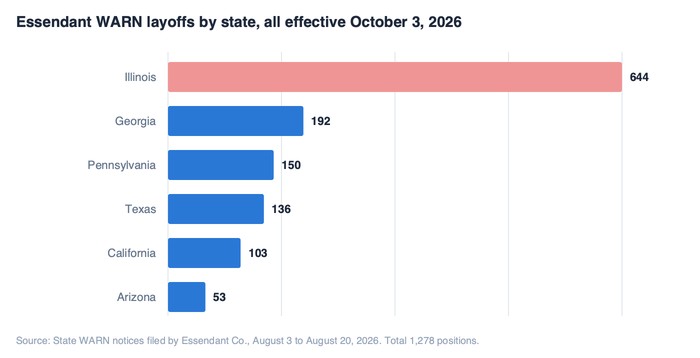
The two Illinois notices were filed on August 3, 2026 and are published through the Illinois Department of Commerce and Economic Opportunity WARN system. Similar notices went to labor agencies in Georgia, Pennsylvania, Texas, California and Arizona over the following two weeks. Added together they cover 1,278 positions.
Illinois carries 644 of the 1,278 cuts. Georgia follows with 192 at 125 Horizon Drive in Suwanee, a permanent facility closure. Pennsylvania accounts for 150 at 125 Green Tree Road near Phoenixville, filed under the entity Essendant Management Services LLC. Texas has 136 at the Irving site in Dallas County, California has 103 split between the Sacramento distribution center at 7021 Roseville Road and four roles in Perris, and Arizona has 53 at 1500 S. 71st Ave in Phoenix.
One detail in the notices matters for anyone weighing their options. The terminations are described as permanent, and affected employees have no bumping rights into other positions. None of the workers named in the filings are represented by a union, so there is no collective bargaining process that could reopen the timeline.
Who was actually cut, and how the 644 Illinois jobs break down
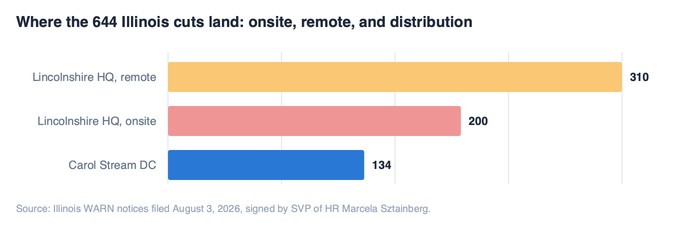
The 644 Illinois cuts split across two very different sites. Lincolnshire, at 200 Tri State International, is the corporate headquarters and accounts for 510 positions. Carol Stream, at 230 Lies Road East, is a distribution center and accounts for 134.
Inside the Lincolnshire number sits a split that no other outlet has broken out. Only 200 of those 510 people actually work at the Lincolnshire building. The other 310 are remote employees who report to that address on paper. For WARN purposes they are counted at the headquarters site, which is why a single office of roughly 200 desks produced a 510-person notice.
In practice, that 310-person remote group is in an unusual position. Illinois rapid response services attach to the site named in the filing, not to the state a remote worker happens to live in, so a remote Essendant employee in Ohio or Florida is tied to the Illinois notice while filing for unemployment where they actually live. Checking both is worth an hour of anyone's time.
The two sites also point at different job markets. Lincolnshire is corporate: finance, merchandising, category management, IT, HR and e-commerce roles. Carol Stream is operations: warehouse supervisors, order selectors, shipping and receiving clerks, and the managers who run them. Those are two separate job searches with almost no overlap in target employers, and the interviews look nothing alike. A category manager will face merchandising and P and L questions. A distribution supervisor will face throughput, safety and staffing scenarios, the kind covered in our set of warehouse operations manager interview questions, which is worth skimming early if that is the side of the business you are coming from.
How this fits the pattern of Essendant closures since 2025
This is the end of a wind-down that started roughly a year ago, not a sudden decision. The sequence is worth having straight, because it is what an interviewer will ask you to explain.
- Fall 2025: Essendant told customers it would exit the office products business and the independent dealer channel, refocusing on janitorial and sanitation, foodservice and technology. Most fulfillment centers closed, leaving five operating facilities.
- September 2025: A California WARN notice covered 146 employees at Perris, effective at the end of that year.
- November 2025: 58 employees were cut at Withers Cove Park Drive in Charlotte, North Carolina.
- August 3 to August 20, 2026: WARN notices across six states covering 1,278 positions, nearly all effective October 3, 2026.
- September 2026: The Illinois filings state the company expects to cease operations and close.
The company behind those filings is not a startup that ran out of runway. Essendant was incorporated in Chicago in 1922 as Utility Supply Company by Harry Hecktman and Morris Wolf, went public in 1981 as United Stationers, and took the Essendant name in 2015. At its peak it stocked more than 160,000 items across 70 distribution centers and served roughly 30,000 reseller customers, with revenue of $5.369 billion in 2016 and 6,400 employees in 2017. An affiliate of Sycamore Partners, which also owns Staples, acquired it in January 2019 for $12.80 per share, a deal valued at roughly $996 million including net debt.
There is active legal scrutiny attached to how the ending was handled. The Illinois Department of Labor has opened an investigation into the layoffs, and a department spokesperson was direct about its limits: "For clarity, the WARN Act doesn't dictate when a business can close." The department said its investigations look at whether appropriate notice was provided, whether affected employees were properly compensated, and whether the company took steps to obtain capital or pursue other options to keep workers employed. Separately, former employee Andrew Viverito filed a federal WARN Act complaint on August 28, 2026 against Essendant Co. and Sycamore Partners II LP in the U.S. District Court for the Northern District of Illinois. Those allegations have not been adjudicated and remain unproven.
The shape of this is closer to a demand collapse than to the profitable-company restructurings that dominated headlines this year. It reads very differently from a case like the Campbell's workforce reduction, where a going concern trimmed staff while continuing to operate.
Why the filings never mention AI
Not one Essendant WARN notice names artificial intelligence, automation, or machine learning. In a year when roughly half of tracked layoff events explicitly cite AI as a driver, that silence is the most telling thing in the documents.
What the filings point to instead is a failed search for a buyer, a failed search for capital, and an end market that shrank underneath the business. U.S. office supplies sales across physical and digital channels totaled $11.5 billion in 2024, down 5 percent year over year with unit demand down 2 percent, and Circana projected another 2 percent decline in 2025 before stabilizing through 2027. A wholesaler whose core category is contracting while it carries a leveraged balance sheet does not need an algorithm to run out of options.
Essendant is not alone in that. The logistics and distribution cuts of 2026 have largely skipped the AI framing that dominated technology announcements, including the FedEx reductions filed across California, where the filings described route and facility economics rather than automation. Warehousing and wholesale distribution have been shedding jobs for ordinary reasons: volume, margin and debt.
This matters for how you talk about the layoff later. If you were cut at Essendant, no interviewer can reasonably suggest a machine replaced your function. The company is closing. That is a cleaner story than most people laid off in 2026 get to tell, and it is worth knowing that before you walk into your first screen.
What the 2026 layoff numbers actually show
The headline picture for 2026 is mixed rather than uniformly bad. Challenger, Gray & Christmas counted 529,914 announced U.S. job cuts in the first eight months of 2026, the lowest year-to-date total since 2022, while hiring plans through August ran at their highest level since 2023. U.S. unemployment held at 4.1 percent in July 2026.
Technology is the outlier inside that calmer aggregate. Layoffs.fyi counted 128,536 tech employees cut at 299 companies between January 1 and September 10, 2026, already more than the whole of 2025. Our running breakdown of what the 2025 and 2026 tech layoff data actually shows tracks where those cuts landed and which company statements held up against their own filings.
Essendant sits outside the tech column entirely, in the logistics and distribution bucket that absorbed more than 7,000 job losses in August 2026 alone across freight, warehousing and manufacturing. That group has been quieter in the press than technology all year, partly because the individual filings are smaller and partly because no one writes a think piece about a wholesaler. The practical effect for job seekers is the opposite of what the coverage implies: there is less competition for attention, and regional employers in the same corridor are often still hiring for the exact roles being cut a few miles away.
What to do if you were affected
Start by counting your runway precisely, because it is longer than most layoffs give you. The Illinois notices were filed on August 3, 2026, with separations on or within 14 days after October 3, 2026. That is roughly nine weeks from filing to the first separation date, and up to about ten weeks for Lincolnshire staff whose termination slides into mid-October. You are being paid for most of that window.
Treat those weeks as search time, not waiting time. Five concrete actions are worth doing in the first week, while you still have system access:
- Export your last two performance reviews and any written recognition. Once your account is disabled, these are gone.
- Write down your actual numbers before you lose the dashboards: order volume handled, cost savings delivered, fill rates, headcount managed, budget owned.
- Collect personal contact details for two managers and two peers who can speak to your work.
- File for unemployment in the state where you live without waiting for your final day.
- Save your WARN notice and the date you actually received it, separately from any severance paperwork.
For the search itself, the practical sequencing for a distribution or corporate role after a closure is covered in our guide to landing a new job after a layoff, which walks through how to order applications, referrals and interview prep over a fixed number of weeks rather than attempting all three badly at once.
The sequencing point is worth taking seriously, because the instinct after a closure announcement is to apply everywhere on day one. That is usually the wrong order. Applications submitted before your resume reflects your actual numbers get screened out and cannot be resubmitted, and most companies will not look at the same candidate twice for the same role within a quarter. A better first week is spent reconstructing what you did, in numbers, while the systems that hold that evidence are still open to you.
Referrals come second, and they are unusually available right now. Roughly 1,278 people are leaving Essendant at once, and some of them will land before you do. A former colleague who started somewhere new in November is a warm referral in December. That network is at its most useful in the first sixty days after a closure, while everyone is still actively helping each other, and it decays quickly after that.
Which brings up the third item on the checklist above. A reference check is one of the few parts of a hiring process you can prepare for months in advance, and a former manager from a company that no longer exists is much harder to track down later. There is no HR department to route the call to and no company directory to search. Ask for personal emails and mobile numbers now, while everyone still shares a Slack workspace, and tell them what role you are targeting so the eventual reference is specific rather than generic.
One thing worth being honest about: interviewing muscles atrophy. Long tenure is an asset on paper and a liability in the room. If your last real interview was in 2019, you are out of practice at the thing that decides the outcome, and the first two screens will be the ones you waste learning that. Structured practice beforehand is the difference between using your nine weeks and burning them.
A round of mock interview practice with feedback after each answer costs an evening and surfaces the specific gaps, usually rambling, missing numbers, or no clear ending to the story, while there is still time to fix them before a real hiring manager hears it.
How to explain an Essendant layoff in your next interview
Lead with the company-level fact, not with yourself. "Essendant filed WARN notices covering 1,278 roles across six states and has told state regulators it expects to cease operations" ends the performance question in one sentence. A closure is the cleanest layoff story there is, because nothing about it can be read as a judgment on you.
Three things to keep in mind when the question comes:
- Give the scale, then move on. Two sentences on the closure, then pivot to what you did there. Dwelling on it invites follow-ups you do not want.
- Do not criticize Sycamore Partners or former leadership. The lawsuit and the state investigation are real, but an interview is not the venue. Bitterness reads as risk.
- Have your numbers ready. Interviewers move on quickly from a closure and get to the work. If you cannot quantify your work, the closure becomes the most memorable part of the conversation.
The exact phrasing matters more than people expect, and our breakdown of how to explain a layoff in an interview covers the wording that works for a closure versus a performance-based cut versus a single role elimination. They are not the same answer, and using the wrong one invites the wrong follow-up.
There is a second question coming that people prepare for less. After the layoff explanation, interviewers frequently ask what you learned or what you would have done differently. That is not a trap, but it is easy to answer badly. Blaming private equity ownership is one way to get it wrong. So is claiming you saw it coming and did nothing. The strongest version names something operational you would push harder on with hindsight, then connects it to how you would approach the role you are interviewing for.
Long tenure also needs framing. Fifteen years at one wholesaler reads as either deep expertise or narrow exposure, depending entirely on how you present it. The fix is to talk about the number of distinct roles, systems, category shifts and reorganizations you worked through rather than the number of years, which turns a single-employer history into a record of adapting repeatedly.
Peer input helps here too. Candidates on the Final Round AI community have compared notes on exactly this problem, and the thread on what phrasing actually works when they ask why you left is worth reading before you draft your own version, because several people there posted both the lines that landed and the ones that visibly stalled the conversation.
Reading other people's wording is useful, but it only gets you to a script. The gap most candidates hit is between having a good answer written down and delivering it cleanly when a stranger asks at minute three of a screen, with nerves involved and no notes in front of them. That gap closes with repetition against realistic questions, not with more editing.
There is also a timing question specific to this closure. Your separation date is fixed, but your last useful day of preparation is not. Interviews scheduled during the notice period are easier to take, because you can still describe yourself as currently employed and you are not yet managing the emotional weight of an empty calendar. Candidates who wait until October 4 to begin lose that framing for no reason, and they lose the least stressful weeks of the whole process.
The practical version of that advice is simple. Aim to have your first real screen booked before the end of September, even if it is for a role you are lukewarm about. A low-stakes first interview is the cheapest way to find out which parts of your story need work, and it converts the notice period from something happening to you into something you are running.
If you want support during the live conversation and not only before it, Final Round AI's Interview CoPilot™ runs as a desktop app across the full loop: you prepare against the actual job description, get real-time structure while the interview is happening, and review a debrief afterwards showing which answers landed. For anyone who has not interviewed since the last decade, the review half usually turns out to be worth more than the live half.
Author's Comment
"The searches that spike after a filing like this are never 'Essendant layoffs.' They are 'can they do this,' 'how long do I get paid,' and 'what do I say in an interview.' People who have been somewhere fifteen years are not shopping for news, they are trying to work out what happens on October 4. The Lincolnshire split is the part I would want flagged if it were me: 310 of those 510 people are remote, which means a large share of this workforce is untethered from Illinois entirely and can search nationally from day one. That is an advantage, and almost nobody in that group will realize they have it."
Jaya Muvania, SEO Specialist at Final Round AI
For continuing coverage of workforce reductions and hiring shifts, you can browse our latest job market news as new filings are reported.
Related Interview Guides
- Tyson Foods Layoffs: 3,321 Jobs Cut Across Two Plants: another large non-tech closure where the WARN filings, not a press release, carried the real numbers.
- 9 Best Ways to Find a Job: the channel-by-channel breakdown to work through during the paid notice period.
- How to Stay Motivated During a Long Tech Job Search: practical structure for the months after a closure, when there is no employer to go back to.
- Career Change at 40: Best Jobs to Transition Into Now: useful for long-tenured Essendant staff weighing whether to stay in office products distribution at all.
Before your first interview
You have roughly nine weeks of paid notice and a layoff story that requires no defending. The variable you control is how prepared you are when the first screen lands. Download the app, run your prep against a real job description, and walk in with your numbers already sharp.
Frequently Asked Questions
How many employees did Essendant lay off in 2026?
Essendant filed WARN notices covering 1,278 positions across six states in August 2026. Illinois accounts for 644 of them, followed by Georgia with 192, Pennsylvania with 150, Texas with 136, California with 103 and Arizona with 53. Almost all separations take effect on October 3, 2026.
Why is Essendant shutting down?
The company told state officials it had been seeking asset sales and additional capital to avoid liquidation and does not know whether those efforts will succeed. It now expects to cease operations. The wind-down follows its fall 2025 exit from the office products business as U.S. office supplies demand kept contracting.
Are the Essendant layoffs because of AI?
No. None of the Essendant WARN notices mention artificial intelligence, automation or machine learning. The filings point to failed asset sales, a failed search for capital, and a shrinking end market. That sets this apart from roughly half of the layoff events tracked during 2026, which did cite AI.
Which locations did Essendant close?
The named sites are the Lincolnshire, Illinois headquarters at 200 Tri State International and the Carol Stream distribution center, plus facilities in Suwanee, Georgia, Phoenixville, Pennsylvania, Irving, Texas, Phoenix, Arizona, and Sacramento and Perris in California. The Suwanee and Phoenixville notices describe permanent facility closures.
Is Essendant still operating?
As of September 2026 Essendant is still operating, with most separations dated October 3, 2026. The company has not filed for bankruptcy protection and has not announced a buyer, but its own WARN filings state it expects to cease operations and close the business.
Table of Contents
Related articles

Trump Says US Doesn't Have Talented Workers to Fill Jobs
President Trump claims America lacks talented workers just two months after imposing $100,000 H-1B visa fee to protect US jobs.

Karpathy Says LLM Coding Split Engineers But Misses the Real Cost
Andrej Karpathy predicts LLM coding will split engineers into builders and coders. But skill atrophy and quality issues are also challenges.

American Airlines Layoffs Affect Hundreds of Management Roles
American Airlines is laying off hundreds of management and support staff to cut costs after reporting a $114 million loss in the third quarter.

Satya Nadella Resumes Hiring at Microsoft — With an AI Skills Requirement
Microsoft is hiring again under Satya Nadella's AI transformation push. Learn what AI skills Microsoft now requires, which roles are open, and how to position your resume.