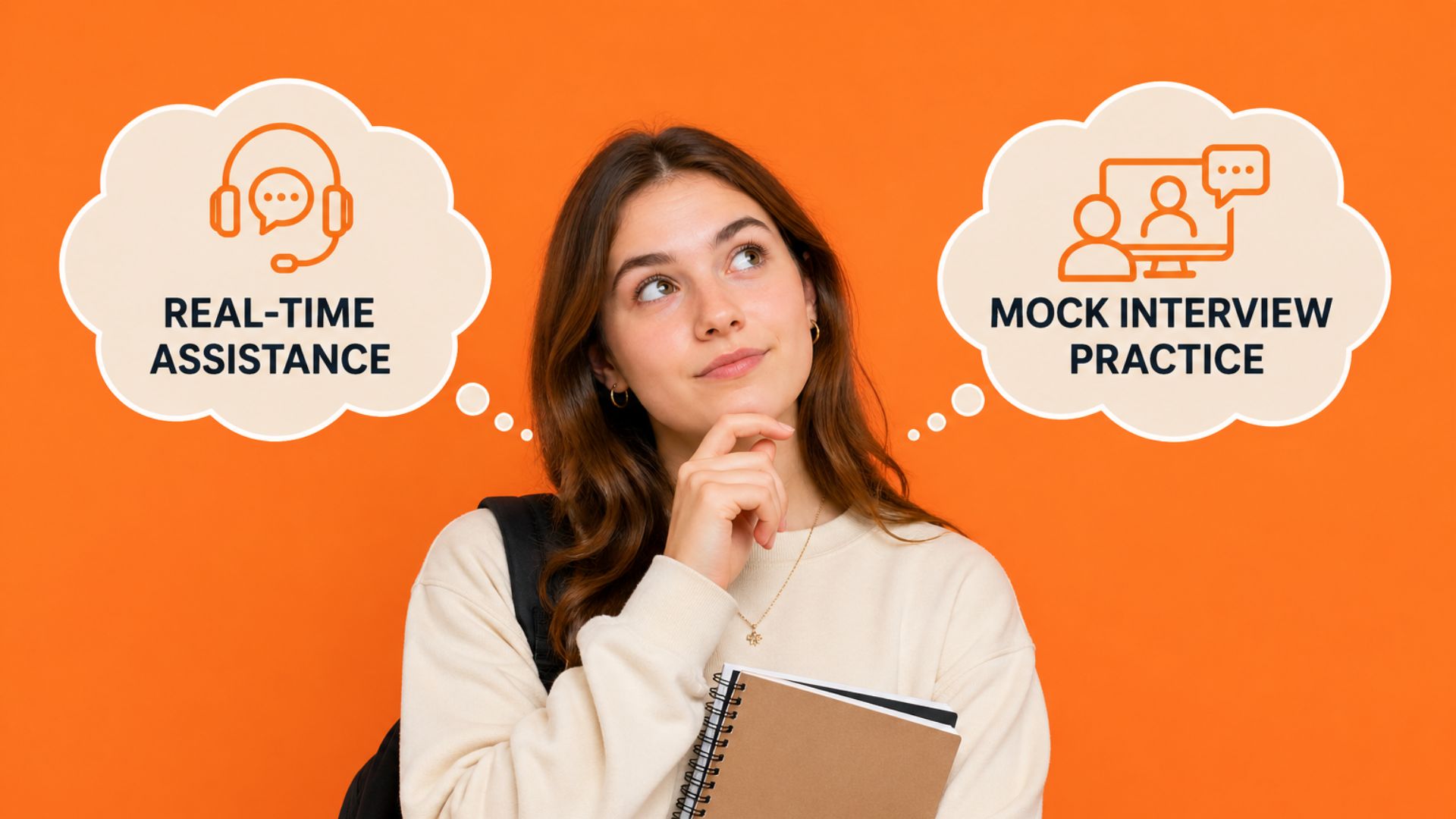
Real-Time AI Interview Assistance vs Mock Interview Practice



Quick Answer
- Mock interview practice builds skills and answer fluency before the interview. Real-time AI assistance provides structured support during the actual live session. Most candidates need both, in that order.
- Interview CoPilot™ covers the full loop: Practice Interview for mock preparation, live session support for real interviews, and automatic Interview Debrief for post-session review.
- Candidates who complete five or more Practice Interview sessions before their first live Interview CoPilot™ session use the live tool more effectively and score higher on post-session debrief metrics.
AI has changed interview preparation more in the past two years than in the two decades before it. Mock practice tools let you rehearse at 2 AM with a simulated hiring manager who gives structured feedback. Real-time copilots run during actual live interviews and surface answer frameworks while the interviewer is still asking the question. Both tools address different moments in the same process, and the best candidates use both strategically.
The sharper question is sequencing: which tool do you use when, and for what specific problem? That depends on where you are in your preparation and what is actually making your interviews harder right now.
How to Decide Which Tool You Need
Most candidates don't need every AI interview feature. They need the right tool for the specific problem making their interviews difficult at this moment.
Choose mock interview practice if your main problem is answer fluency, story structure, or never having rehearsed your experience out loud under time pressure. If you stumble when asked to describe a project from three years ago, that is a preparation problem, not a live-session problem.
Choose real-time assistance if you already know your material well and need support with recall, reframing under unexpected questions, or staying composed when a round goes in an unexpected direction. If you genuinely know the domain but blank under pressure, a live tool addresses that specific failure mode.
Choose both if you have the time and discipline to use both. The right sequence is almost always practice first, live support later. See Best AI Interview Tools in 2026 for the broader landscape if you're still deciding between platforms.
What Real-Time AI Interview Assistance Actually Does
Real-time AI interview assistance is a tool that runs during an actual live interview. It listens to the interviewer's questions through your computer audio, transcribes the question within a few seconds, and surfaces structured talking points and STAR method frameworks on your screen before you begin your answer.
The suggestions appear only on your screen, not in your video feed or any shared screen view. Interview CoPilot™ runs through a desktop app and uses GPU-level rendering to stay invisible even when you share your screen during technical rounds.
Three things make real-time assistance most valuable in practice. First, it prevents blanking on questions you genuinely know the answer to. High-stakes interviews trigger a stress response that disrupts access to well-rehearsed information. Having structured cues visible reduces that disruption. Second, it helps structure complex behavioral answers under time pressure. Knowing the Situation-Task-Action-Result framework intellectually and applying it correctly in real time under pressure are different skills. Third, it reduces the cognitive load of active listening, so you can focus more attention on the interviewer's question and less on simultaneously constructing your answer. The practical benefits of using AI interview assistants covers these mechanisms in more depth.
What Mock Interview Practice Actually Does
AI mock interviews are practice sessions powered by artificial intelligence that simulate real interview scenarios. You select the role and interview type, the AI generates realistic questions, and you respond as you would in the actual interview. The AI then analyzes your responses and provides feedback on clarity, structure, specificity, and delivery.
The Practice Interview feature in Interview CoPilot™ generates role-specific questions based on your uploaded resume and the job description you're targeting. That means the questions you practice answering aren't generic interview questions. They're questions calibrated to the job you're actually trying to get, and the feedback references your actual experience rather than generic advice.
What mock practice does that real-time assistance cannot: it builds the underlying fluency that makes you capable of improvising when the actual interview diverges from what you rehearsed. A candidate who has answered 50 behavioral questions in practice can handle an unexpected follow-up in a way that a candidate who has only used the live tool cannot. The preparation investment compounds over sessions in a way that live assistance, used without prior practice, does not.
The Honest Tradeoffs
Real-time assistance has one well-documented failure mode: candidates who rely on it without adequate preparation produce answers that sound polished but fall apart under follow-up. Across 816,000 live Interview CoPilot™ sessions in 2025 and 2026, the candidates who report difficult sessions almost always describe the same pattern: the initial answer went smoothly, then a follow-up question exposed that they couldn't extend the point naturally. The live tool surfaced a good answer. The candidate hadn't actually internalized it.
The fix is not avoiding the live tool. It is sequencing correctly: use Practice Interview to build real fluency across behavioral and technical question types, then use Interview CoPilot™ in live sessions as a memory and structure support layer rather than a primary answer source. Candidates who complete five or more Practice Interview sessions before their first live session consistently report that the live tool confirms what they already know rather than providing new information they couldn't otherwise access. That is the correct relationship between the two.
Mock practice has its own limitation: it simulates the cognitive structure of an interview but not the physiological stress. Your heart rate, the physical presence of another person, and the actual stakes all change performance in ways that practice alone cannot fully replicate. The gap between practice performance and live performance is real, and choosing a platform with a short setup time reduces it meaningfully.
When to Use Each Tool
Use mock practice first, consistently, starting at least one week before a critical interview. The goal is not to memorize answers. It is to make answer structure automatic and your specific stories fluent enough to retrieve under pressure. Run practice sessions until you can complete a 30-minute behavioral interview without consulting notes.
Add real-time assistance for high-stakes sessions where the cost of a strong performance gap is high: final rounds, roles at companies you've been pursuing for a long time, rounds that require covering a lot of unfamiliar territory quickly. Run at least one test session with the tool before the real interview so the setup is familiar.
The Parakeet AI review and Interview Sidekick review cover how other live tools compare if you're evaluating specific platforms before committing. For candidates in active job searches, having both practice and live support running through one platform avoids the overhead of managing multiple subscriptions and ensures the preparation context carries over into the live session.
See how other candidates are sequencing their preparation in the Final Round AI community discussion on AI interview tools. Browse interview preparation guides for format-specific strategies.
Author's Note
From Jaya Muvania
The most common mistake I see: candidates buy the live interview tool but skip the practice sessions. Then they get to a follow-up question during the real interview and the tool can't help them, because the tool surfaces answers based on what you already know. If you haven't practiced the domain, the suggestions become a crutch you can't defend. Do the five practice sessions first. Every candidate I've spoken with who uses the live tool effectively says the same thing: by the time they're in the real interview, the AI is just confirming what they already know.
Frequently Asked Questions
What is the difference between real-time AI interview assistance and mock interview practice?
Real-time AI interview assistance provides live answer suggestions and structural coaching while an actual interview is happening. Mock interview practice involves simulated interviews that run before the real session, with AI feedback on recorded responses. Real-time assistance helps in the moment; mock practice builds skills and confidence ahead of time. The two approaches address different parts of the process and work best when used together, with practice preceding live use.
Does using real-time AI assistance reduce preparation quality?
Used incorrectly, real-time assistance can create a dependency. Candidates who rely entirely on in-interview AI suggestions without building foundational knowledge through practice struggle with follow-up questions the tool cannot anticipate. The most effective approach is using mock interview practice to build genuine competency, then using real-time assistance as a confidence and memory support layer during the actual interview.
Which interview types benefit most from real-time AI assistance?
Behavioral and situational interview rounds benefit most because the questions are often predictable in structure and the AI can suggest relevant examples and frameworks. Technical coding interviews are more variable, and over-reliance on real-time suggestions can slow response time. System design interviews fall in between, where real-time architectural suggestions are genuinely useful without replacing foundational knowledge.
How many mock interviews should I do before using real-time assistance?
Candidates who complete at least five to ten structured mock interviews across behavioral and technical categories tend to use real-time assistance more effectively. With that foundation, they can recognize when an AI suggestion aligns with their knowledge and quickly adapt it in conversational flow. Candidates with fewer practice sessions tend to accept AI suggestions verbatim, which produces responses that lack personal depth.
Candidates who use AI that answers interview questions to practice before the real interview typically feel more prepared and confident going in.
Related Interview Guides
- AI Interview Prep: 3 Phases Most Candidates Skip: The preparation framework that separates candidates who use AI tools effectively from those who don't see results.
- AI Interview Tools With the Lowest Learning Curve: Which platforms minimize the gap between first-use setup and effective live interview use.
- Tips for Using an AI Interview Assistant: How to get the most out of a real-time copilot during live sessions, including practice setup and the glance-don't-read technique.
- Best AI Interview Practice Tools for 2026: Which mock interview platforms give the most accurate feedback for different role types and experience levels.
Table of Contents
Related articles
I Tried Chiku AI, Here is My Honest Review
I tested Chiku AI for live interview assistance to see if it is really useful for US candidates.

Interview CoPilot™ Free Plan: What You Get
Interview CoPilot™ free plan explained: what is included, what requires a Pro subscription, and how to upgrade for live Copilot assistance and automatic debriefs.
Flipkart Interview Process: SDE and Machine Coding Guide
Complete Flipkart SDE interview guide: OA, DSA technical round, the machine coding round that tests object-oriented software design, system design, and the HR round. SDE-1 compensation 18 to 25 LPA in 2026.
AI for MNC Interviews in India: Infosys, TCS, Cognizant Prep
AI interview prep for Infosys, TCS, Cognizant, and Wipro: round formats, track systems, and how Interview CoPilot helps you prepare for the HR round that eliminates most candidates.

Interview Coaching for Career Changers: Land Your Dream Job
Unlock your potential with interview coaching tailored for career changers, empowering you to land your dream job.
InterviewMan vs Cluely: Which Handles Interviews?
InterviewMan vs Cluely: compare pricing, stealth features, and interview coverage in 2026. InterviewMan at $12/month annual vs Cluely at $149.99/month for stealth. Which is worth it for your job search?